Indigenous stealth frigate Taragiri delivered to Indian Navy
Source:The Hindu ↗
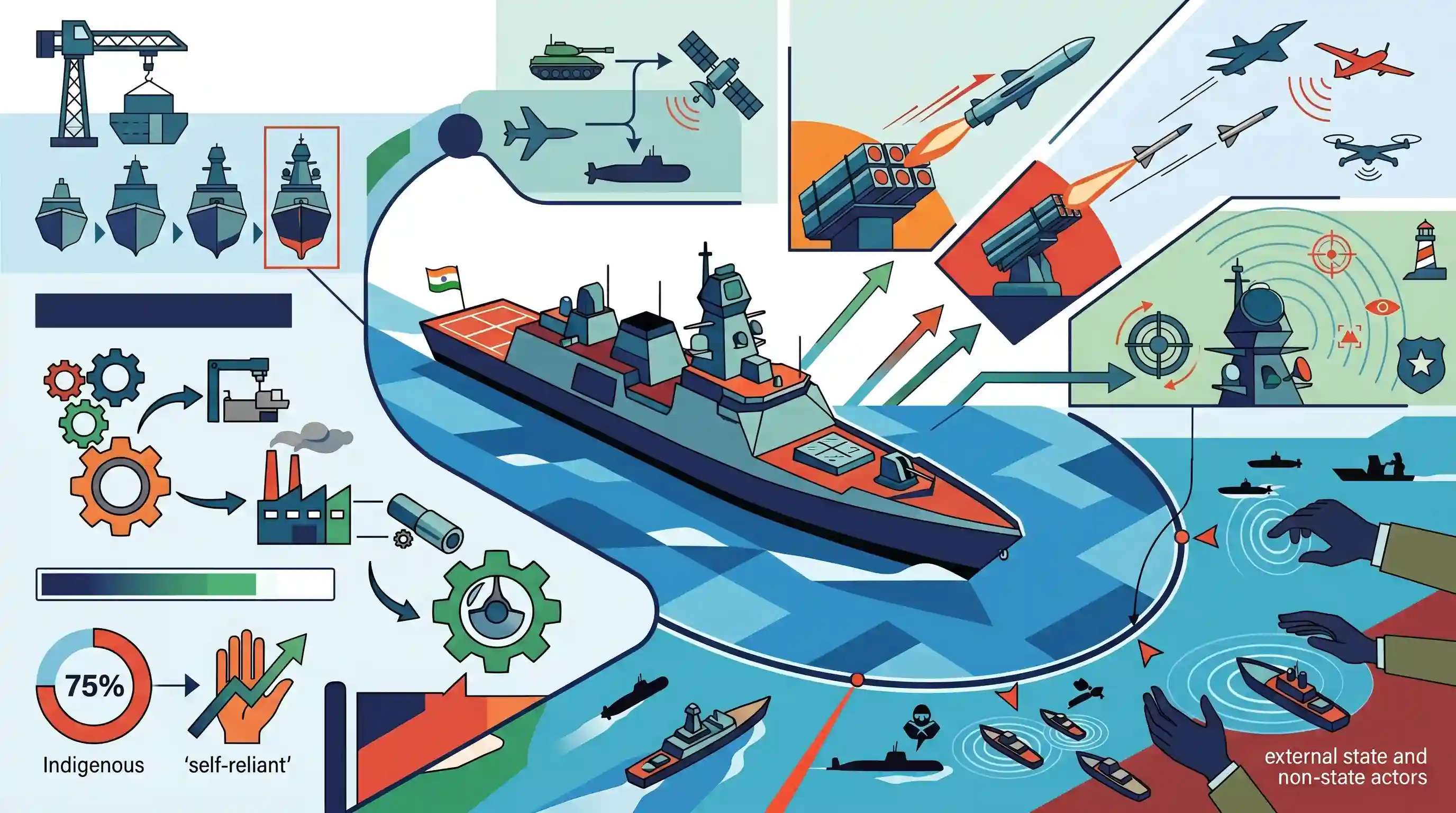
Why It Matters
The delivery of the indigenous stealth frigate 'Taragiri' is crucial for UPSC aspirants as it directly aligns with the GS Paper 3 syllabus topics of 'Indigenization of technology and developing new technology' and 'Security challenges and their management'. Understanding this development is essential for answering questions on India's defence modernization, the 'Aatmanirbhar Bharat' push in the defence sector, the role of MSMEs in military production, and the strategic enhancement of the Indian Navy's maritime security capabilities in the Indo-Pacific region.
Summary
The indigenous stealth frigate 'Taragiri', built by Mazagon Dock Shipbuilders Limited (MDL), has been successfully delivered to the Indian Navy. As the fourth ship of the Project 17A (Nilgiri-class) stealth frigates, its delivery marks a pivotal moment for India's 'Aatmanirbhar Bharat' initiative in defence production, featuring 75% indigenous content and stimulating the local MSME sector. Equipped with advanced weapon systems like the BrahMos supersonic cruise missile, Medium Range Surface-to-Air Missiles (MRSAM), and sophisticated radar, 'Taragiri' significantly upgrades the Navy's multi-mission combat capabilities and bolsters India's maritime security framework.
Key Points
- 'Taragiri', the fourth stealth frigate of the Project 17A (Nilgiri-class), has been officially delivered to the Indian Navy by Mazagon Dock Shipbuilders Limited (MDL).
- The project highlights a significant stride in 'Aatmanirbhar Bharat' (self-reliance) in defence manufacturing, boasting approximately 75% indigenous content.
- The construction of the ship involved around 200 MSMEs and generated substantial direct and indirect employment, contributing to the domestic industrial ecosystem.
- Designed by the Indian Navy's Warship Design Bureau (WDB), the frigate features advanced stealth characteristics, Combined Diesel or Gas (CODOG) propulsion, and state-of-the-art weapons systems like the BrahMos missile, MRSAM, and ASW torpedoes.
- The addition of 'Taragiri' bolsters India's maritime security capabilities against threats across air, surface, and sub-surface domains, reflecting ongoing efforts to modernize naval forces.
Important Terms
Project 17A (Nilgiri-class)

The Indian Navy's program to build seven Nilgiri-class stealth guided-missile frigates. These ships feature advanced stealth, indigenous weapons like BrahMos, and 75% local content, utilizing modular integrated construction for efficiency.
UPSC context
GS Paper 3: Science and Technology (Indigenization) and Security. Tests knowledge of modern naval modernization and indigenous platform capabilities.
Aatmanirbhar Bharat (Defence)
A flagship policy aiming for strategic self-reliance across sectors. In defense, it mandates domestic procurement (Positive Indigenization Lists), boosts MSME participation, and prioritizes 'Indian-IDDM' (Indigenously Designed, Developed, and Manufactured) equipment.
UPSC context
GS Paper 3: Economy and Internal Security. Tests understanding of policies reducing import dependency and enhancing strategic autonomy.
Warship Design Bureau (WDB)
The Indian Navy’s in-house organization responsible for the conceptualization and design of various indigenous warships, ranging from small craft to aircraft carriers and advanced stealth frigates like Project 17A.
UPSC context
GS Paper 3: Science and Technology. Highlights India's transition from a 'Buyer's Navy' to a 'Builder's Navy' through domestic design capability.
Mazagon Dock Shipbuilders Limited (MDL)
A premier Maharatna Defence Public Sector Undertaking (DPSU) in Mumbai. It is a lead shipyard for constructing major naval assets, including the Nilgiri-class frigates, Project 15B destroyers, and Scorpene-class submarines.
UPSC context
GS Paper 3: Infrastructure and Security. Relevant for questions on the role of DPSUs in strengthening India’s maritime security framework.
Garden Reach Shipbuilders & Engineers (GRSE)
A leading Miniratna shipyard in Kolkata and a key partner in Project 17A. It was the first Indian shipyard to build a warship and plays a vital role in constructing indigenous frigates and corvettes.
UPSC context
GS Paper 3: Security and Industrial Growth. Tests knowledge of domestic shipbuilding infrastructure and collaborative defense production.
Prelims Trap
Project 17A aims to build 100% indigenous nuclear-powered attack submarines.
Project 17A builds Nilgiri-class stealth frigates (not submarines) and features 75% indigenous content. UPSC often uses "100% indigenous" as an extreme-statement trap.
Static Concepts Connected
How do Frigates differ from Destroyers and Corvettes?
- Destroyers: Largest surface combatants designed for offensive multi-mission capability, heavy firepower, and fleet escort roles (e.g., Project 15B).
- Frigates: Medium-sized warships, slightly smaller than destroyers, optimized for fleet protection, anti-submarine warfare, and stealth operations (e.g., Project 17A).
- Corvettes: Small, fast, and agile vessels primarily used for coastal patrol, fast attack, and short-range defensive missions.
What distinguishes Cruise Missiles from Ballistic Missiles?
- Trajectory: Ballistic missiles follow a sub-orbital, parabolic flight path; cruise missiles fly within the Earth's atmosphere.
- Propulsion & Guidance: Cruise missiles are continuously powered and guided (like jet aircraft); ballistic missiles are unpowered and mostly unguided during descent.
- Detection evasion: Cruise missiles fly at very low altitudes (sea-skimming) to evade radar detection, unlike high-arcing ballistic missiles.
Cross-Topic Patterns
Defence MSMEs & Aatmanirbhar Bharat
Project 17A’s reliance on 200 MSMEs highlights the policy shift toward building a broad-based domestic military-industrial ecosystem, reducing dependency on monolithic Defence PSUs.
Blue Water Navy & IOR Security
Advanced stealth and anti-submarine capabilities of Nilgiri-class frigates directly counter growing PLA-Navy subsurface incursions, securing critical Indian Ocean sea lines of communication.

Expect a Prelims matching question pairing Naval Projects (15B, 17A, 75I) with their vessel classes (Destroyer, Frigate, Submarine).
Linked PYQs · 3
Linked PYQs · 3
- 2022MainsGS3
What are the maritime security challenges in India ? Discuss the organisational, technical and procedural initiatives taken to improve the maritime security.
- 2025MainsGS3
Why is maritime security vital to protect India's sea trade? Discuss maritime and coastal security challenges and the way forward.
- 2023PrelimsGS1
Consider the following statements: 1. Ballistic missiles are jet-propelled at subsonic speeds throughout their flights, while cruise missiles are rocket-powered only in the initial phase of flight. 2. Agni-V is a medium-range supersonic cruise missile, while BrahMos is a solid-fuelled intercontinental ballistic missile. Which of the statements given above is/are correct?
