India Navigates Strategic Challenges in the Bay of Bengal
Source:The Hindu ↗
Why It Matters
The Bay of Bengal's strategic significance is increasing due to Indo-Pacific dynamics. Understanding India's diplomatic and security maneuvers in this region is essential for GS Paper 2 (International Relations) and GS Paper 3 (Security).
Summary
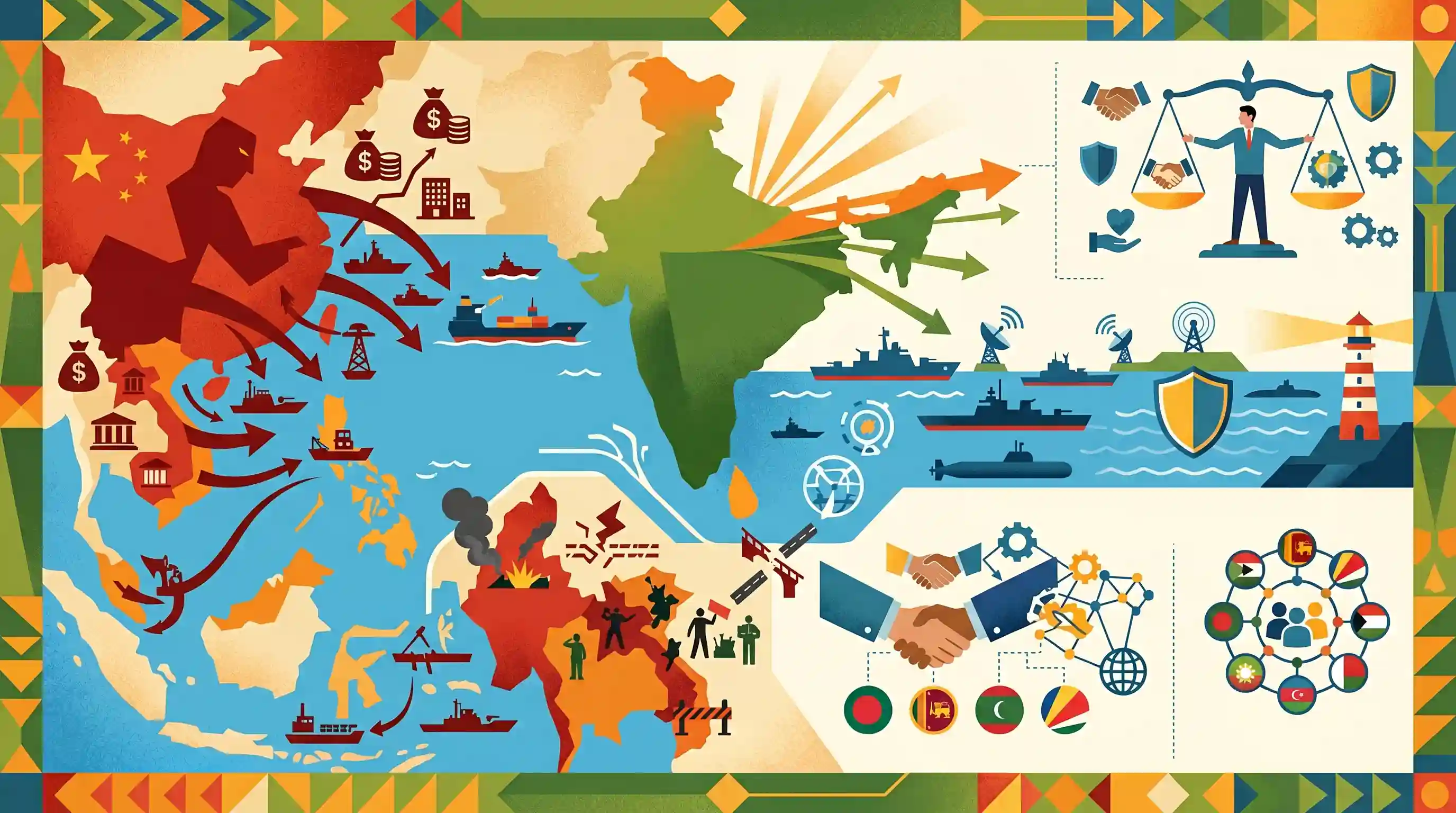
The article discusses the geopolitical complexities India faces in the Bay of Bengal, a region vital to its strategic and economic interests. As the bridge between South and Southeast Asia, the Bay is central to India's 'Act East' and 'Neighborhood First' policies. However, India's influence is challenged by China's expanding maritime footprint and strategic investments in littoral states. Furthermore, domestic political transitions and conflicts in neighboring countries such as Myanmar and Bangladesh pose significant hurdles to regional stability and connectivity initiatives. To navigate these challenges, India must employ an uneasy but necessary balancing act: enhancing maritime security operations, deepening bilateral ties with neighbors, and leveraging regional organizations like BIMSTEC to foster a cohesive and secure maritime environment.
Key Points
- The Bay of Bengal is a crucial geostrategic theater where India's 'Neighborhood First' and 'Act East' policies intersect.
- India is performing a delicate balancing act to counter growing external influence, primarily from China, while maintaining its position as a net security provider in the region.
- Internal instability and evolving political scenarios in littoral states like Myanmar and Bangladesh complicate regional cooperation and infrastructure connectivity projects.
- Strengthening maritime security capabilities and revitalizing multilateral frameworks like BIMSTEC are essential to safeguarding trade routes and ensuring regional stability.
Important Terms
Act East Policy

India’s proactive 2014 diplomacy to strengthen economic, strategic, and cultural ties with Southeast and East Asia, making the Northeast region a gateway for regional connectivity.
UPSC context
GS-II (International Relations); tests regional diplomacy, maritime security, and development of India's Northeast as a strategic bridge.
Neighborhood First Policy
A diplomatic strategy prioritizing immediate neighbors through enhanced connectivity, infrastructure development, and development assistance to ensure regional stability and counter external influences like China.
UPSC context
GS-II (International Relations); central to questions on South Asian regionalism, bilateral ties, and India's role as a regional leader.
SAGAR
Security and Growth for All in the Region; India’s strategic vision (2015) for the Indian Ocean, focusing on maritime cooperation, security, and sustainable 'Blue Economy' growth.
UPSC context
GS-II/III (IR & Security); tests India's maritime doctrine, role as a 'net security provider,' and Indo-Pacific strategy.
BIMSTEC
A seven-nation regional grouping (South and Southeast Asia) along the Bay of Bengal littoral, serving as a functional bridge for economic and technical cooperation.
UPSC context
GS-II (International Relations); key for sub-regional cooperation topics and as a pragmatic alternative to the stalled SAARC.
ASEAN
A 10-member Southeast Asian regional organization that forms the 'central pillar' of India’s Act East Policy and is vital for regional economic integration.
UPSC context
GS-II (International Relations); essential for understanding 'ASEAN Centrality' in the Indo-Pacific and India's trade/security architecture in Asia.
Prelims Trap
The Kaladan project connects Kolkata port to Chittagong port in Bangladesh to provide access to India's Northeast.
The Kaladan project explicitly bypasses Bangladesh. It links Kolkata to Sittwe port in Myanmar by sea, goes up the Kaladan River to Paletwa, and finally connects by road to Mizoram.
Static Concepts Connected
How does BIMSTEC membership geographically differ from SAARC?
- SAARC Exclusives: Afghanistan, Pakistan, and Maldives are members of SAARC but are structurally excluded from BIMSTEC.
- BIMSTEC Exclusives: Myanmar and Thailand are members of BIMSTEC (but not SAARC), acting as a geopolitical bridge between South Asia and Southeast Asia.
- Common Members: India, Bangladesh, Bhutan, Nepal, and Sri Lanka are the five nations that overlap in both regional groupings.
What constitutes China's 'Malacca Dilemma'?
- Strategic Chokepoint: A vast majority of China's oil and energy imports transit through the narrow, easily disruptable Strait of Malacca.
- Naval Vulnerability: During a conflict, rival powers (especially the Indian Navy stationed at the Andamans) could blockade this strait, crippling the Chinese economy.
- Bypass Strategies: China invests heavily in deep-sea ports like Kyaukpyu (Myanmar) and Gwadar (Pakistan) to establish overland energy corridors bypassing this maritime bottleneck.
Cross-Topic Patterns
Internal Security + Myanmar crisis
Rebel captures of strategic nodes like Paletwa in Myanmar directly threaten India's Northeast insurgency management and delay the completion of critical cross-border infrastructure.
Andaman bases + Maritime Chokepoints
India's strategic military infrastructure development in the Andaman and Nicobar Islands serves as a crucial counter-leverage point against China's naval inroads into the Bay of Bengal.

Expect a 2026 multi-statement Prelims question testing the exact route of the Kaladan project alongside BIMSTEC's geographical footprint.
Linked PYQs · 4
Linked PYQs · 4
- 2022MainsGS2
Do you think that BIMSTEC is a parallel organisation like the SAARC ? What are the similarities and dissimilarities between the two ? How are Indian foreign policy objectives realized by forming this new organisation?
- 2024MainsGS2
Discuss the geopolitical and geostrategic importance of Maldives for India with a focus on global trade and energy flows. Further also discuss how this relationship affects India's maritime security and regional stability amidst international competition ?
- 2025MainsGS3
Why is maritime security vital to protect India's sea trade? Discuss maritime and coastal security challenges and the way forward.
- 2022MainsGS3
What are the maritime security challenges in India ? Discuss the organisational, technical and procedural initiatives taken to improve the maritime security.
