India Trade Deficit with China Crosses One Hundred Billion Dollars
Source:The Hindu ↗
ఇది ఎందుకు ముఖ్యం
It highlights the critical challenge of economic dependence on a strategic adversary, posing serious implications for domestic manufacturing, supply chain resilience, and national security.
సారాంశం
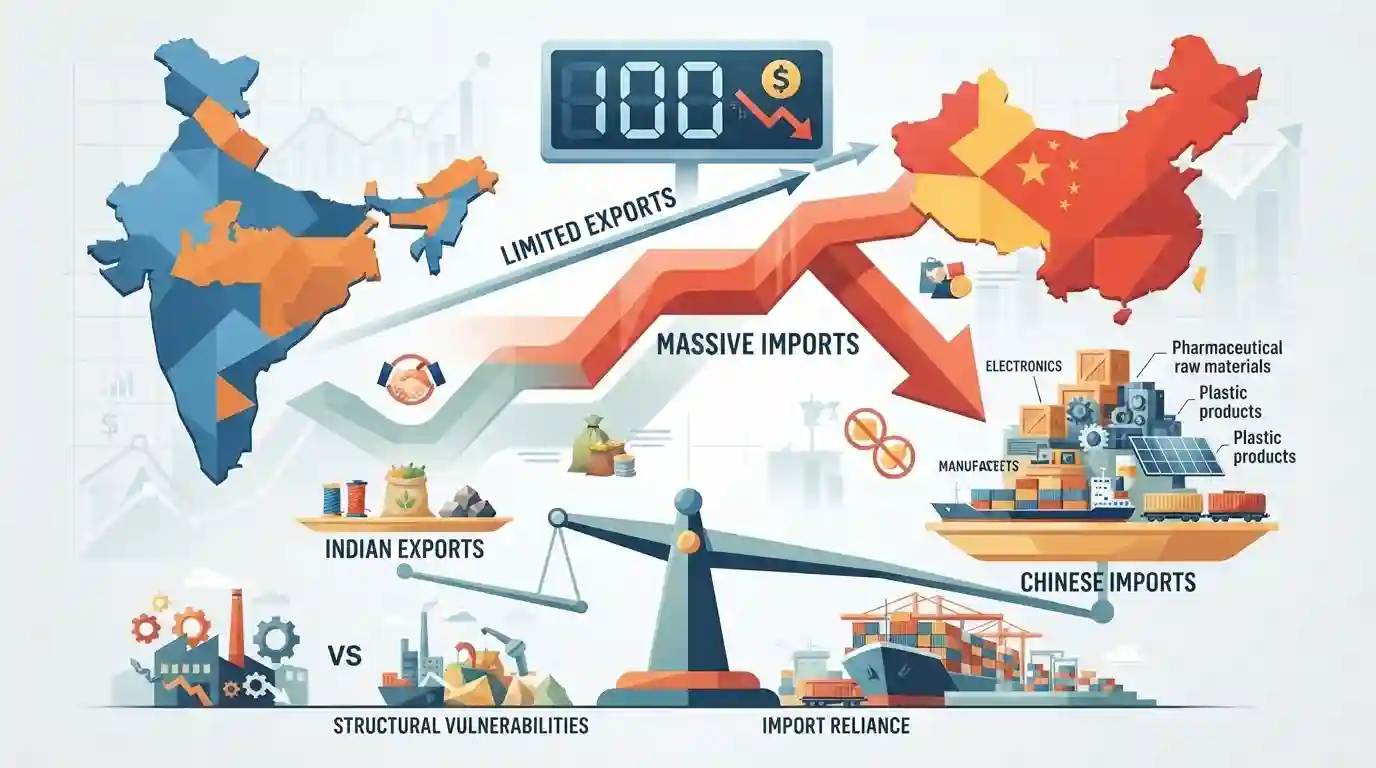
India's trade deficit with China crossed USD 100 billion in 2026, underscoring deep-seated structural vulnerabilities and heavy import reliance on Chinese goods despite diplomatic and economic counter-measures.
ముఖ్య అంశాలు
- India's trade deficit with China crossed the USD 100 billion mark in 2026, highlighting an asymmetrical trade relationship.
- The widening deficit is driven by heavy dependence on Chinese imports for critical sectors, including electronics, active pharmaceutical ingredients (APIs), and heavy machinery.
- Despite various policy measures like Production-Linked Incentive (PLI) schemes and import restrictions, structural supply-chain dependencies on China persist.
ముఖ్యమైన పదాలు
Trade Deficit

The economic measure of when a country's total imports of goods and services exceed its total exports over a given period, representing a negative balance of trade.
UPSC context
UPSC GS Paper III (Indian Economy): Tests understanding of external sector, balance of payments, current account dynamics, and foreign trade policies.
Structural Vulnerabilities
Deep-rooted economic imbalances where a country is permanently dependent on foreign imports for critical value-added industrial inputs, components, and raw materials due to domestic manufacturing gaps.
UPSC context
UPSC GS Paper III (Economic Development): Essential for analyzing manufacturing bottlenecks, import reliance, supply chain resilience, and the success of initiatives like Make in India.
అనుసంధానమైన స్థిర భావనలు
What are the key structural components and drivers of India's trade deficit with China?
- Electronics & Tech: Intermediate Goods: Heavy reliance on Chinese electronic components, telecom gear, and computer hardware.
- API Dependence: Pharma Inputs: High dependence on China for Active Pharmaceutical Ingredients (APIs) and Key Starting Materials (KSMs).
- Machinery & Chemicals: Capital Goods: Substantial imports of heavy machinery, power equipment, and chemical precursors used in Indian domestic production.
అంతర-అంశ నమూనాలు
Pharma APIs + Supply Chain Security
India's structural import dependence on China for APIs directly intersects with national health security and the vulnerability of domestic generic drug manufacturing.
PLI Schemes + Structural Trade Deficits
Heavy capital and intermediary goods imports from China complicate the success of domestic manufacturing initiatives like Make in India and PLI schemes.

Trade deficit with China + PLI scheme efficacy + API dependency is a prime candidate for an analytical Mains GS-3 question.
అనుసంధాన PYQలు · 2
అనుసంధాన PYQలు · 2
- 2024MainsGS2
‘The West is fostering India as an alternative to reduce dependence on China's supply chain and as a strategic ally to counter China's political and economic dominance.’ Explain this statement with examples.
- 2017MainsGS3
Account for the failure of manufacturing sector in achieving the goal of labour-intensive exports. Suggest measures for more labour-intensive rather than capital-intensive exports.
