Services Exports Drive Reduction in India Quarterly Trade Deficit
Source:The Hindu ↗
Why It Matters
This data illustrates structural shifts in India's external sector, particularly the reliance on services exports to bridge the merchandise trade deficit. It also highlights the success of policies aimed at boosting domestic manufacturing (such as the PLI scheme), as seen in the sharp rise in electronics exports, and underscores strategic trade dependencies on countries like the US, UAE, and China.
Summary
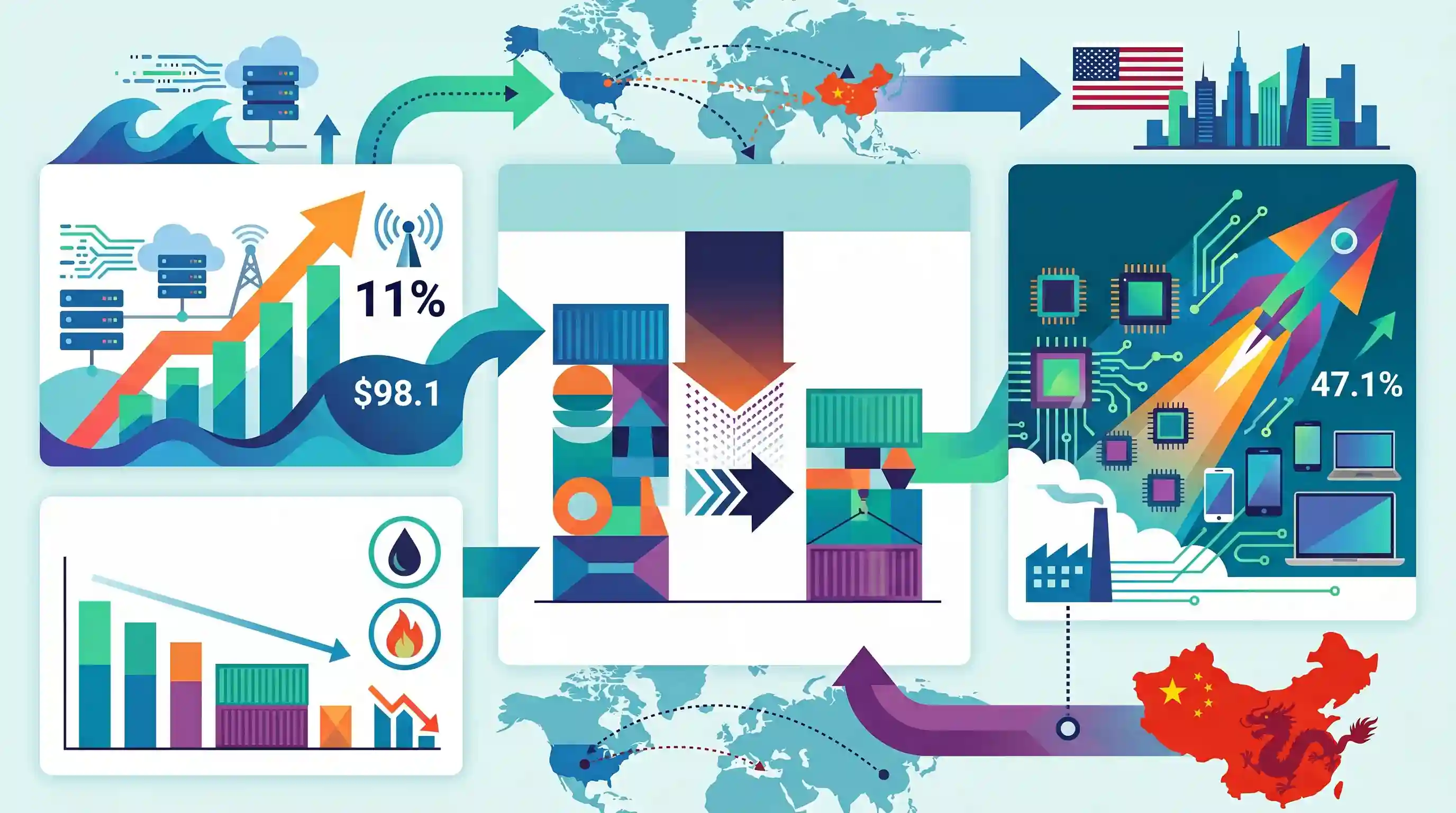
The article outlines India's foreign trade performance for the first quarter, highlighting a 9.4% narrowing of the overall trade deficit to $20.3 billion. This improvement was primarily driven by an 11% surge in services exports, which reached $98.1 billion, helping to offset slower merchandise export growth of 2% caused by declining petroleum prices. A notable sectoral highlight is the 47.1% jump in electronics exports, underscoring India's growing manufacturing footprint. The US continues to be India's top export destination, while China remains the largest source of imports.
Key Points
- India's overall trade deficit for Q1 narrowed by 9.4% to $20.3 billion, driven by robust performance in the services sector.
- Services exports increased by nearly 11% to reach $98.1 billion, offsetting the sluggish 2% growth in merchandise exports ($112.2 billion) caused by falling petroleum prices.
- The electronics sector emerged as the highest growth area in exports, surging 47.1% to $12.4 billion during the quarter.
- The United States remained India's top export destination, while China continued to be the largest source of imports.
Important Terms
Trade Deficit

An economic condition where the value of a country's imports exceeds its exports. In the Indian context, it typically refers to the merchandise (goods) trade gap recorded by the Commerce Ministry.
UPSC context
GS Paper III: Indian Economy. Key indicator for assessing external sector stability and the impact of global demand on domestic manufacturing.
Services Exports
Intangible exports including IT, software, and consultancy. India’s strong surplus in this sector, primarily driven by Global Capability Centres (GCCs), frequently helps narrow the overall trade deficit.
UPSC context
GS Paper III: Indian Economy. Relevant for discussing India’s shift toward a knowledge-based economy and its competitive advantage in global trade negotiations.
Balance of Payments (BoP)
A systematic record of all economic transactions between residents of a country and the rest of the world, comprising the Current Account and Capital Account.
UPSC context
GS Paper III: Indian Economy. Crucial for understanding macroeconomic health, currency valuation, and historical events like the 1991 economic crisis.
Current Account Deficit (CAD)
A broad measure of the trade balance that includes the net trade in goods and services, plus net income from abroad and transfer payments like remittances.
UPSC context
GS Paper III: Indian Economy. Tests the ability to distinguish between visible trade (goods) and invisible trade (services) and their combined impact on the rupee.
Ministry of Commerce and Industry
The nodal Union ministry responsible for formulating India’s Foreign Trade Policy (FTP), promoting exports, and overseeing the Directorate General of Foreign Trade (DGFT) and Special Economic Zones (SEZs).
UPSC context
GS Paper II & III: Governance and Economy. Important for questions on industrial policy, export-led growth, and Ease of Doing Business initiatives.
World Trade Organization (WTO)
The only global international organization dealing with the rules of trade between nations. India is a founding member and active advocate for the interests of the Global South.
UPSC context
GS Paper III: Economy/International Relations. Tests knowledge of multilateral trade agreements, dispute settlement mechanisms, and India’s stance on global trade barriers.
Prelims Trap
A drop in global crude oil prices automatically increases the nominal value of India's merchandise exports.
India is a major exporter of refined petroleum. Cheaper crude reduces the import bill but simultaneously shrinks the nominal dollar value of India's top export commodity.
Static Concepts Connected
What are the primary components of the Current Account in India's Balance of Payments?
- Visible Trade: The export and import of physical goods, which historically runs a structural deficit in India.
- Invisible Trade: Comprises Services (IT, travel), Income (interest, dividends), and Transfers (remittances). India's massive services surplus acts as a crucial buffer.
How does the PLI Scheme support India's electronics manufacturing exports?
- Financial Incentives: Provides cash incentives (typically 4-6%) calculated on incremental sales of goods manufactured domestically, explicitly rewarding scale.
- GVC Integration: Aims to reduce import dependence and deeply integrate Indian manufacturing into complex Global Value Chains (GVCs).
Cross-Topic Patterns
PLI Scheme + China+1 Strategy
The 47% surge in electronics exports directly validates the PLI scheme's success in capturing global value chains as multinational corporations execute their 'China Plus One' diversification strategies.
Exchange Rates vs. Export Competitiveness
Sluggish merchandise exports despite a weaker Rupee highlight how global commodity prices (like crude oil) often override the theoretical export benefits of currency depreciation.

Expect 2026 prelims to test the structural contrast: merchandise deficit vs. services surplus, linking PLI-led electronics to overall BoP.
Linked PYQs · 4
Linked PYQs · 4
- 2020PrelimsGS1
With reference to the international trade of India at present, which of the following statements is/are correct? 1. India's merchandise exports are less than its merchandise imports. 2. India's imports of iron and steel, chemicals, fertilisers and machinery have decreased in recent years. 3. India's exports of services are more than its imports of services. 4. India suffers from an overall trade/current account deficit. Select the correct answer using the code given below:
- 2023PrelimsGS1
Consider the following statements: Statement-I: India accounts for 3.2% of global export of goods. Statement-II: Many local companies and some foreign companies operating in India have taken advantage of India's 'Production-linked Incentive' scheme. Which one of the following is correct in respect of the above statements?
- 2017MainsGS3
Account for the failure of manufacturing sector in achieving the goal of labour-intensive exports. Suggest measures for more labour-intensive rather than capital-intensive exports.
- 2013PrelimsGS1
The balance of payments of a country is a systematic record of
