State-wise GST collections and fiscal contribution rankings
Source:a2ztaxcorp ↗
Why It Matters
Understanding state-wise GST collections is crucial for analyzing fiscal federalism, economic disparities, and revenue generation trends across Indian states for MPSC examinations.
Summary
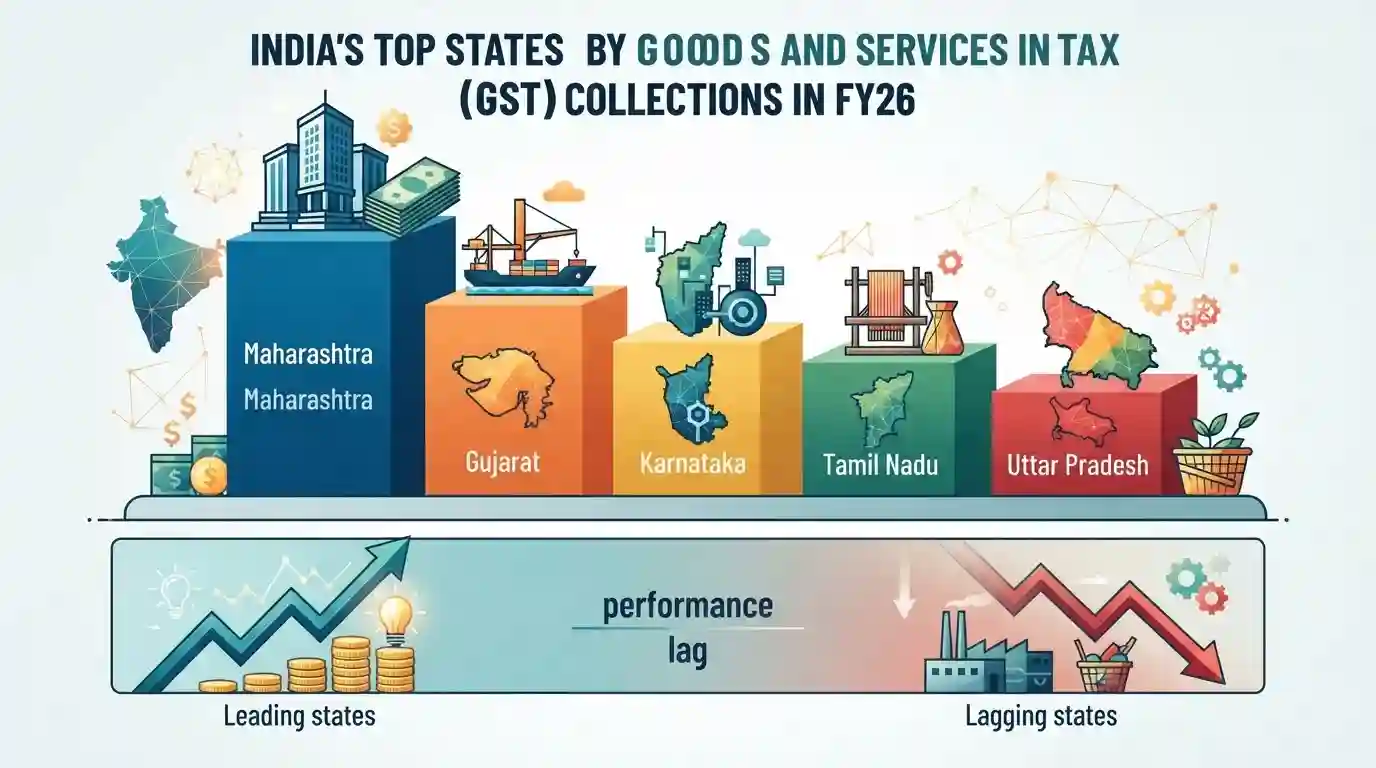
The article outlines India's top states by Goods and Services Tax (GST) collections in FY26, highlighting Maharashtra's top position and examining the performance and lag of various states in indirect tax revenue generation.
Key Points
- Maharashtra continues to lead India in terms of absolute Goods and Services Tax (GST) collections in FY26.
- States like Karnataka, Gujarat, and Tamil Nadu follow closely behind in total GST revenue generation.
- The report highlights the disparity between industrialized states and economically lagging regions in terms of indirect tax contributions.
Important Terms
Goods and Services Tax Act

A comprehensive indirect tax reform implemented via the 101st Constitutional Amendment Act, 2016, unifying fragmented central and state levies into a single destination-based tax system.
UPSC context
Crucial for MPSC/UPSC General Studies Paper II (Polity) and Paper III (Economy)—testing federal tax structure and fiscal reforms.
Goods and Services Tax Council
A constitutional body under Article 279A comprising central and state ministers, chaired by the Union Finance Minister, tasked with recommending GST rates, rules, and exemptions.
UPSC context
Important for MPSC Polity and Economy; tests cooperative federalism, constitutional bodies, and decision-making mechanisms.
Ministry of Finance
The apex ministry of the Government of India responsible for economic policy, public finance, the Union Budget, and taxation via revenue and expenditure departments.
UPSC context
Tested in MPSC/UPSC Economics and Polity regarding budgetary processes, fiscal management, and revenue collection oversight.
Prelims Trap
Maharashtra leads all states in both absolute GST collections and per-capita tax growth rate.
Aspirants often confuse absolute GST collections with per-capita GST revenue or state-wise tax buoyancy growth rates.
Static Concepts Connected
What are the core constitutional provisions and institutional structure governing the Goods and Services Tax (GST) in India?
- Article 279A: Constitutional Amendment, Introduced via the 101st Constitutional Amendment Act, 2016, adding Article 279A which established the GST Council.
- GST Council: Council Composition, Chaired by the Union Finance Minister with state finance ministers as members, operating on a 3/4th weighted voting majority.
- Consumption Nature: Destination-Based Tax, GST is a consumption-based tax levied at each stage of the value chain, replacing a cascading array of central and state indirect levies.
Cross-Topic Patterns
GST Collections + Fiscal Federalism
GST buoyancy is tied directly to industrial state performance, but compensation cess phase-outs heighten fiscal federalism debates on revenue sharing.
Indirect Taxation + Finance Commission Devolution
Disparity between industrial powerhouses (Maharashtra, Karnataka) and consumer/lagging states impacts horizontal devolution formulas recommended by the Finance Commission.

Expect MPSC statement-based questions pairing Maharashtra's absolute GST share with state-wise structural disparity trends in indirect taxes.
Linked PYQs · 1
Linked PYQs · 1
- 2018MPSC_PRELIMSGS1
Who is the Chairman of the 15th Finance Commission ?
