India Third Way Approach Balances AI Regulation and Innovation
Source:The Hindu ↗
Why It Matters
Provides a crucial framework for answering GS3 questions on AI, emerging technologies, and innovation, as well as GS2 questions regarding global technology governance, DPI diplomacy, and India's role in the Global South.
Summary
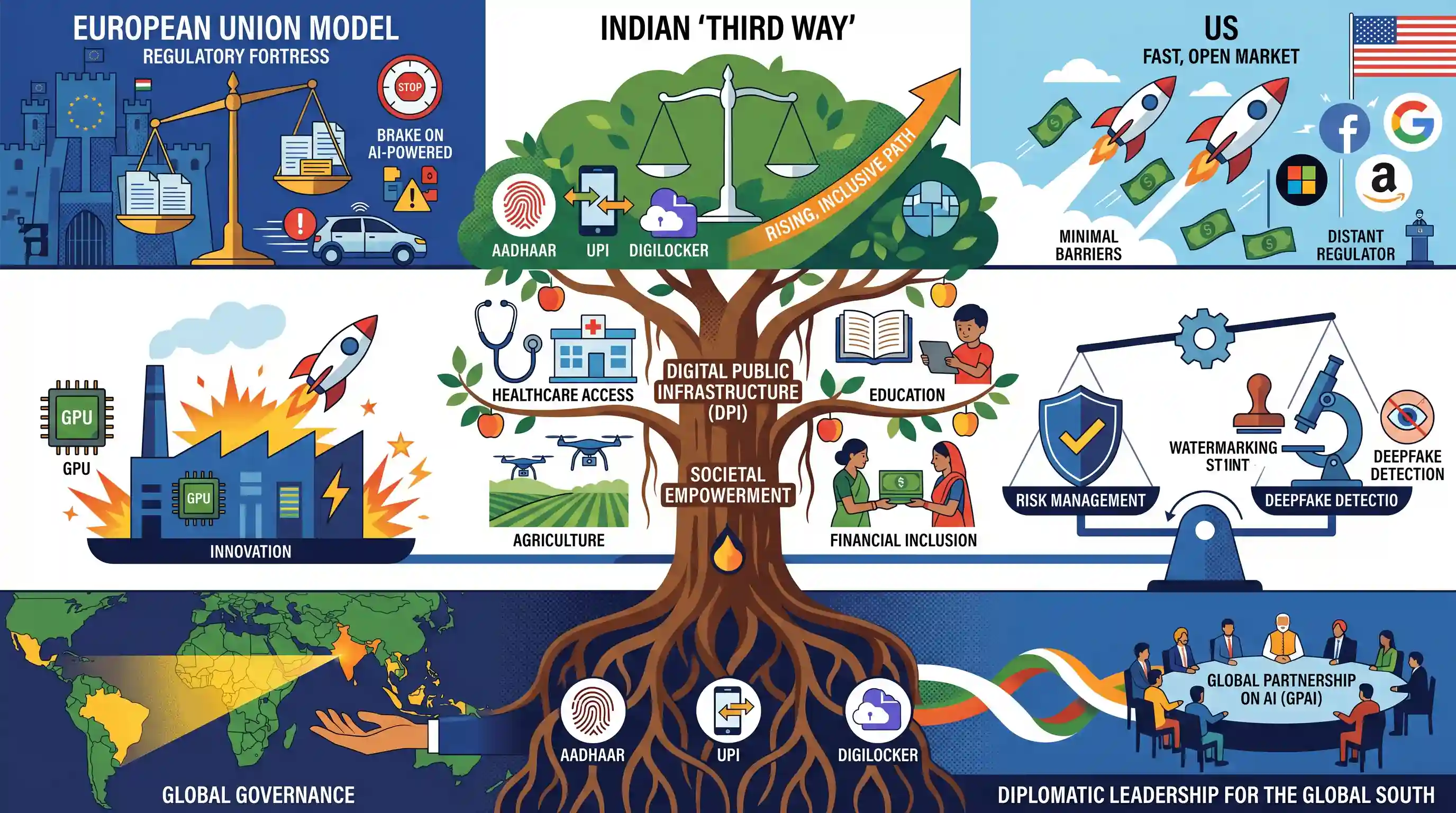
The article discusses India's unique 'third way' approach to Artificial Intelligence (AI) governance, which strikes a balance between the European Union's stringent regulatory framework and the United States' market-driven model. India's strategy focuses on leveraging Digital Public Infrastructure (DPI) to democratize technology, promoting societal empowerment, and managing risks without stifling innovation. Furthermore, it highlights India's diplomatic push to position itself as a leader for the Global South in global AI governance forums.
Key Points
- The article contrasts the European Union's heavy-handed, rights-based regulatory approach (EU AI Act) with the United States' market-driven, laissez-faire model for AI governance.
- India is charting a unique 'third way' that balances risk-based regulation with the need to foster innovation, particularly for startups.
- Central to India's strategy is the use of Digital Public Infrastructure (DPI), with initiatives like the IndiaAI Mission and Bhashini aiming to democratize AI access and solve local, societal challenges.
- India's approach also positions it as a leader for the Global South, advocating for inclusive global AI governance frameworks that reflect the needs of developing nations.
Important Terms
Digital Public Infrastructure (DPI)

A set of open, interoperable, and scalable digital systems (like Aadhaar and UPI) that enable society-wide delivery of essential services such as identity, payments, and data exchange.
UPSC context
GS-III: e-Governance and Economy; tests knowledge of India's foundational digital systems and the 'India Stack' model.
IndiaAI Mission
A ₹10,372 crore national initiative launched in 2024 to build a robust AI ecosystem, focusing on 10,000+ GPU compute capacity, indigenous foundational models, and datasets for priority sectors.
UPSC context
GS-III: Science and Technology; covers government schemes and technological self-reliance (Atmanirbhar Bharat).
EU AI Act
The world's first comprehensive legal framework for AI, utilizing a risk-based approach to categorize systems into four levels: Unacceptable, High, Limited, and Minimal risk.
UPSC context
GS-II: International Relations/Global Governance; tests comparative study of international regulatory frameworks and their impact on India.
Global Partnership on Artificial Intelligence (GPAI)
An international multi-stakeholder initiative (29 members) focused on bridging the gap between AI theory and practice through research and human-centric application; India served as Lead Chair in 2024.
UPSC context
GS-II: Important International Institutions; tests India’s leadership role in setting global technological standards.
Bhashini
An AI-powered language translation platform under the National Language Translation Mission (NLTM) aimed at bridging the language divide in digital services across 22 scheduled Indian languages.
UPSC context
GS-II: Governance/Social Justice; relevant for inclusive digital growth and linguistic accessibility in e-governance.
Prelims Trap
India's AI strategy relies on a comprehensive, statutory horizontal regulatory framework similar to the EU AI Act.
India has not enacted a horizontal statutory AI law like the EU. It follows a 'third way' blending innovation with DPI and sectoral guidelines.
Static Concepts Connected
What constitutes India's Digital Public Infrastructure (DPI) framework?
- Identity layer: Aadhaar provides a foundational, biometric-based digital identity for targeted service delivery.
- Payments layer: Unified Payments Interface (UPI) ensures interoperable, real-time fiat transfers across banks.
- Data empowerment layer: Data Empowerment and Protection Architecture (DEPA) facilitates secure, consent-driven data sharing (e.g., Account Aggregators).
What is the Global Partnership on Artificial Intelligence (GPAI)?
- Origin & Membership: Launched in 2020; India is a founding member and assumed the Lead Chair position in 2024.
- Mandate: Focuses on responsible AI development, aiming to bridge the gap between theory and practice, grounded in human rights.
- Secretariat: The permanent secretariat is hosted by the Organisation for Economic Co-operation and Development (OECD) in Paris.
Cross-Topic Patterns
DPI and AI as Soft Power
India leverages DPI and inclusive AI platforms like Bhashini to position itself as the Global South's leader, echoing its previous digital and vaccine diplomacy strategies at global forums.
Data Sovereignty and AI Models
The IndiaAI Mission's mandate to build indigenous foundational models connects directly to India's DPDP Act and the broader strategic push for data localization.

Mains 2026 GS3: Expect a direct comparative question on AI governance models (EU's rights-based vs India's DPI-led 'Third Way').
Linked PYQs · 4
Linked PYQs · 4
- 2023MainsGS3
Introduce the concept of Artificial Intelligence (AI). How does Al help clinical diagnosis? Do you perceive any threat to privacy of the individual in the use of Al in healthcare?
- 2020PrelimsGS1
With the present state of development, Artificial Intelligence can effectively do which of the following? 1. Bring down electricity consumption in industrial units 2. Create meaningful short stories and songs 3. Disease diagnosis 4. Text-to-Speech Conversion 5. Wireless transmission of electrical energy Select the correct answer using the code given below:
- 2024MainsGS2
e-governance is not just about the routine application of digital technology in service delivery process. It is as much about multifarious interactions for ensuring transparency and accountability. In this context evaluate the role of the 'Interactive Service Model' of e-governance.
- 2025MainsGS2
India-Africa digital partnership is achieving mutual respect, co-development and long-term institutional partnerships. Elaborate.
