India Tech Spending Growth and Asia Pacific Digital Infrastructure
Source:The Hindu ↗
Why It Matters
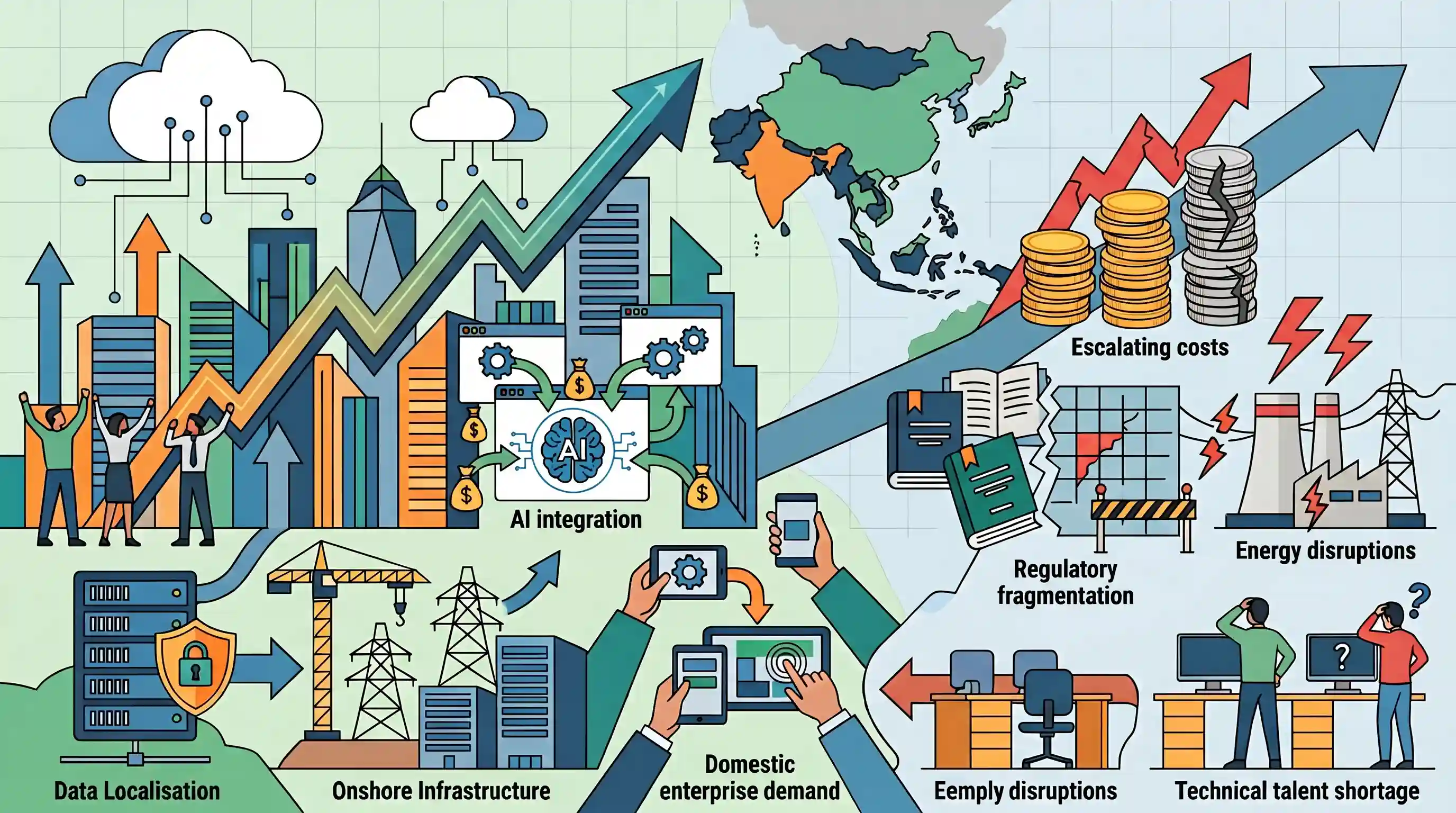
Highlights India's emerging dominance in digital infrastructure and technology adoption within the APAC region, illustrating the economic impacts of domestic policies like data localisation and the rapid integration of AI and cloud computing.
Summary
According to a report by Forrester, India's tech spending is forecast to grow by 13.4% in 2026, making it the fastest-growing market in the Asia Pacific (APAC) region. The robust double-digit growth is fueled by strong domestic enterprise demand, accelerated cloud adoption, and data localisation policies that are driving significant onshore infrastructure investments. Furthermore, software spending is surging as vendors increasingly integrate artificial intelligence (AI) into their products. However, while the broader APAC region is projected to spend over $437 billion on new technologies by 2030, this momentum faces substantial headwinds, including escalating software and hardware costs, regulatory fragmentation, energy disruptions, and technical talent shortages.
Key Points
- India's tech spending is projected to grow 13.4% in 2026, slightly down from 13.7% in 2025 but remaining the highest in the Asia Pacific (APAC) region.
- Growth is propelled by strong domestic enterprise demand, rapid cloud computing adoption, and onshore infrastructure investments driven by data localisation rules.
- Software spending is increasing as technology vendors embed artificial intelligence (AI) capabilities into their offerings, affecting renewal pricing.
- The broader APAC region is expected to spend over $437 billion on acquiring new technology between 2025 and 2030.
- Challenges to regional tech spending include software inflation, volatile hardware costs, energy supply disruptions, regulatory fragmentation, and talent shortages.
Important Terms
Data Localisation

The legal requirement to store and process data within the physical borders of the country where it is generated.
UPSC context
GS Paper 2 & 3: Critical for digital sovereignty, the DPDP Act 2023, and internal security/investigation access.
Cloud Computing
On-demand delivery of IT resources—like servers, storage, and databases—over the internet with pay-as-you-go pricing.
UPSC context
GS Paper 3: Core infrastructure for e-Governance (MeghRaj/GI Cloud) and India's digital transformation.
Digital Economy
Economic activity resulting from digital technologies, online connections, and the use of data as a strategic resource.
UPSC context
GS Paper 3: Central to India's goal of becoming a $5 trillion economy with a $1 trillion digital component.
Regulatory Fragmentation
A situation where multiple, often conflicting or overlapping, laws and standards govern the same sector across different jurisdictions.
UPSC context
GS Paper 2: Affects ease of doing business, innovation, and international cooperation in the technology sector.
Global Capability Centres (GCCs)
Offshore units established by multinational corporations to perform specialized functions like R&D, IT services, and high-end analytics.
UPSC context
GS Paper 3: Vital driver of India’s services sector growth, high-skill employment, and global software exports.
Artificial Intelligence (AI)
Technology that enables machines to perform tasks requiring human-like intelligence, such as learning, reasoning, and problem-solving.
UPSC context
GS Paper 3: Scientific innovation, ethical governance, and its impact on the future of labor and productivity.
Prelims Trap
The Digital Personal Data Protection Act 2023 mandates strict data localisation, requiring all personal data to be stored exclusively on Indian servers.
The DPDP Act 2023 actually abandoned strict data localisation. It permits cross-border data transfers by default, restricting transfers only to specific countries blacklisted by the government.
Static Concepts Connected
What is the difference between Data Localisation and Data Mirroring?
- Data Localisation: Mandates that specific data must be collected, processed, and stored exclusively on servers physically located within the country's sovereign borders.
- Data Mirroring: Allows data to be transferred and processed globally, provided that a live copy or backup is securely maintained on servers within the home country.
What are the three core service models of Cloud Computing?
- IaaS (Infrastructure): Provides virtualized computing resources like virtual machines, storage, and networks over the internet (e.g., AWS EC2).
- PaaS (Platform): Offers a framework and environment for developers to build, test, and deploy applications without managing underlying hardware.
- SaaS (Software): Delivers fully functional software applications over the internet on a subscription basis, managed entirely by the vendor.
Cross-Topic Patterns
AI standards as trade barriers
As software vendors embed AI, regulatory fragmentation across the EU, US, and India will increasingly act as non-tariff barriers, directly impacting India's IT services export competitiveness.
Data Centers vs. Net Zero
The push for onshore infrastructure and data localisation challenges India's renewable energy transition, given the massive power, water, and cooling demands of new AI-ready data centers.

Expect a GS3 Mains question linking the exponential energy demands of AI data centers with India's Net Zero targets and data policies.
Linked PYQs · 3
Linked PYQs · 3
- 2023MainsGS3
What is the status of digitalization in the Indian economy? Examine the problems faced in this regard and suggest improvements.
- 2023MainsGS3
Introduce the concept of Artificial Intelligence (AI). How does Al help clinical diagnosis? Do you perceive any threat to privacy of the individual in the use of Al in healthcare?
- 2019PrelimsGS1
Which of the following adopted a law on data protection and privacy for its citizens known as 'General Data Protection Regulation' in April 2016 and started implementation of it from 25th May, 2018?
