India Tuberculosis Elimination Target and Treatment Regimens
Source:Indian Express ↗
Why It Matters
The article connects public health governance with clinical advancements and socio-environmental determinants. It provides vital case-study material for GS-2 (health policies and governance) and GS-3 (disease management and technology interventions), illustrating the complexities of eradicating endemic diseases in India.
Summary
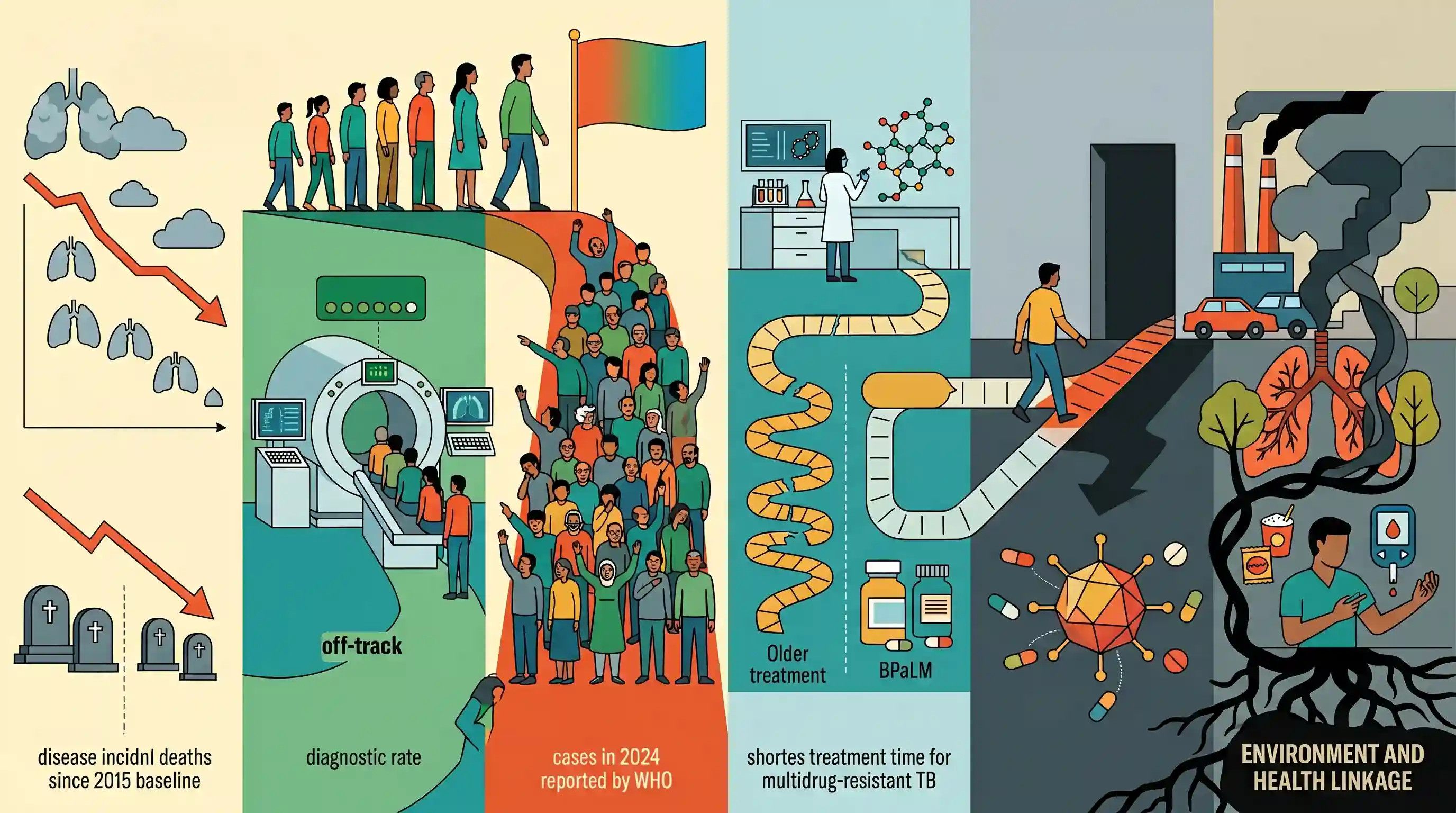
The article evaluates India's ongoing efforts and challenges in eradicating tuberculosis (TB) as the 2025 elimination deadline approaches. While India has made notable strides—achieving a 21% drop in incidence and a 28% reduction in deaths since 2015, alongside an improved 80% diagnostic rate—the country remains off-track for its 2025 goal, with the WHO reporting over 27 lakh cases in 2024. A key clinical advancement is the rollout of the BPaLM regimen, which significantly shortens treatment time for multidrug-resistant TB. Nevertheless, systemic issues such as treatment dropouts, the persistence of MDR-TB, and the compounding effects of environmental pollution and diabetes continue to obstruct comprehensive disease elimination.
Key Points
- India is unlikely to meet its ambitious target of eliminating tuberculosis (TB) by 2025, five years ahead of the global deadline.
- According to the WHO's Global TB report, India continues to bear a high disease burden, recording over 27 lakh TB cases in 2024.
- Despite challenges, India has achieved a 21% reduction in TB incidence and a 28% decline in TB-related deaths since 2015, with the healthcare system now diagnosing 80% of estimated cases.
- The introduction of the BPaLM regimen marks a major breakthrough by cutting the treatment duration for multidrug-resistant TB (MDR-TB) by six months.
- Significant hurdles remain, including MDR-TB strains, patient dropouts, and emerging evidence that environmental pollution and diabetes heavily exacerbate TB outcomes.
Important Terms
National TB Elimination Programme (NTEP)

India's flagship public health initiative aimed at eliminating tuberculosis by 2025, five years ahead of global targets. It focuses on early diagnosis and comprehensive treatment through a 'Detect-Treat-Prevent-Build' strategy.
UPSC context
GS Paper 2: Government Policies; tests knowledge of national health targets and institutional frameworks for disease control.
BPaLM Regimen
A groundbreaking 6-month, all-oral treatment regimen for drug-resistant tuberculosis consisting of Bedaquiline, Pretomanid, Linezolid, and Moxifloxacin. It significantly reduces treatment duration from the traditional 18–24 months.
UPSC context
GS Paper 3: Science & Technology; relevant for innovations in medical science and managing antimicrobial resistance (AMR).
Multidrug-Resistant Tuberculosis (MDR-TB)
A form of tuberculosis caused by bacteria that do not respond to at least isoniazid and rifampicin, the two most powerful first-line anti-TB drugs. It remains a major obstacle to elimination.
UPSC context
GS Paper 2: Health; tests understanding of public health challenges and the impact of treatment non-adherence.
Pradhan Mantri TB Mukt Bharat Abhiyaan
An initiative launched in 2022 to provide additional diagnostic, nutritional, and vocational support to TB patients through community involvement. It encourages individuals and organizations (Ni-kshay Mitras) to 'adopt' and support patients.
UPSC context
GS Paper 2: Social Justice; focuses on community-led healthcare models and public-private partnerships in welfare.
Ni-kshay Poshan Yojana
A Direct Benefit Transfer (DBT) scheme providing monthly financial assistance (₹500–₹1,000) to all notified TB patients to meet nutritional requirements, which is critical for treatment success and immunity.
UPSC context
GS Paper 2: Welfare Schemes; important for socio-economic interventions targeting vulnerable populations in the health sector.
Ni-kshay Portal
The web-enabled patient management system for TB control under NTEP. It facilitates real-time tracking of cases, treatment adherence monitoring, and the disbursement of direct benefit transfers to patients.
UPSC context
GS Paper 2: E-Governance; relevant for the role of digital technology and ICT in improving public healthcare delivery.
Prelims Trap
India's target for the elimination of tuberculosis aligns with the global WHO Sustainable Development Goal deadline of 2030.
India's National TB Elimination Programme targets 2025, exactly five years ahead of the 2030 SDG target. Aspirants often conflate national and global deadlines.
Static Concepts Connected
What distinguishes Multidrug-Resistant (MDR) and Extensively Drug-Resistant (XDR) TB?
- MDR-TB: Infection resistant to at least Isoniazid and Rifampicin, which are the two most potent first-line anti-TB drugs.
- XDR-TB: Resistant to first-line drugs plus any fluoroquinolone and at least one core second-line drug, making treatment extremely difficult.
- Primary Causes: Resistance is largely driven by incomplete treatment, poor drug adherence, and patient dropouts from lengthy regimens.
What are the key interventions under India's National TB Elimination Programme (NTEP)?
- Ni-kshay Poshan Yojana: Provides a Direct Benefit Transfer (DBT) of ₹500 per month to registered TB patients to ensure proper nutritional support.
- Universal DST: Universal Drug Susceptibility Testing ensures early detection of drug-resistant strains (like MDR-TB) in all newly diagnosed cases.
- Shorter Regimens: Recent introductions like the all-oral BPaLM regimen drastically reduce treatment time for drug-resistant TB from 20 months to 6 months.
Cross-Topic Patterns
TB, Diabetes & Air Pollution Syndemic
Emerging evidence linking air pollution and diabetes to worsened TB outcomes shifts the focus toward 'syndemics', bridging Environmental Ecology with Public Health in GS3.
MDR-TB and Antimicrobial Resistance (AMR)
MDR-TB is a major subset of the global AMR crisis. UPSC often links specific drug-resistant pathogens to broader national action plans on antimicrobial resistance.

Expect a 2026 prelims question testing the BPaLM regimen's application for MDR-TB alongside India's ambitious 2025 elimination deadline.
Linked PYQs · 4
Linked PYQs · 4
- 2019PrelimsGS1
Which of the following are the reasons for the occurrence of multi-drug resistance in microbial pathogens in India? 1. Genetic predisposition of some people 2. Taking incorrect doses of antibiotics to cure diseases 3. Using antibiotics in livestock farming 4. Multiple chronic diseases in some people Select the correct answer using the code given below.
- 2021MainsGS2
“Besides being a moral imperative of a Welfare State, primary health structure is a necessary precondition for sustainable development.” Analyze.
- 2020MainsGS2
In order to enhance the prospects of social development, sound and adequate health care policies are needed particularly in the fields of geriatric and maternal health care. Discuss.
- 2020PrelimsGS1
What is the importance of using Pneumococcal Conjugate Vaccines in India? 1. These vaccines are effective against pneumonia as well as meningitis and sepsis. 2. Dependence on antibiotics that are not effective against drug-resistant bacteria can be reduced. 3. These vaccines have no side effects and cause no allergic reactions. Select the correct answer using the code given below:
