Strategic Dehyphenation and India Foreign Policy Shift Beyond Pakistan
Source:The Hindu ↗
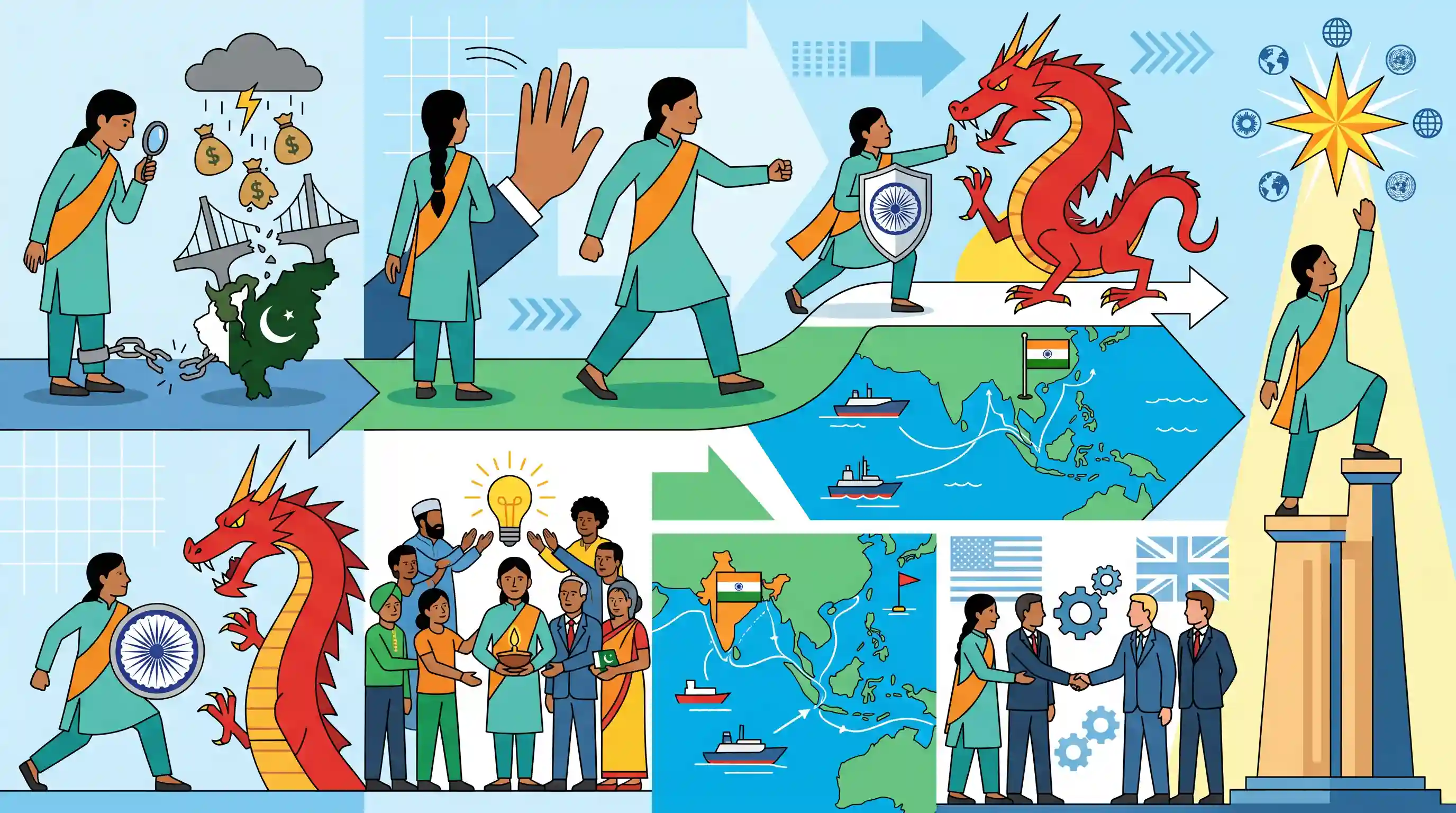
Why It Matters
Highlights the critical shift in India's foreign policy from a traditional Pakistan-centric approach to a broader global strategy focused on China, the Indo-Pacific, and multi-alignment. This is highly relevant for GS-2 questions on shifting geopolitical dynamics and neighborhood relations.
Summary
The article argues that India's foreign policy and strategic vision must conclusively move beyond its historical fixation on Pakistan. With Pakistan mired in severe economic and political crises, its geopolitical weight and capacity to act as a peer competitor have drastically diminished. Consequently, New Delhi should adopt a stance of "strategic indifference" toward Islamabad. Instead of being bogged down by bilateral hyphenation, India must focus its diplomatic capital on more consequential global imperatives. These include countering China's expansive influence, asserting leadership within the Global South, solidifying its presence in the Indo-Pacific, and deepening strategic alliances with the West. Detaching from the Pakistan-centric narrative is deemed essential for India to realize its aspirations as a leading global power.
Key Points
- India's rapid economic growth and expanding global footprint contrast sharply with Pakistan's multi-dimensional political and economic crises.
- The article advocates for a policy of 'strategic indifference' toward Pakistan, arguing that New Delhi gains little from engaging in reactive bilateral disputes.
- Major Western powers have successfully 'de-hyphenated' India and Pakistan, increasingly viewing India as an independent global player and a vital strategic counterweight to China.
- India must reallocate its diplomatic bandwidth toward broader geopolitical imperatives, including managing the Chinese threat, expanding influence in the Indo-Pacific, and championing the Global South.
Important Terms
Strategic Indifference

A foreign policy approach of deliberate disengagement from a problematic neighbor to prioritize internal growth and broader global strategic goals.
UPSC context
GS Paper 2 (International Relations); marks the shift in India’s Pakistan policy from active engagement to purposeful neglect.
De-hyphenation
A diplomatic strategy where India maintains independent, merit-based relationships with rival nations (e.g., Israel-Palestine) without allowing one relationship to constrain the other.
UPSC context
GS Paper 2; crucial for understanding India's pursuit of strategic autonomy and independent foreign policy.
Global South
A term for economically developing nations in Africa, Asia, and Latin America seeking more equitable representation in the global order.
UPSC context
GS Paper 2; relevant to India's leadership role and "Voice of Global South" initiative.
Indo-Pacific
A geopolitical region spanning the Indian and Pacific Oceans, central to India's maritime security and vision of a rules-based order.
UPSC context
GS Paper 2; tests India's SAGAR vision, QUAD membership, and regional security architecture.
Leading Power
An aspirational status where India seeks to proactively influence global norms and provide public goods, rather than merely balancing major powers.
UPSC context
GS Paper 2; examines India’s diplomatic evolution and global governance ambitions.
Neighborhood First Policy
India’s core foreign policy priority focusing on building ties, connectivity, and mutual prosperity with its immediate South Asian neighbors.
UPSC context
GS Paper 2; critical for analyzing India's regional influence and neighborhood diplomacy.
Prelims Trap
"De-hyphenation in Indian foreign policy applies exclusively to separating ties with Israel and Palestine."
While famous for Israel-Palestine, 'de-hyphenation' in broader IR originally refers to Western powers treating India and Pakistan independently, rather than a singular zero-sum conflict zone.
Static Concepts Connected
What distinguishes India's current "Multi-alignment" from traditional "Non-Alignment"?
- Strategic posture: Non-alignment sought passive equidistance and abstention from Cold War blocs. Multi-alignment involves proactive, parallel engagement with competing global powers.
- Issue-based partnerships: Multi-alignment focuses on maximizing national interest through overlapping, issue-based groupings (e.g., participating in Quad, SCO, and BRICS concurrently).
- Pragmatic transactionalism: Unlike NAM's ideological solidarity with the Third World, multi-alignment is rooted in pragmatic transactionalism and economic growth (e.g., buying Russian oil while deepening US tech ties).
How does the static "Gujral Doctrine" shape India's neighborhood approach?
- Non-reciprocity principle: India must not ask for reciprocity from smaller neighbors like Bangladesh, Nepal, and Sri Lanka, offering unilateral concessions in good faith.
- Pakistan exclusion: Crucially, this principle of asymmetric concession deliberately excluded Pakistan, maintaining a distinct security perimeter based on reciprocity and anti-terrorism conditions.
Cross-Topic Patterns
Shift from SAARC to BIMSTEC
The posture of "strategic indifference" to Pakistan explains India's abandonment of the paralyzed SAARC framework in favor of BIMSTEC, effectively linking the 'Neighborhood First' policy with 'Act East'.
Naval modernization and China counterweight
Moving past the continental fixation on the Pakistan border redirects defense capital towards maritime security, accelerating naval expansion to counter China's string of pearls in the Indian Ocean.

Expect a GS2 Mains question assessing the transition from 'Neighborhood First' to 'Indo-Pacific Multi-alignment' by isolating Pakistan.
Linked PYQs · 2
Linked PYQs · 2
- 2015MainsGS2
Terrorist activities and mutual distrust have clouded India-Pakistan relations. To what extent the use of soft power like sports and cultural exchanges could help generate goodwill between the two countries? Discuss with suitable examples.
- 2024MainsGS2
‘The West is fostering India as an alternative to reduce dependence on China's supply chain and as a strategic ally to counter China's political and economic dominance.’ Explain this statement with examples.
