ISRO technological milestones and commercial space capabilities
Source:The Hindu ↗
Why It Matters
ISRO's ongoing advancements—specifically the SpaDeX mission, launch vehicle evolution, and the commercialization of space—are critical for the GS-3 Science and Technology syllabus. The linkage of space applications to broader socioeconomic progress (like agricultural revolutions) provides a holistic perspective required for Mains answers evaluating the utility of India's space program.
Summary
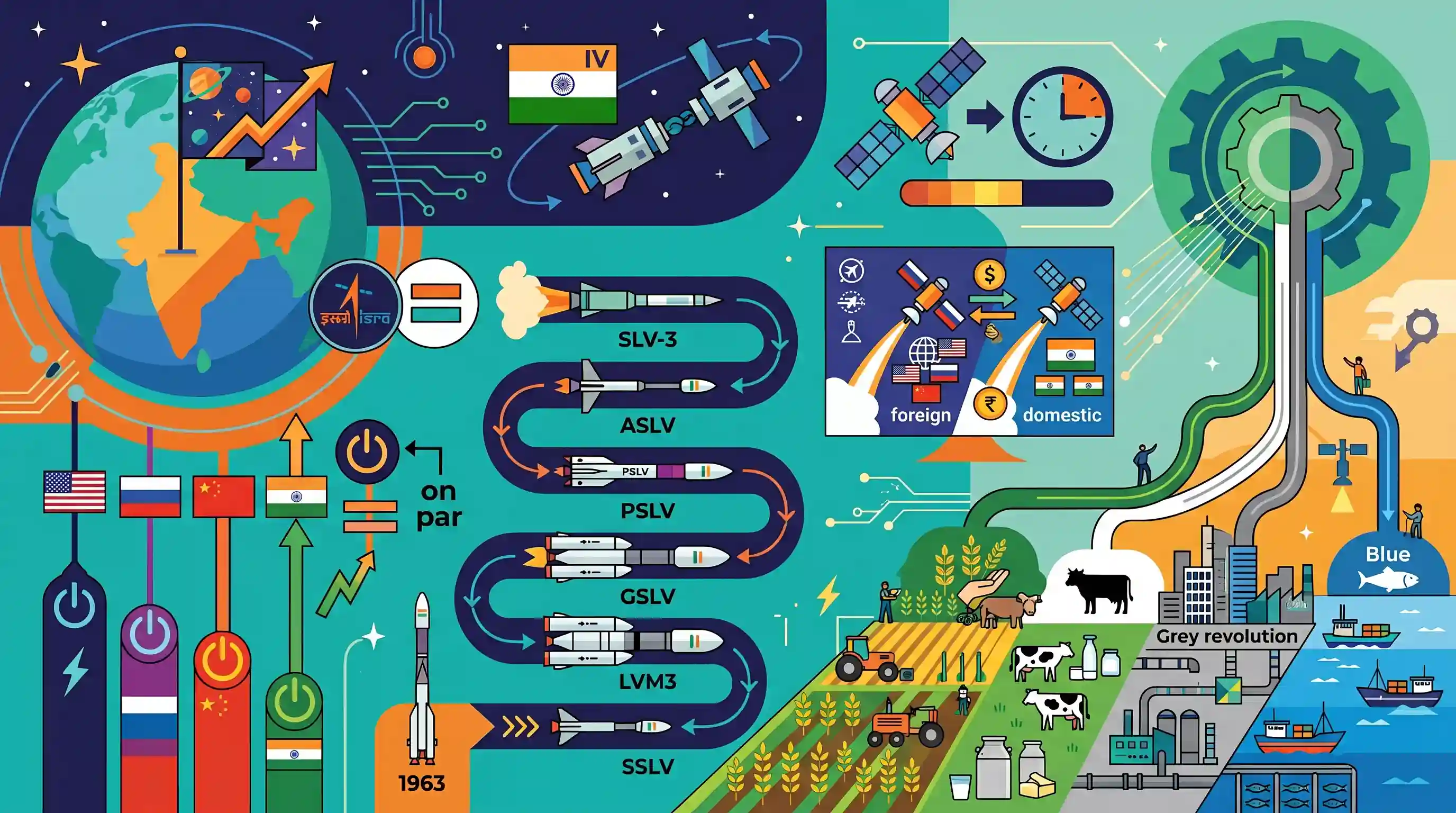
Addressing the convocation at Alagappa University, ISRO's Liquid Propulsion Systems Centre Director V. Narayanan highlighted that India's space research accomplishments are now on par with developed nations. He emphasized the success of the Space Docking Experiment (SpaDeX), which positions India as the fourth country to achieve space docking capabilities. The address chronicled ISRO's journey from its first rocket launch in 1963 to the development of six generations of launch vehicles (SLV3 to SSLV). Narayanan also noted that satellite lifespans have doubled to 15 years, and ISRO has successfully launched 400 foreign satellites alongside 133 domestic ones. Furthermore, he linked scientific advancements to India's socioeconomic transformations, citing the Green, White, Grey, and Blue revolutions.
Key Points
- ISRO's successful Space Docking Experiment (SpaDeX) makes India the fourth nation globally to achieve docking and undocking in space.
- India has systematically developed six generations of space launch vehicles: SLV3, ASLV, PSLV, GSLV, LVM3, and SSLV, completing 102 vehicle missions to date.
- The operational lifespan of Indian satellites has been enhanced from 7 years to 15 years, improving long-term mission viability.
- ISRO has established a strong commercial footprint by launching 400 satellites for 32 foreign countries, alongside operating 133 domestic satellites.
- Space technology has played a foundational role in enabling socioeconomic progress, complementing India's Green, White, Grey, and Blue revolutions.
Important Terms
SpaDeX (Space Docking Experiment)

ISRO’s technology demonstrator that achieved autonomous docking of two spacecraft in January 2025. This capability is vital for the future Bharatiya Antariksh Station (BAS) and lunar sample return missions.
UPSC context
GS Paper 3 (Science & Tech); tests knowledge of indigenous space milestones, orbital mechanics, and future space station infrastructure.
Liquid Propulsion Systems Centre (LPSC)
ISRO’s lead center for designing and realizing advanced liquid and cryogenic propulsion systems. It developed the Vikas engine and indigenous cryogenic stages used in PSLV, GSLV, and LVM3.
UPSC context
GS Paper 3 (Science & Tech); relevant for institutional frameworks and indigenization of high-thrust propulsion technology.
Small Satellite Launch Vehicle (SSLV)
ISRO’s 3-stage solid launch vehicle designed for rapid, low-cost, on-demand launches of small satellites (up to 500kg). It enables 72-hour integration for commercial and academic payloads.
UPSC context
GS Paper 3 (Science & Tech - Space); focuses on the commercialization of space and NewSpace India Limited (NSIL) operations.
Blue Revolution
The rapid expansion of India’s fisheries and aquaculture sector since the 1980s. Space technology supports this via satellite-based Potential Fishing Zone (PFZ) advisories and marine resource mapping.
UPSC context
GS Paper 3 (Agriculture/Economy); examines interdisciplinary applications of science for socioeconomic development and food security.
Launch Vehicle Generations
The evolutionary stages of ISRO’s rockets, including 1st Gen (SLV-3), 2nd Gen (ASLV), 3rd Gen (PSLV), and 4th Gen (GSLV/LVM3). They track India's progress from small payloads to heavy-lift capabilities.
UPSC context
GS Paper 3 (Science & Tech); tests understanding of the chronological and technological growth of India’s space transport systems.
Prelims Trap
India is the third country globally to demonstrate space docking capabilities via the SpaDeX mission.
India is actually the fourth country to achieve space docking, after the USA, Russia, and China. Aspirants often forget to account for China's advanced space capabilities.
Static Concepts Connected
What are the primary payload differences between ISRO's operational launch vehicles?
- PSLV: Lifts up to 1,750 kg to Sun-Synchronous Polar Orbits; known as India's highly reliable workhorse.
- GSLV: Utilizes an indigenous cryogenic upper stage to place ~2,250 kg payloads into Geosynchronous Transfer Orbit (GTO).
- LVM3: Heavy-lift vehicle capable of placing 4,000 kg to GTO and 8,000 kg to LEO; used for Chandrayaan-3.
- SSLV: Designed for rapid, on-demand commercial launch of small satellites (up to 500 kg) into LEO.
How does ISRO's satellite network directly support primary economic sectors?
- Agriculture: Earth Observation satellites (like RESOURCESAT) enable crop acreage estimation, drought assessment, and precision soil mapping.
- Fisheries: Oceansat data helps INCOIS generate Potential Fishing Zone (PFZ) advisories, actively supporting the Blue Revolution.
- Disaster Management: Meteorological tracking and NavIC integration provide early cyclone warnings and coordinate last-mile relief logistics.
Cross-Topic Patterns
SpaDeX + Bhartiya Antariksh Station
In-space docking is a prerequisite for assembling the modular Bhartiya Antariksh Station (BAS) by 2035, connecting this S&T milestone to India's long-term human spaceflight goals.
Space Commercialization + FDI Norms
ISRO's launch of 400 foreign satellites synergizes with recent policies allowing up to 100% FDI in the space sector, aiming to boost India's global space economy share.

Expect a 2026 Prelims S&T question pairing SpaDeX/docking tech with upcoming Bhartiya Antariksh Station (BAS) and Gaganyaan targets.
Linked PYQs · 4
Linked PYQs · 4
- 2018PrelimsGS1
With reference to India's satellite launch vehicles, consider the following statements: 1. PSLVs launch the satellites useful for Earth resources monitoring whereas GSLVs are designed mainly to launch communication satellites. 2. Satellites launched by PSLV appear to remain permanently fixed in the same position in the sky, as viewed from a particular location on Earth. 3. GSLV Mk III is a four-staged launch vehicle with the first and third stages using solid rocket motors; and the second and fourth stages using liquid rocket engines. Which of the statements given above is/are correct?
- 2016MainsGS3
Discuss India's achievements in the field of Space Science and Technology. How the application of this technology has helped India in its socio-economic development?
- 2017MainsGS3
Explain various types of revolutions, took place in Agriculture after independence in India. How these revolutions have helped in poverty alleviation and food security in India?
- 2017MainsGS3
India has achieved remarkable successes in unmanned space missions including the Chandrayaan and Mars Orbitter Mission, but has not ventured into manned space missions. What are the main obstacles to launching a manned space mission, both in terms of technology and logistics? Examine critically.
