Growth Prospects of the Sericulture Industry and Silk Value Chain
Source:The Hindu ↗
Why It Matters
Sericulture serves as a crucial agro-based industry that offers significant non-farm employment and income generation in rural areas. The expansion of the silk value chain, the 'Silk Samagra' scheme, and technological interventions are highly relevant for topics covering rural development, MSMEs, and agriculture-allied sectors in the Indian economy.
Summary
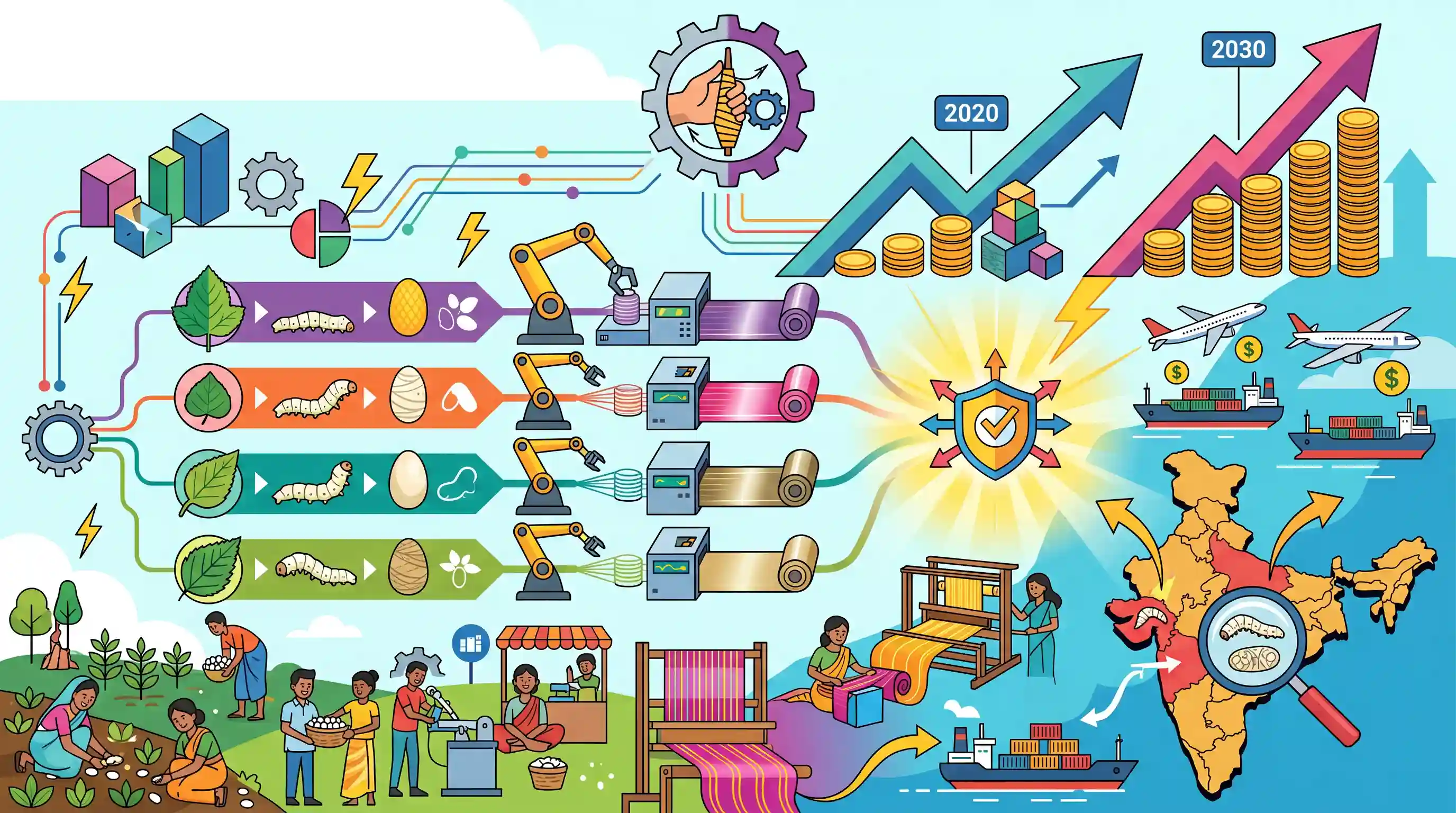
The Central Silk Board (CSB), under the Ministry of Textiles, has set an ambitious target to double India's silk value chain to ₹1,10,000 crore by 2030. Currently producing 41,121 metric tonnes of raw silk—dominantly mulberry, along with eri, taser, and muga—the aim is to reach 54,000 metric tonnes by 2030. This growth will be driven by mechanisation and technology, supported by the 'Silk Samagra' scheme. The initiative has expanded sericulture to non-traditional areas, with Gujarat recently starting Eri silk farming. Additionally, silk exports are expected to cross ₹2,500 crore in FY26, highlighting the sector's importance for rural employment and the textile industry.
Key Points
- The Central Silk Board plans to double India's silk value chain from the current ₹55,000 crore to ₹1,10,000 crore by 2030.
- India currently produces 41,121 metric tonnes of raw silk, with mulberry silk comprising over 70%, complemented by eri, taser, and muga varieties.
- The target for raw silk production by 2030 is 54,000 metric tonnes, to be achieved through heightened mechanisation and technological intervention.
- The 'Silk Samagra' scheme is spearheading the development of the sericulture industry, facilitating expansion into non-traditional silk-producing states like Gujarat.
- Silk exports stood at ₹2,300 crore in the last fiscal year and are projected to surpass ₹2,500 crore in FY26.
Important Terms
Silk Samagra

An integrated Central Sector Scheme aimed at scaling up silk production, improving quality, and empowering rural/tribal families through R&D, seed support, and technology up-gradation.
UPSC context
GS Paper 2/3: Government Schemes and Agro-based Industries; tests understanding of integrated development for doubling farmers' income.
Central Silk Board
A statutory body established in 1948 under the Ministry of Textiles to promote, regulate, and coordinate the development of the silk industry in India.
UPSC context
GS Paper 2: Statutory/Regulatory Bodies; tests knowledge of apex institutions governing specialized economic sectors.
Sericulture
The practice of rearing silkworms for the production of raw silk; a labor-intensive, agro-based cottage industry providing significant employment in rural India.
UPSC context
GS Paper 3: Major crops/cropping patterns; tests socio-economic impacts on rural employment and women empowerment.
Vanya Silk
A collective term for non-mulberry 'wild' silks—Tasar, Eri, and Muga—reared traditionally by tribal communities in forest-based ecosystems.
UPSC context
GS Paper 3: Economic Geography/Agriculture; tests India's unique global standing as the only producer of all commercial silks.
Silk Mark
A certification mark launched by the Silk Mark Organisation of India to guarantee the purity and authenticity of 100% natural silk products.
UPSC context
Prelims: Quality certification marks; tests awareness of consumer protection measures in the textile sector.
Muga Silk
A high-quality, golden-yellow silk produced exclusively in Assam by the silkworm Antheraea assamensis; it is a Geographical Indication (GI) protected product.
UPSC context
Prelims/GS Paper 1: Cultural Geography/GI tags; tests knowledge of regional products and traditional livelihoods.
Prelims Trap
India is the world's largest producer of raw silk since it produces all five commercial varieties.
While India uniquely produces all five commercial silk varieties, it is the second-largest producer globally after China. India is, however, the world's largest consumer.
Static Concepts Connected
What are the key commercial varieties of silk produced in India?
- Mulberry Silk: Accounts for over 70% of total production, predominantly cultivated in states like Karnataka, Andhra Pradesh, and Tamil Nadu.
- Vanya Silks: Non-mulberry 'wild' silks (Tropical Tasar, Oak Tasar, Eri, Muga) reared by tribal communities on forest host trees like oak, castor, and arjun.
- Muga Silk: Known for its distinct golden-yellow tint, this premium variety is unique to India and predominantly confined to Assam, holding a GI tag.
What is the statutory framework governing India's sericulture sector?
- Central Silk Board: A statutory body established in 1948 under the Ministry of Textiles, responsible for overall sector development, R&D, and quality control.
- Silk Samagra: A Central Sector Scheme executed by CSB to scale up domestic production, boost mechanization, and reduce India's reliance on imported silk.
Cross-Topic Patterns
Vanya Silks and Tribal Livelihoods
Non-mulberry silks are forest-based, deeply integrating sericulture with tribal economies in Central and Northeast India, overlapping with forest rights and non-timber forest produce (NTFP) policies.
Non-traditional sericulture geography
The introduction of Eri silk farming in Gujarat reflects a strategic shift, using technology to expand sericulture beyond traditional southern and northeastern agro-climatic zones.

Expect a 2026 Prelims pair-matching question linking silk varieties (Muga, Eri, Tasar) to their host trees or primary producing states.
Linked PYQs · 2
Linked PYQs · 2
- 2015MainsGS3
Livestock rearing has a big potential for providing non-farm employment and income in rural areas. Discuss suggesting suitable measures to promote this sector in India.
- 2023MainsGS3
Faster economic growth requires increased share of the manufacturing sector in GDP, particularly of MSMEs. Comment on the present policies of the Government in this regard.
