Axiom Four Space Mission Involving Indian Astronaut Postponed
Source:The Hindu ↗
Why It Matters
The mission is a prime example of the commercialization of space exploration and international collaboration. For UPSC aspirants, it is vital for tracking India's evolving space capabilities, especially in manned missions ahead of Gaganyaan, and understanding the role of private actors like Axiom Space and SpaceX in low-Earth orbit operations.
Summary
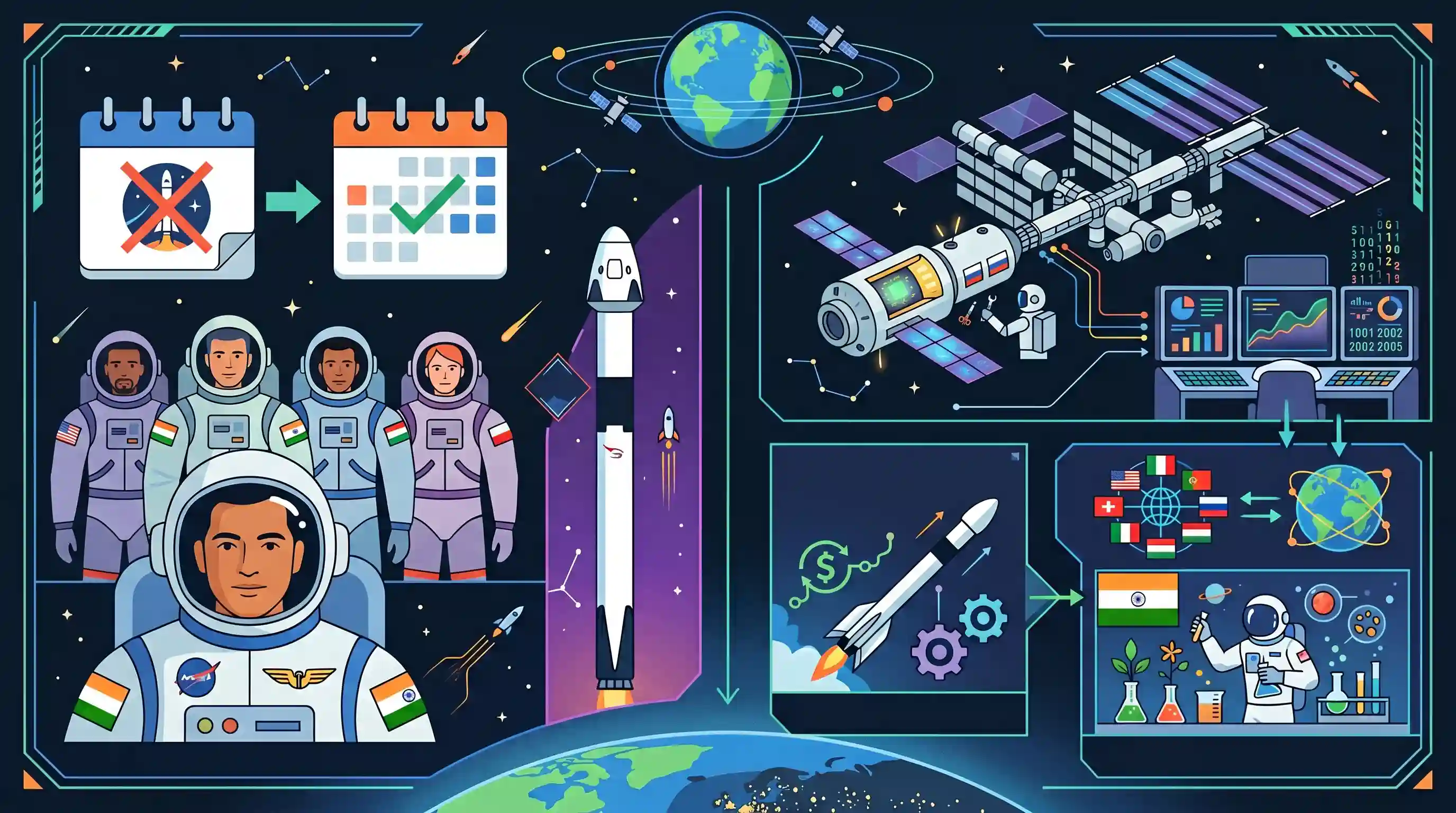
The Axiom-4 commercial space mission to the International Space Station (ISS), featuring Indian astronaut Shubhanshu Shukla as the mission pilot, has been postponed to June 22, 2025. The delay is intended to give NASA time to evaluate ISS operations following recent repairs on the Russian Zvezda service module. The mission, utilizing a SpaceX Falcon 9 rocket, also includes astronauts from the US, Hungary, and Poland. This development highlights the growing role of private entities like Axiom Space and SpaceX in manned spaceflight and underscores India's active participation in international space research and micro-gravity experiments.
Key Points
- Indian astronaut Shubhanshu Shukla is participating as the mission pilot in the Axiom-4 commercial space mission to the International Space Station (ISS).
- The mission is organized by private aerospace company Axiom Space and will launch on SpaceX's Falcon 9 rocket.
- The launch has been postponed to June 22, 2025, to allow NASA to evaluate the ISS after repairs on the Russian Zvezda service module.
- Earlier delays were caused by a liquid oxygen leak in the Falcon-9 boosters and leaks in the ageing Russian module of the ISS.
- ISRO is actively coordinating with Axiom Space to manage time-sensitive experimental specimens intended for the mission.
Important Terms
Axiom-4 mission

The fourth private astronaut mission to the International Space Station (ISS), featuring Indian Group Captain Shubhanshu Shukla as mission pilot to gain operational expertise for India's Gaganyaan program.
UPSC context
GS Paper 3 (Science & Technology); critical for human spaceflight and India's participation in international microgravity research.
Zvezda service module
The primary Russian module of the ISS providing life support, propulsion, and living quarters; its recent structural repairs and leaks caused the postponement of the Axiom-4 mission.
UPSC context
GS Paper 3 (Space Tech); tests knowledge of International Space Station components and international technical cooperation challenges.
Falcon 9
A partially reusable medium-lift rocket developed by SpaceX; it is the launch vehicle for the Axiom-4 mission and recently used by India for heavy satellite launches.
UPSC context
GS Paper 3 (Science & Technology); focuses on cost-reduction in space through reusability and India's shift toward commercial launch services.
Axiom Space
A private US-based space company that organizes commercial flights to the ISS and is developing the world's first commercial space station.
UPSC context
GS Paper 3 (Economy/Science); relates to the "New Space" era and the privatization/commercialization of the global space sector.
ISRO
India’s national space agency; its involvement in Ax-4 marks a strategic step toward training astronauts and conducting experiments before its indigenous Gaganyaan mission.
UPSC context
GS Paper 3 (S&T); essential for topics on indigenous technology, human spaceflight programs, and international strategic partnerships.
NASA
The United States' federal space agency; it partners with private companies like Axiom and SpaceX to manage ISS operations and international astronaut programs.
UPSC context
GS Paper 2 & 3; signifies Indo-US space cooperation under the iCET framework and global space governance.
Prelims Trap
Axiom-4 is a joint government spaceflight mission organized directly by NASA and ISRO.
Axiom-4 is a commercial spaceflight orchestrated by the private company Axiom Space using a SpaceX rocket. While ISRO and NASA facilitate it, it is not a traditional government-to-government mission.
Static Concepts Connected
What are the core modules and orbit of the International Space Station (ISS)?
- Multinational Effort: A joint collaborative project involving five participating space agencies: NASA (USA), Roscosmos (Russia), JAXA (Japan), ESA (Europe), and CSA (Canada).
- Zvezda Module: The functional center of the Russian segment, providing essential life support systems, flight control, and living quarters for the crew.
- Low Earth Orbit: The ISS orbits in Low Earth Orbit (LEO) at approximately 400 km altitude, which is identically the target orbit for India's upcoming Gaganyaan mission.
What are the primary parameters of India's Gaganyaan Mission?
- Mission Goal: To demonstrate human spaceflight capability by sending a crew of three members to a 400 km orbit for three days and returning them safely to Earth.
- Launch Vehicle: The mission will utilize the Human Rated LVM3 (HLVM3), ISRO's heavy-lift launcher reconfigured with life support and crew escape systems.
- Precursor Experience: Indian astronauts (Gaganyatris) are participating in missions like Axiom-4 to gain practical micro-gravity and operational spaceflight experience before India's indigenous launch.
Cross-Topic Patterns
Commercial Space + IN-SPACe reforms
The reliance on Axiom and SpaceX highlights the global trend of privatizing Low Earth Orbit operations, a model India is actively adopting via IN-SPACe and NSIL reforms.
Artemis Accords + Indo-US iCET
Placing an ISRO astronaut on a US-launched mission directly builds on India's 2023 signing of the Artemis Accords and broadens the Indo-US Initiative on Critical and Emerging Technology (iCET).

Expect a multi-statement question on Gaganyaan precursors linking ISRO's commercial ISS tie-ups and the anatomy of the Space Station.
Linked PYQs · 2
Linked PYQs · 2
- 2025PrelimsGS1
Consider the following space missions : I. Axiom-4 II. SpaDeX III. Gaganyaan How many of the space missions given above encourage and support micro-gravity research?
- 2016MainsGS3
Discuss India's achievements in the field of Space Science and Technology. How the application of this technology has helped India in its socio-economic development?
