Axiom 4 Mission Featuring Indian Astronaut Targets June Launch
Source:The Hindu ↗
Why It Matters
UPSC frequently tests knowledge of India's role in cutting-edge space technology and international missions. Shubhanshu Shukla's participation in Axiom-4 directly ties into India's growing human spaceflight capabilities (contextual to Gaganyaan) and the increasing role of private players like SpaceX and Axiom Space in the domain. Technical challenges mentioned (like liquid oxygen leaks) also reflect the obstacles in manned space missions, a key theme in GS3 Mains.
Summary
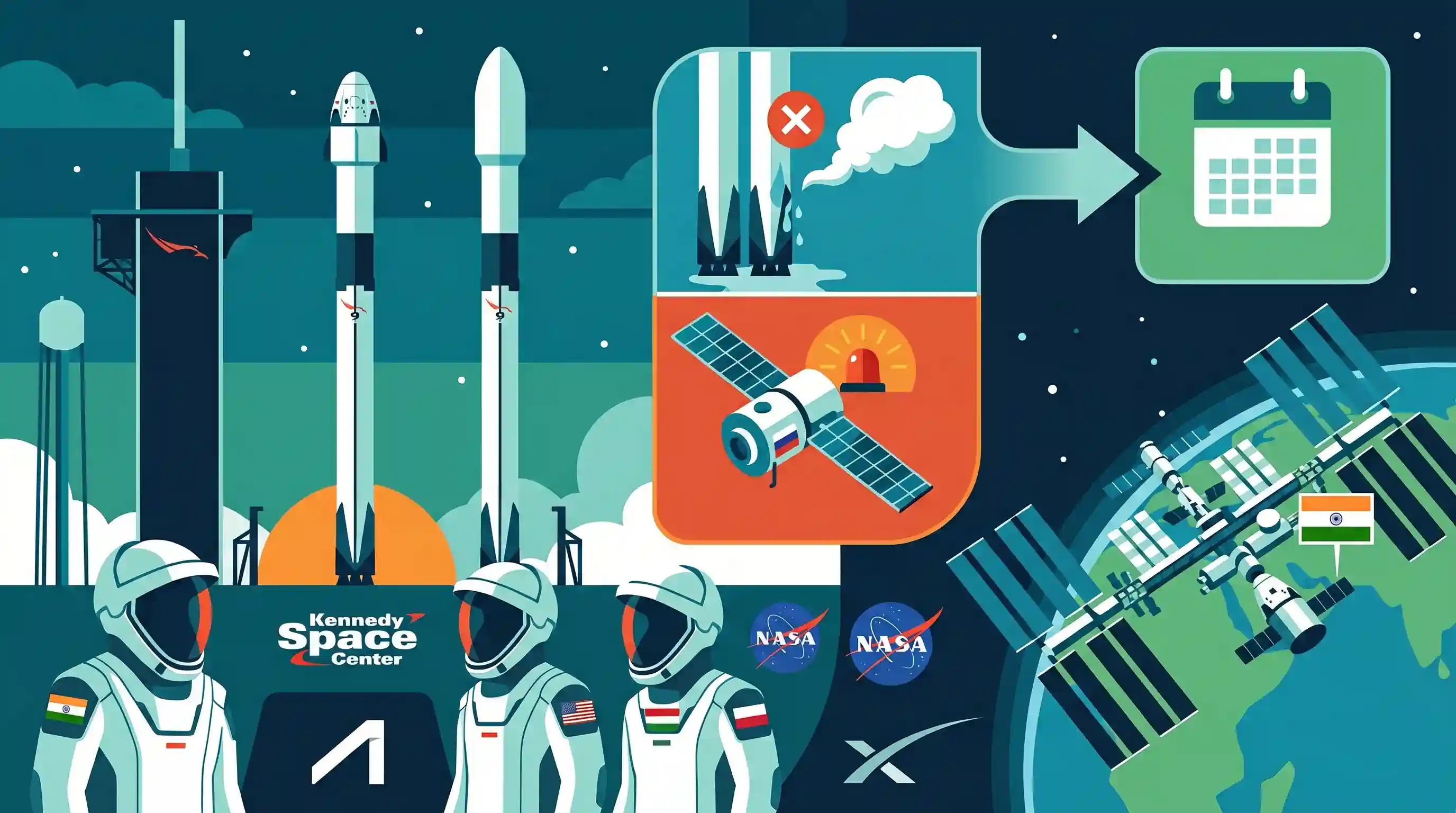
Indian astronaut Shubhanshu Shukla is set to pilot the upcoming Axiom-4 commercial mission to the International Space Station (ISS). Organised by NASA, Axiom Space, and SpaceX, the mission crew includes members from the US, India, Hungary, and Poland. Originally delayed due to technical snags—including a liquid oxygen leak in the Falcon-9 rocket boosters and issues within the ISS's Russian module—the mission is now targeting a June 25 launch from the Kennedy Space Centre. This mission represents a critical step in private space exploration and boosts India's presence in international manned spaceflight.
Key Points
- Axiom-4 is a collaborative private astronaut mission to the International Space Station (ISS) led by NASA, Axiom Space, and SpaceX.
- Indian astronaut Shubhanshu Shukla is serving as the mission pilot, marking a significant milestone for India's space endeavours.
- The crew will travel to the ISS on a SpaceX Dragon spacecraft launched by a Falcon-9 rocket from NASA's Kennedy Space Centre.
- The launch faced several delays due to a liquid oxygen leak in the Falcon-9 boosters and leaks in the ISS's ageing Russian module, highlighting the technical and logistical challenges of manned spaceflight.
Important Terms
Axiom-4 Mission (Ax-4)

A private crewed mission to the International Space Station (ISS) organized by Axiom Space and SpaceX, involving multinational astronauts including India’s Shubhanshu Shukla.
UPSC context
GS III (Space Technology). Represents India’s entry into commercial human spaceflight and a precursor to the indigenous Gaganyaan mission.
Gaganyatri
The official designation for Indian astronauts selected by ISRO for the national human spaceflight program, Gaganyaan.
UPSC context
GS III (Science & Tech). Crucial terminology for India’s space missions and human spaceflight advancements.
Axiom Space
A US-based private space infrastructure developer that organizes commercial missions to the ISS and is building the world's first private space station.
UPSC context
GS III (Space Technology). Key player in the commercialization of space and international collaboration for Indian astronauts.
International Space Station (ISS)
A collaborative habitable satellite in low Earth orbit, serving as a microgravity laboratory for international scientific research.
UPSC context
GS III (Science). Central to global space cooperation and the primary destination for current crewed missions.
ISRO
India's national space agency responsible for space research, satellite communication, and missions like Gaganyaan, Chandrayaan, and Aditya-L1.
UPSC context
GS III (Science & Tech). The lead organization for all Indian space policy and current affairs.
Commercialization of Space
The strategic transition of the space industry to include private companies in providing services such as launches, research, and orbital habitation.
UPSC context
GS III (Economy/Space). Tests understanding of the "New Space" era and the entry of private players in India's space sector.
Prelims Trap
"Axiom-4 is a joint bilateral space mission between ISRO and NASA."
Axiom-4 is not a government-to-government mission. It is a private, commercial spaceflight organized by Axiom Space, even though it carries an ISRO astronaut to facilitate Gaganyaan training.
Static Concepts Connected
Who are the primary partner agencies managing the International Space Station (ISS)?
- NASA (USA): NASA (USA) is the lead agency, providing the structural framework, power, and day-to-day operational control.
- Roscosmos (Russia): Roscosmos provides crucial life support systems, propulsion, and orbital maintenance for the station.
- ESA, JAXA, CSA: The European (ESA), Japanese (JAXA), and Canadian (CSA) space agencies contribute specific research modules and advanced robotics (like the Canadarm).
What distinguishes cryogenic from semi-cryogenic rocket engines?
- Propellant composition: Cryogenic engines use liquid hydrogen (fuel) and liquid oxygen (oxidizer). Semi-cryogenic engines use refined kerosene (RP-1) as fuel and liquid oxygen as the oxidizer.
- Storage and handling: Semi-cryogenic engines are easier to handle because kerosene is liquid at room temperature, unlike hydrogen which requires extreme sub-zero storage (-253°C).
- Thrust vs. Efficiency: Cryogenic engines offer higher specific impulse (efficiency), but semi-cryogenic engines offer higher thrust density, making them ideal for heavy-lift boosters (like Falcon-9).
Cross-Topic Patterns
Gaganyaan training via private spaceflight
India is utilizing the commercial Axiom-4 mission to give its Gaganyaan astronaut-designate real-time operational experience, bridging domestic human spaceflight ambitions with global private spaceflight capabilities.
Ageing ISS and the push for BAS
Frequent leaks in the legacy Russian modules underscore the impending retirement of the ISS, accelerating the geopolitical race for independent outposts like India's planned Bharatiya Antariksha Station (BAS).

Expect a Prelims 2026 multi-statement question testing the distinction between ISRO's Gaganyaan and private LEO missions like Axiom.
Linked PYQs · 2
Linked PYQs · 2
- 2025PrelimsGS1
Consider the following space missions : I. Axiom-4 II. SpaDeX III. Gaganyaan How many of the space missions given above encourage and support micro-gravity research?
- 2017MainsGS3
India has achieved remarkable successes in unmanned space missions including the Chandrayaan and Mars Orbitter Mission, but has not ventured into manned space missions. What are the main obstacles to launching a manned space mission, both in terms of technology and logistics? Examine critically.
