India Global Greenfield Investment Share Surpasses China
Source:The Hindu ↗
Why It Matters
Understanding global investment trends, particularly greenfield FDI shifts between India and China, is critical for evaluating India's economic growth strategies, industrial policies, and competitiveness in attracting global capital.
Summary
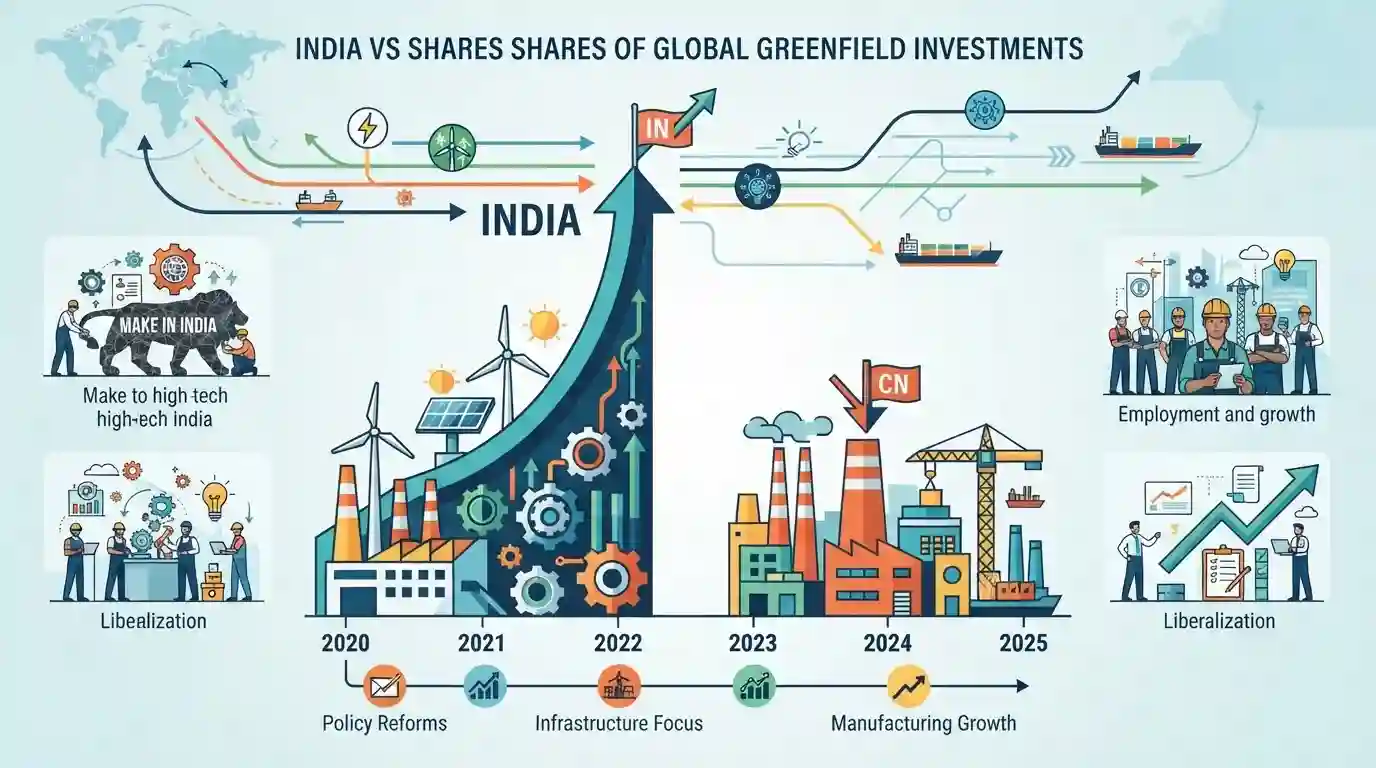
Between 2020 and 2025, India's share of global greenfield investments surpassed double that of China's, reflecting a significant structural shift in international capital flows and highlighting India's growing attractiveness as a global manufacturing and investment hub.
Key Points
- India's share of global greenfield investments was more than double that of China between 2020 and 2025, highlighting a shift in global capital deployment.
- Greenfield investments refer to new capital expenditure and projects built from scratch, generating fresh employment and industrial capacity.
- This trend underscores India's rising prominence as a preferred investment destination relative to traditional manufacturing powerhouses like China.
Important Terms
Greenfield Investments

A type of foreign direct investment where a parent company creates a brand-new operation in a foreign country from scratch, constructing new facilities and infrastructure rather than buying an existing business.
UPSC context
Mains GS Paper III (Indian Economy & Mobilization of Resources); tests understanding of global capital flows, FDI trends, and manufacturing competitiveness.
UNCTAD
A principal intergovernmental body of the United Nations General Assembly that promotes the integration of developing countries into the global economy and monitors global trade, investment, and development trends.
UPSC context
Prelims / Mains GS Paper II & III; frequently tested for international reports on trade, investment, and global economic governance.
Industrial Policy
Government-led strategies and concerted interventions designed to promote, support, and steer specific domestic industries, sectors, or manufacturing activities to accelerate economic development and competitiveness.
UPSC context
Mains GS Paper III (Changes in Industrial Policy and Growth); tests analytical understanding of state intervention, manufacturing policies, and economic reforms.
Static Concepts Connected
What are the key differences between Greenfield and Brownfield foreign direct investments?
- Greenfield definition: New facilities created from scratch, building infrastructure on unused land; directly adds to gross fixed capital formation and new employment.
- Brownfield definition: Involves acquiring or leasing existing production facilities or companies in the host country; does not immediately add new capacity from scratch.
- Policy treatment: FDI policy in India generally permits 100% automatic route for most greenfield manufacturing, whereas brownfield sectors often attract stricter conditionalities or approval routes.
Cross-Topic Patterns
Greenfield FDI + China Plus One Strategy
India's greenfield surge reflects supply-chain diversification away from China (China Plus One), directly linking trade policy, FDI inflows, and geopolitical alignments like the Indo-Pacific Economic Framework.
Greenfield Investment + PLI Schemes for Manufacturing
Capital formation from greenfield projects directly fuels manufacturing employment targets under Make in India and Production Linked Incentive (PLI) schemes.

Expect UPSC to test the distinction between greenfield and brownfield FDI regarding automatic vs. approval routes and employment impact.
Linked PYQs · 1
Linked PYQs · 1
- 2023MainsGS3
Faster economic growth requires increased share of the manufacturing sector in GDP, particularly of MSMEs. Comment on the present policies of the Government in this regard.
