Bonded Labour System Realities and Constitutional Safeguards
Source:The Hindu ↗
Why It Matters
Bonded labour represents a direct violation of Article 23 (Right against Exploitation) and highlights the ongoing challenges in protecting vulnerable sections like Dalits and Adivasis. For UPSC aspirants, it is a crucial case study linking constitutional guarantees with grassroots socio-economic realities, poverty, and governance deficits.
Summary
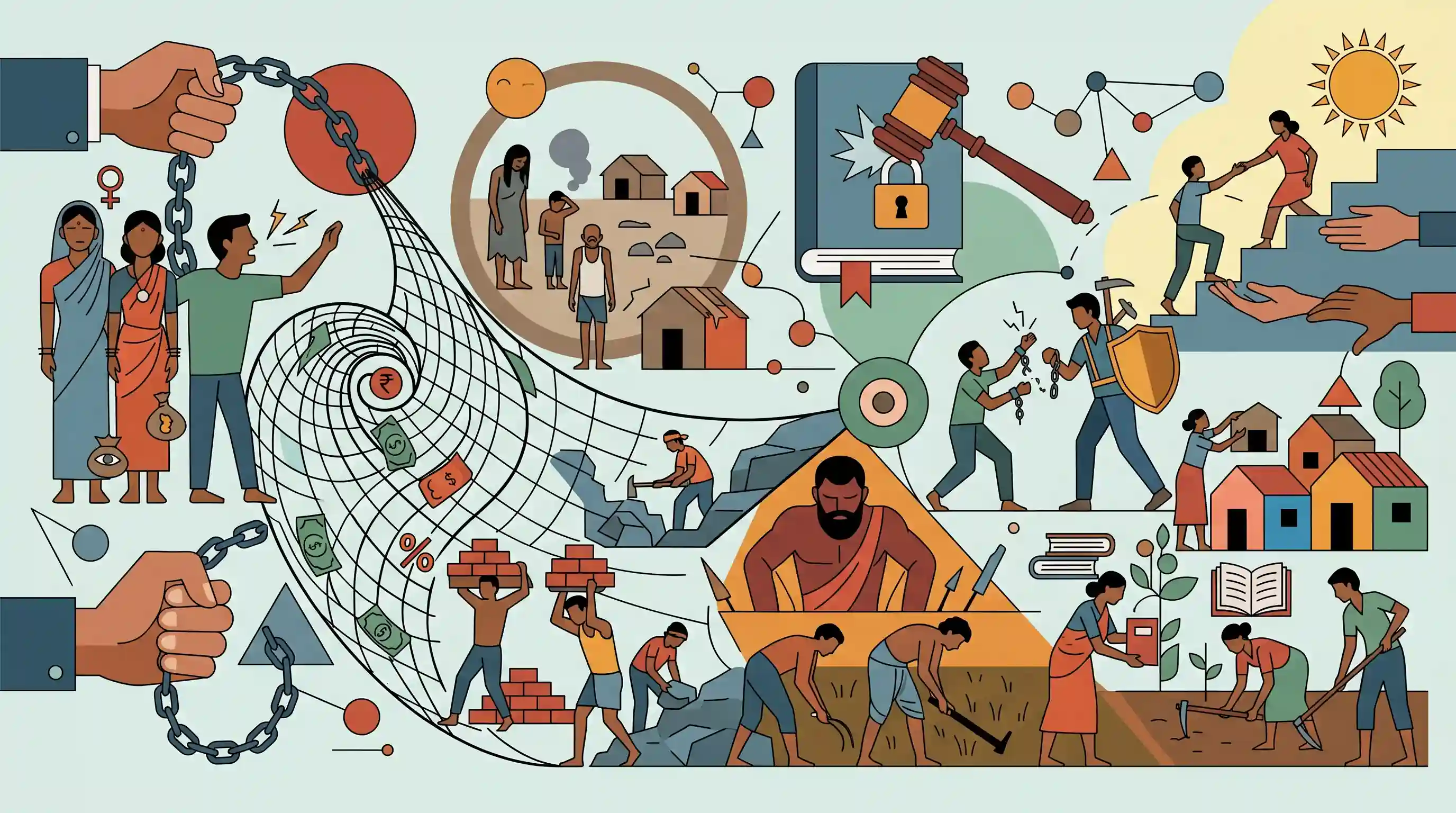
The article underscores the persistent and shameful reality of bonded labour in India, framing it as a severe violation of human rights and modern-day slavery. Although the Bonded Labour System (Abolition) Act of 1976 and Article 23 of the Constitution outlaw forced labour, marginalized groups—particularly Dalits, Adivasis, and the rural poor—continue to fall into debt traps. The piece highlights that deep-rooted poverty, lack of access to formal credit, and informal economic structures perpetuate this exploitation. It emphasizes that meaningful eradication demands not only robust legal enforcement but also the socio-economic empowerment and comprehensive rehabilitation of vulnerable communities to break the cycle of systemic deprivation.
Key Points
- Despite formal abolition through the Bonded Labour System (Abolition) Act, 1976, the practice persists as a modern form of slavery in India.
- Article 23 of the Indian Constitution expressly guarantees the Right against Exploitation, prohibiting forced labour and human trafficking.
- Vulnerable communities, primarily Dalits, Adivasis, and the rural poor, are disproportionately ensnared in bonded labour due to systemic socio-economic marginalization.
- The root causes include extreme poverty, debt traps induced by a lack of access to formal credit, and widespread informal employment.
- Eradicating bonded labour requires strict law enforcement, comprehensive rehabilitation of victims, and policies that liberate the poor from ongoing cycles of systemic deprivation.
Important Terms
Article 23 of the Indian Constitution

A Fundamental Right in Part III that prohibits human trafficking, 'begar', and all other forms of forced labour, making such practices punishable by law.
UPSC context
GS Paper II (Polity) and GS Paper I (Social Justice); critical for questions on Fundamental Rights and exploitation of vulnerable sections.
Bonded Labour System (Abolition) Act, 1976
Central legislation that abolished the bonded labour system, discharged all associated debts, and established an institutional framework for the release and rehabilitation of victims.
UPSC context
GS Paper II (Social Justice/Government Policies); focuses on legal protections for the rural poor and marginalized communities.
National Human Rights Commission (NHRC)
A statutory body established under the Protection of Human Rights Act (1993) to monitor human rights violations and oversee the implementation of bonded labour abolition laws.
UPSC context
GS Paper II (Statutory Bodies); tested in terms of its role in safeguarding human rights and its monitoring powers.
Begar
A traditional Indian form of forced labour where a person is compelled to work for another without any remuneration or payment.
UPSC context
GS Paper II (Polity/Fundamental Rights); often used in Prelims to test specific constitutional terminology and historical forms of exploitation.
Debt Bondage
A condition where a person's labour is pledged as security for a loan, often characterized by high interest rates and minimal wages that keep the debtor in perpetual servitude.
UPSC context
GS Paper I (Society) and GS Paper II (Social Justice); relevant for essays and answers on poverty, migration, and inequality.
Vigilance Committees
Statutory bodies at the District and Sub-divisional levels responsible for the identification, release, and economic/social rehabilitation of bonded labourers under the 1976 Act.
UPSC context
GS Paper II (Social Justice); important for understanding the decentralised implementation of welfare and labor laws.
Prelims Trap
The Indian Constitution explicitly defines the 'bonded labour system' under Article 23.
Article 23 prohibits 'begar' and similar forms of forced labour, but the specific term and definition of the 'bonded labour system' were introduced by the 1976 Act, not the Constitution.
Static Concepts Connected
What is the scope and nature of Article 23 (Right against Exploitation)?
- Constitutional Scope: Explicitly prohibits traffic in human beings, 'begar', and other similar forms of forced labour.
- Absolute Protection: Unlike most fundamental rights, Article 23 protects the individual against both the State and private citizens.
- The Exception: Article 23(2) allows the State to impose compulsory service for public purposes, provided there is no discrimination on grounds of religion, race, caste, or class.
What are the key provisions of the Bonded Labour System (Abolition) Act, 1976?
- Debt Extinguishment: Immediately freed laborers from any obligation to render bonded labor and legally extinguished all related outstanding debts.
- Asset Protection: Prohibits the eviction of freed laborers from their homesteads or agricultural lands attached to their previous debt.
- Mandated Rehabilitation: Requires District Magistrates and local Vigilance Committees to ensure the economic and social rehabilitation of rescued laborers.
Cross-Topic Patterns
Financial Inclusion as a Rights Enabler
Lack of institutional credit drives the rural poor to informal moneylenders. Schemes like PMJDY and SHG-bank linkages therefore act as critical tools for enforcing fundamental rights and preventing forced labour.
NHRC and Supreme Court synergy
The Supreme Court has actively utilized the National Human Rights Commission (NHRC) to monitor the implementation of the Bonded Labour Abolition Act, linking constitutional mandates with statutory bodies.

Expect a multi-statement prelims question testing Article 23's enforceability against private individuals alongside NHRC's statutory role.
Linked PYQs · 3
Linked PYQs · 3
- 2020PrelimsGS1
Which one of the following categories of Fundamental Rights incorporates protection against untouchability as a form of discrimination?
- 2016MainsGS1
An essential condition to eradicate poverty is to liberate the poor from the process of deprivation. Substantiate this statement with suitable examples.
- 2024MainsGS1
Critically analyse the proposition that there is a high correlation between India's cultural diversities and socio-economic marginalities.
