India Services Sector PMI Hits Four and a Half Year Low
Source:The Hindu ↗
কেন এটি গুরুত্বপূর্ণ
The Purchasing Managers' Index (PMI) is a vital high-frequency macroeconomic indicator. A structural slowdown in the services sector—which is the largest contributor to India's GDP—alongside minimal employment generation illustrates the ongoing challenge of 'jobless growth'. Additionally, the passing of costs onto consumers indicates persistent inflationary pressures, directly influencing the Reserve Bank of India's (RBI) monetary policy and interest rate decisions.
সারসংক্ষেপ
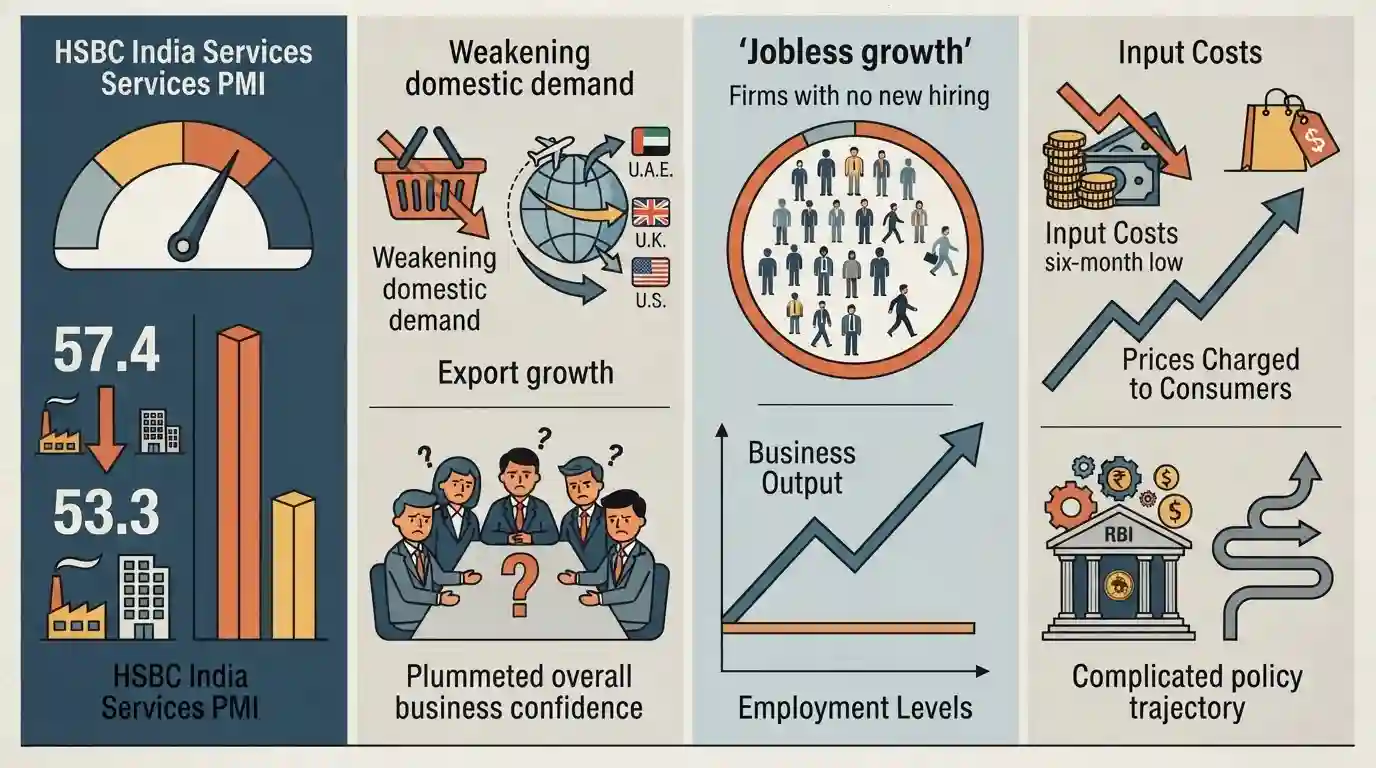
India's services sector expansion slowed to a four-and-a-half-year low in July 2026, with the HSBC India Services Purchasing Managers' Index (PMI) dropping to 53.3 from 57.4 in June. The slowdown was attributed to weakening domestic and international demand, alongside intense market competition. Although new export business from regions like the U.A.E., U.K., and U.S. remained a bright spot, overall business confidence plummeted. Crucially, the data underscores a 'jobless growth' trend, as 92% of firms reported no increase in hiring despite business expansion. Furthermore, while input cost pressures reached a six-month low, firms passed earlier costs onto consumers at the fastest rate since April, signaling potential sticky retail inflation that could complicate the RBI's monetary policy trajectory.
মূল বিষয়
- India's services sector growth, measured by the HSBC India Services PMI, fell to a 53-month low of 53.3 in July 2026, though it remained in the expansion zone (above 50).
- The deceleration was driven by easing domestic and export demand, intense competition, and a subsequent drop in business confidence to a seven-month low.
- Despite the expansion in business activity, employment generation remained extremely weak, with 92% of surveyed firms reporting no change in payrolls, highlighting structural 'jobless growth' concerns.
- While input cost inflation (fuel, labor, materials) eased to a six-month low, companies increased their selling prices at the fastest pace since April to protect margins, pointing to persistent retail inflation risks.
- The HSBC India Composite PMI Output Index also declined from 57.1 in June to 54.3 in July, as the sharp slowdown in services offset a minor acceleration in manufacturing.
গুরুত্বপূর্ণ শব্দ
Purchasing Managers' Index (PMI)

A survey-based economic indicator reflecting the health of manufacturing and service sectors. Compiled by S&P Global, a PMI above 50 denotes business expansion, while below 50 indicates contraction.
UPSC context
GS Paper 3 (Economy). Vital for tracking macroeconomic growth trends, industrial health, and business cycles.
Jobless Growth
A structural economic condition where GDP expands without generating proportional employment. In India, this phenomenon is driven by reliance on capital-intensive services and stagnant labor-intensive manufacturing.
UPSC context
GS Paper 3 (Employment). Highly tested regarding India's demographic dividend and inclusive development challenges.
Sticky Inflation
An economic phenomenon where prices of goods and services persist at high levels and do not drop quickly despite changes in supply, demand, or central bank interventions.
UPSC context
GS Paper 3 (Inflation & Monetary Policy). Crucial for analyzing the RBI's interest rate decisions and macroeconomic stability.
Reserve Bank of India (RBI)
India's central bank and regulatory body responsible for executing monetary policy, managing foreign exchange, and maintaining price stability through inflation targeting mechanisms.
UPSC context
GS Paper 3 (Monetary Policy). Foundational for understanding interest rate changes, banking regulations, and economic control.
S&P Global
A global provider of financial market data and intelligence. It conducts corporate surveys to compile and publish the widely-tracked Purchasing Managers' Index (PMI) across various countries.
UPSC context
Prelims (Economy). Frequently featured in questions identifying the publishing agencies of major global economic indices.
প্রিলিমস ফাঁদ
A drop in the Services PMI from 57.4 to 53.3 indicates that India's service sector contracted in July.
A PMI above 50 still signifies expansion. A decrease from 57 to 53 means growth slowed down (deceleration), not that the sector shrank (contraction) in absolute terms.
সংযুক্ত স্থির ধারণা
How does Purchasing Managers’ Index (PMI) differ from Index of Industrial Production (IIP)?
- Nature of data: PMI is a qualitative, survey-based sentiment indicator; IIP is a quantitative measure of physical output volume.
- Sector coverage: PMI covers both manufacturing and services; IIP measures only manufacturing, mining, and electricity.
- Agency: PMI is released monthly by private entities (S&P Global); IIP is compiled by the National Statistical Office (NSO).
What is Jobless Growth and its primary cause in India?
- Definition: GDP growth occurs while employment generation remains stagnant or declines, decoupling economic expansion from job creation.
- Sectoral mismatch: India's growth is led by capital-intensive services (IT, finance) rather than labor-intensive manufacturing, limiting employment potential.
- Structural weakness: Skill deficits and rigid labor regulations inhibit small-scale firms from scaling up and hiring more.
আন্তঃবিষয় প্যাটার্ন
Services exports + FTAs
Sustained services export growth to the UAE and UK highlights how bilateral trade pacts insulate India’s external sector from domestic economic slowdowns.
Cost-push inflation + Monetary transmission
Rapid output price hikes to protect margins during slowing demand cause sticky retail inflation, preventing the RBI from cutting interest rates.

The divergence between expanding services GDP (PMI > 50) and stagnant employment generation is highly likely to be tested in GS-3 2026.
সংযুক্ত PYQ · 2
সংযুক্ত PYQ · 2
- 2020PrelimsGS1
Consider the following statements: 1. The weightage of food in Consumer Price Index (CPI) is higher than that in Wholesale Price Index (WPI). 2. The WPI does not capture changes in the prices of services, which CPI does. 3. Reserve Bank of India has now adopted WPI as its key measure of inflation and to decide on changing the key policy rates. Which of the statements given above is/are correct?
- 2015MainsGS3
The nature of economic growth in India in recent times is often described as jobless growth. Do you agree with this view ? Give arguments in favour of your answer.
