India Services Sector Growth Eases Amid Slower Demand in September
Source:The Hindu ↗
Why It Matters
The PMI is a vital high-frequency indicator of macroeconomic health. Understanding its components—such as output, new orders, and price indices—is essential for assessing India's short-term GDP growth trajectory, tracking inflation trends, and analyzing the underlying factors that influence the Reserve Bank of India's monetary policy decisions.
Summary
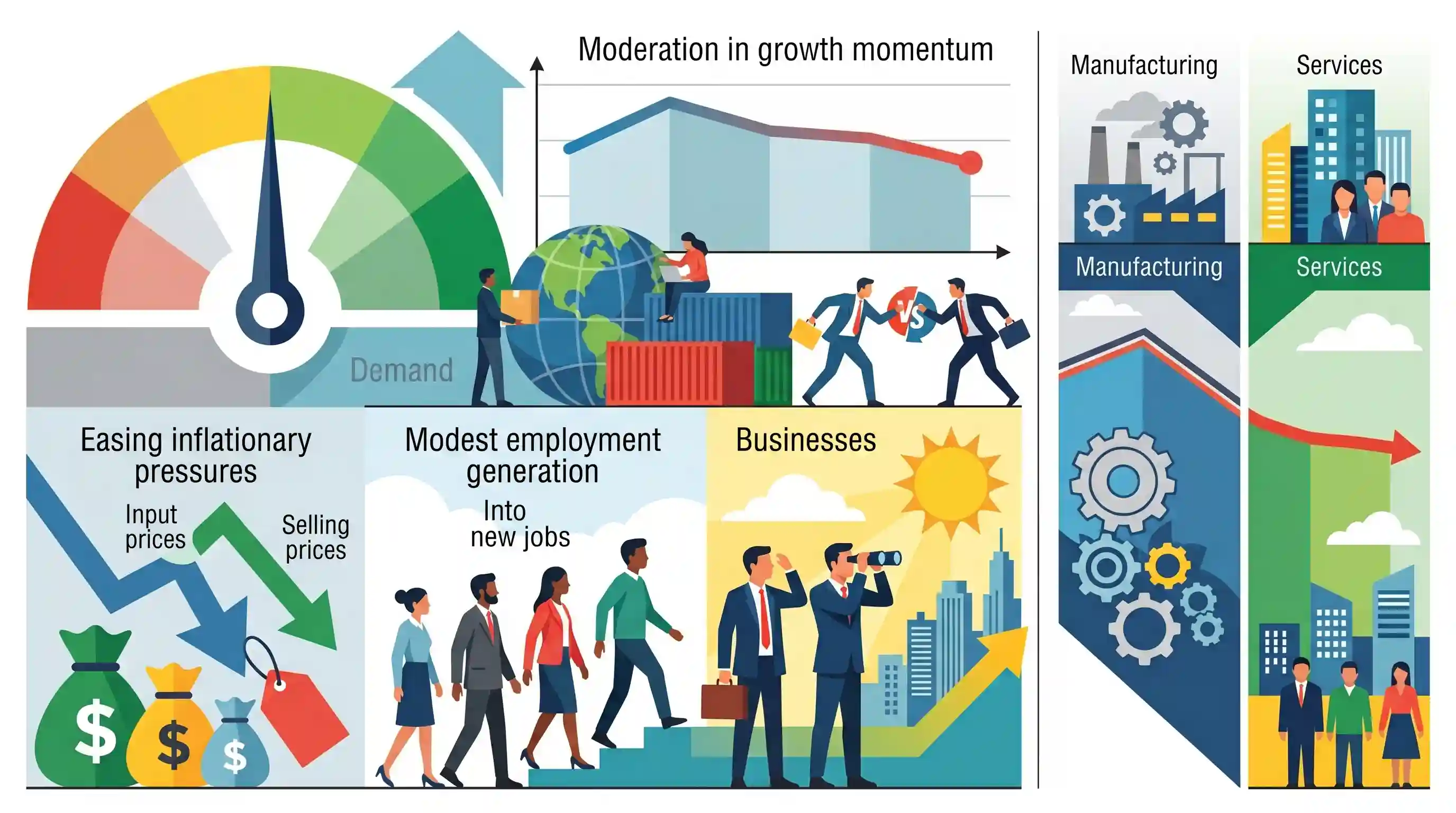
The HSBC India Services Purchasing Managers' Index (PMI) fell to 60.9 in September 2024 from a 15-year high of 62.9 in August, indicating a moderation in growth momentum. This deceleration was attributed to softer demand and intense international competition curbing new export orders. However, the sector remained in strong expansion territory (an index value above 50). A major positive development was the easing of inflationary pressures, with both input costs and selling prices growing at their slowest pace in several months. Employment generation continued at a modest rate, and businesses maintained high optimism about future growth prospects. The Composite PMI also dipped, reflecting a broader but still robust economic expansion across both the manufacturing and services sectors.
Key Points
- India's Services PMI (compiled by S&P Global) eased to 60.9 in September 2024, down from August's 15-year high of 62.9, signaling a slower but continued expansion.
- The moderation was driven by softer domestic demand and fierce international competition, leading to a slowdown in new export orders.
- Inflationary pressures eased significantly, with input cost and output charge inflation dropping to their lowest levels since March.
- Despite the slowdown, employment levels increased moderately, and business sentiment regarding the 12-month outlook remained highly optimistic due to anticipated efficiency gains and robust demand.
- The Composite PMI Output Index also slipped to a 10-month low of 61.0, reflecting a parallel cooling in both the manufacturing and services sectors.
Important Terms
Purchasing Managers' Index (PMI)

A survey-based indicator measuring the monthly change in business activity. A score above 50 signifies expansion, below 50 indicates contraction, and 50 denotes no change.
UPSC context
GS III (Economy); tested as a leading indicator of economic health and business cycle shifts before official GDP data.
Services PMI
A sectoral index tracking business conditions in service industries like finance and IT, based on variables like new orders, output, and employment.
UPSC context
GS III (Services Sector); essential for monitoring the largest component of India's GVA and its growth momentum.
Composite PMI
A single-figure measure of overall economic health, calculated as a weighted average of the manufacturing and services sector indices.
UPSC context
GS III (Macroeconomic Indicators); used to evaluate the broad performance of the private sector and its contribution to national output.
Services Sector
The tertiary sector of the economy providing intangible goods. It is India's dominant sector, contributing over 55% to GVA.
UPSC context
GS III (Indian Economy); critical for Mains discussions on sectoral growth patterns and employment elasticity.
Input Cost Inflation
Rising costs for raw materials, labor, and utilities used by businesses. High input costs can lead to cost-push inflation in the wider economy.
UPSC context
GS III (Inflation); key to understanding producer-level price pressures and their impact on corporate profitability.
S&P Global
A global financial information firm that compiles and publishes the PMI data for India, reflecting real-time business conditions.
UPSC context
Prelims (Important Indices); relevant for identifying the agencies responsible for releasing key high-frequency economic data.
Prelims Trap
The Services Purchasing Managers' Index (PMI) is published monthly by the National Statistical Office (NSO).
PMI is compiled by a private entity (S&P Global), not the NSO. NSO releases IIP and CPI. UPSC frequently swaps government and private data publishers to test institutional clarity.
Static Concepts Connected
What is the fundamental difference between PMI and IIP?
- Nature: PMI is a survey-based leading indicator of private sentiment, while IIP measures actual physical volume of production (lagging indicator).
- Publisher: PMI is compiled by private firms (S&P Global); IIP is published by the government's NSO (MoSPI).
- Coverage: PMI covers both manufacturing and services separately; IIP covers only the industrial sector (mining, manufacturing, electricity).
How does services sector inflation impact standard inflation indices?
- CPI inclusion: CPI captures services (health, education, transport) directly, making it highly sensitive to services input costs and wage hikes.
- WPI exclusion: WPI captures only goods (primary articles, fuel, manufactured products), entirely excluding the services sector from its basket.
Cross-Topic Patterns
Services dominance vs. Labour absorption
Despite driving >55% of India's GVA, services absorb only ~30% of the workforce. Strong PMI expansions rarely translate to proportional employment generation, keeping the 'jobless growth' debate central to Mains GS3.
Service inflation as a core driver
Sticky service costs (like transport and health) keep core inflation elevated. A softening in PMI input costs signals direct relief for the RBI's CPI-based inflation-targeting mandate.

Expect a comparative Prelims statement linking PMI, IIP, and CPI publishers, or a Mains probe into the services sector's jobless growth.
Linked PYQs · 3
Linked PYQs · 3
- 2021PrelimsGS1
With reference to Indian economy, demand-pull inflation can be caused/ increased by which of the following? 1. Expansionary policies 2. Fiscal stimulus 3. Inflation-indexing wages 4. Higher purchasing power 5. Rising interest rates Select the correct answer using the code given below.
- 2022MainsGS3
Economic growth in the recent past has been led by increase in labour productivity." Explain this statement. Suggest the growth pattern that will lead to creation of more jobs without compromising labour productivity.
- 2023PrelimsGS1
Consider the following statements: Statement-I: In the post-pandemic recent past, many Central Banks worldwide had carried out interest rate hikes. Statement-II: Central Banks generally assume that they have the ability to counteract the rising consumer prices via monetary policy means. Which one of the following is correct in respect of the above statements?
