Scientific Integrity and Research Ethics in Indian Higher Education
Source:The Hindu ↗
Why It Matters
Scientific integrity is crucial for fostering genuine innovation, global competitiveness, and public trust in India\'s R&D ecosystem. The systemic flaws highlighted in evaluating higher education and research, particularly within the NIRF, point to a pressing need for institutional reforms and ethical oversight in Indian academia.
Summary
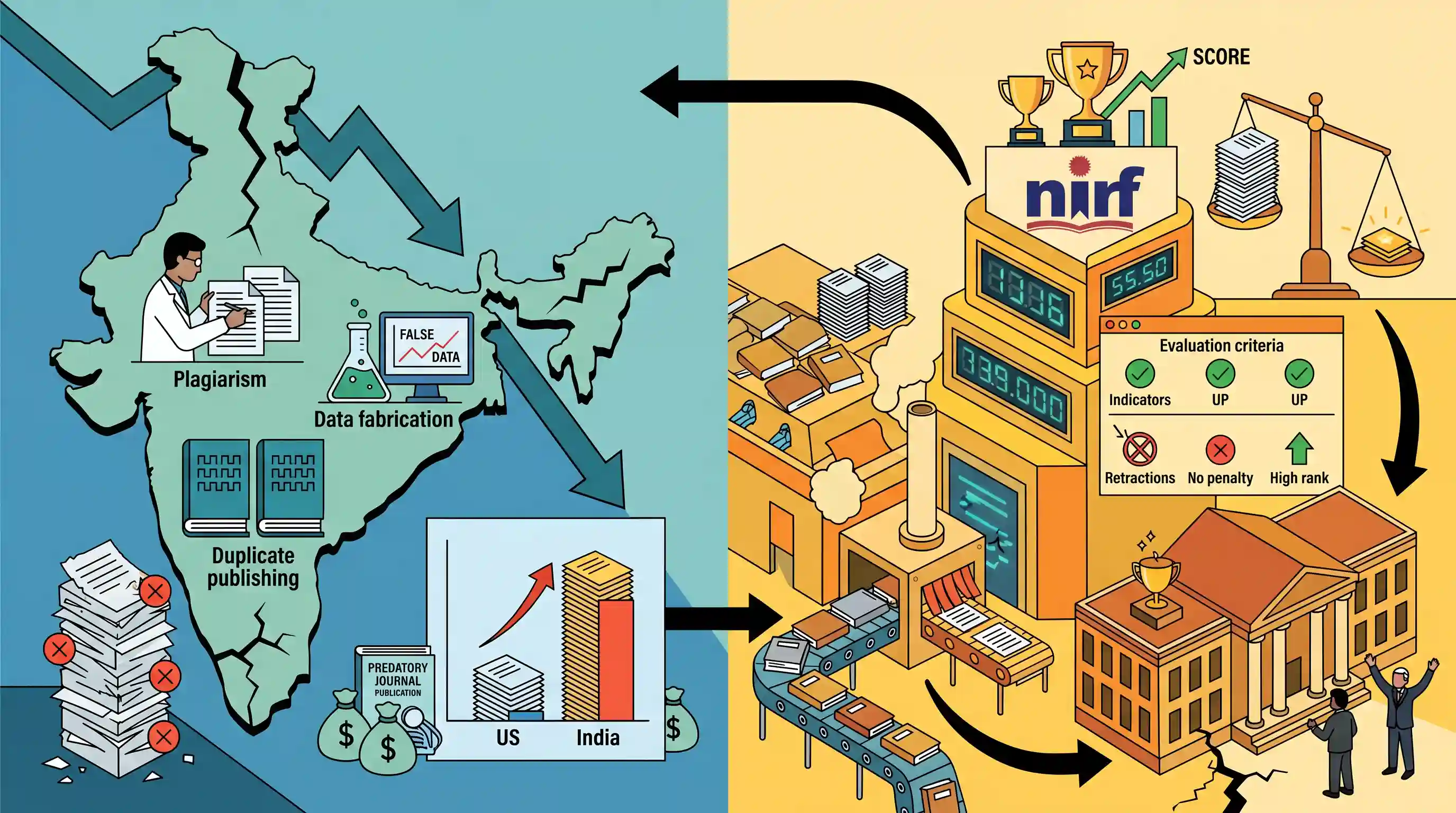
Renowned geneticist Partha P. Majumder has warned of an alarming decline in India\'s scientific integrity, noting that the country\'s research paper retraction rate now exceeds that of the US. Speaking at the Kerala Sasthra Sahitya Parishad conference, he attributed this crisis to the proliferation of predatory journals, plagiarism, data fabrication, and duplicate publishing. Dr. Majumder criticized institutional evaluation metrics, particularly the National Institutional Ranking Framework (NIRF), for incentivizing publication volume over quality and failing to penalize retractions, thereby allowing unethical research practices to flourish with institutional complicity.
Key Points
- Renowned geneticist Partha P. Majumder warned that India\'s scientific paper retraction rate has surpassed that of the US, highlighting a crisis in research rigour and ethics.
- Major violations compromising biomedical research include plagiarism (27%), data falsification and fabrication (27.5%), and duplicate publications (21%).
- Institutional metrics such as the National Institutional Ranking Framework (NIRF), H-index, and impact factors are driving researchers to prioritize the sheer volume of publications over quality.
- Academic institutions are often complicit in these unethical practices, as ranking frameworks do not penalize paper retractions.
Important Terms
National Institutional Ranking Framework (NIRF)

A methodology adopted by the Ministry of Education to rank higher education institutions in India based on teaching, research, and professional practices.
UPSC context
GS Paper II/III: Critical for analyzing educational quality and the impact of ranking metrics on research ethics.
National Institute of Biomedical Genomics (NIBMG)
India's first autonomous research institute dedicated to genomics, established under the Department of Biotechnology to focus on genetic causes of diseases.
UPSC context
GS Paper III: Represents India's advancements and infrastructure in biotechnology and precision medicine.
Kerala Sasthra Sahitya Parishad (KSSP)
A voluntary people's science movement in Kerala that promotes scientific temper and rationalism through public education and social activism.
UPSC context
GS Paper I/IV: A model for civil society engagement in promoting scientific literacy and social reform.
Predatory Journals
Exploitative journals that charge publication fees from authors without providing standard editorial services like peer review or quality control.
UPSC context
GS Paper III: A major challenge to the credibility and quality of India's research ecosystem.
Research Paper Retraction
The formal withdrawal of a published study from a journal due to unethical practices, data fabrication, or major errors.
UPSC context
GS Paper III/IV: An indicator of the declining integrity and ethical standards in scientific research.
Scientific Integrity
The commitment to ethical standards and honesty in scientific research, ensuring that data and results are credible and transparent.
UPSC context
GS Paper IV: Core value in professional ethics and its role in national scientific progress.
Prelims Trap
The NIRF ranking system includes a negative weightage parameter for retracted research papers to maintain scientific integrity.
This is false. The article explicitly highlights that NIRF fails to penalize retractions. Its heavy weightage on research counts volume and citations, inadvertently incentivizing malpractice.
Static Concepts Connected
What are the core parameters of the National Institutional Ranking Framework (NIRF)?
- Teaching & Learning: Focuses on student strength, faculty-student ratio, and financial resources.
- Research & Practice: Evaluates publications, quality of publications (via metrics like H-index), and patents. This parameter carries a significant 30% weightage.
- Outreach & Inclusivity: Measures student representation across states, women's representation, and inclusion of economically/socially challenged students.
- Graduation Outcomes: Assesses placement rates, higher studies enrollment, and university examination results.
What do H-index and Impact Factor measure in scientific research?
- H-index: Measures both productivity and citation impact of a specific researcher (e.g., an h-index of 10 means 10 papers have at least 10 citations each).
- Impact Factor: Measures the frequency with which the average article in a specific journal has been cited in a given year, indicating journal prestige.
- Predatory Journals: Exploitative open-access publishing business models that charge publication fees to authors without providing robust peer review and editorial services.
Cross-Topic Patterns
Academic Ethics & the Anusandhan NRF
The operationalization of the newly established Anusandhan National Research Foundation (ANRF) must address these systemic ethical flaws, not just funding deficits, to truly globalize Indian science.
GS IV: Metrics corrupting institutional ethics
The "publish or perish" culture serves as a classic GS IV case study of Goodhart's Law: when a measure (NIRF rank) becomes a target, it ceases to be a good measure.

Expect a multi-statement Prelims question on NIRF parameters and UGC's CARE list regulations aimed at curbing predatory journals.
Linked PYQs · 3
Linked PYQs · 3
- 2015MainsGS2
The quality of higher education in India requires major improvements to make it internationally competitive. Do you think that the entry of foreign educational institutions would help improve the quality of higher and technical education in the country? Discuss.
- 2023MainsGS4
What do you understand by 'moral integrity' and 'professional efficiency' in the context of corporate governance in India ? Illustrate with suitable examples.
- 2020MainsGS2
Institutional quality is a crucial driver of economic performance". In this context suggest reforms in Civil Service for strengthening democracy.
