India Satellite Supply Chain Import Dependency Challenges
Source:The Hindu ↗
Why It Matters
Understanding the structural vulnerabilities and import dependencies of India's space manufacturing sector is crucial for evaluating the goals of Atmanirbhar Bharat and commercial space policy reforms.
Summary
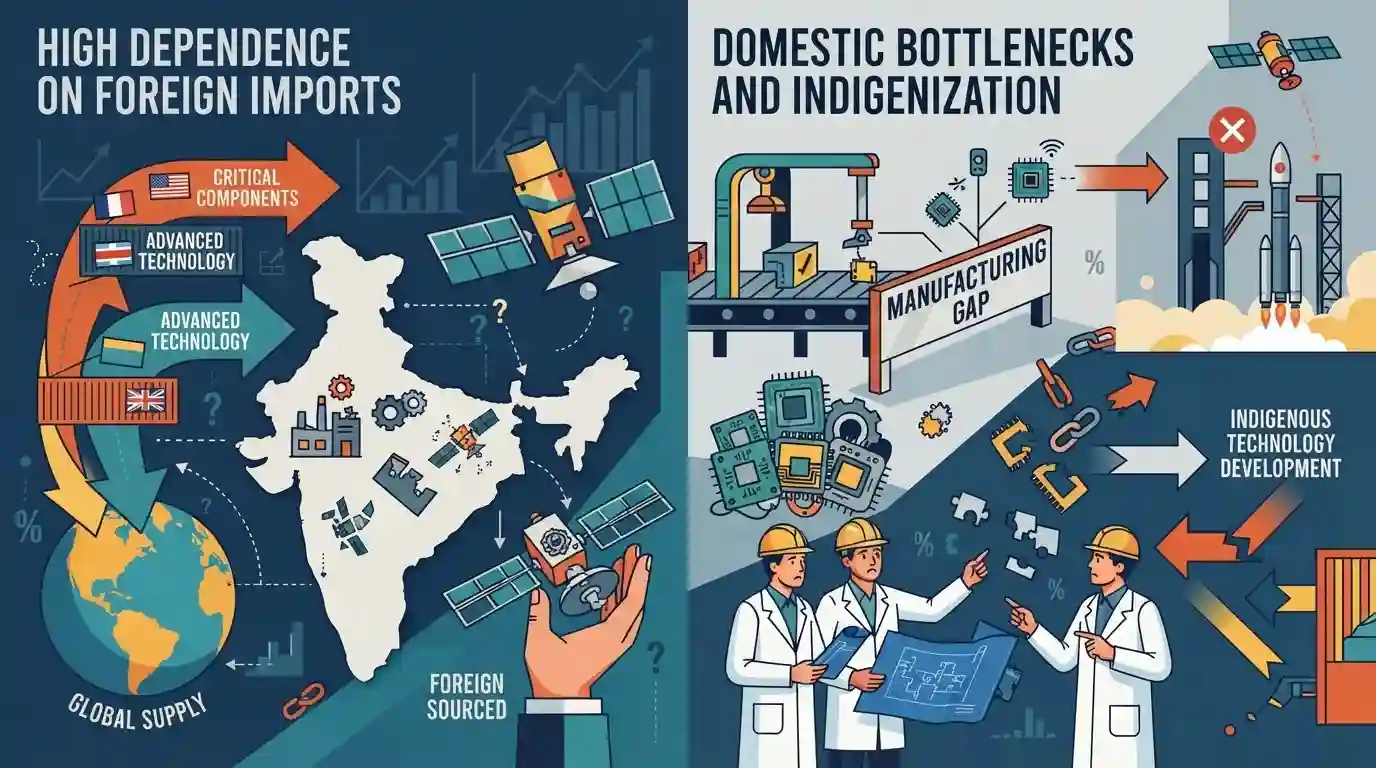
A report by India's space industry body reveals that the country's satellite supply chain remains highly dependent on foreign imports, highlighting significant bottlenecks in domestic manufacturing, component availability, and indigenous technology development for the commercial space sector.
Key Points
- India's satellite supply chain relies heavily on foreign imports for critical components like electronics, sensors, and structural materials.
- The space industry body highlights vulnerabilities in the domestic space manufacturing ecosystem despite recent private sector reforms.
- Scaling up indigenous component manufacturing is vital for India to achieve self-reliance and capture a larger share of the global commercial space market.
- High dependency on imports poses risks regarding supply chain disruptions, geopolitical constraints, and intellectual property access.
Important Terms
Indian Space Association (ISPA)

The apex national trade body representing India's private space industry, working as a bridge between the government, startups, and private players to advocate for policy reforms and commercial space growth.
UPSC context
UPSC GS Paper III (Science & Technology - Space). Tests understanding of private sector participation, space policy, and industry bottlenecks in India.
IN-SPACe
An autonomous nodal agency under the Department of Space acting as a single-window authority to promote, regulate, and supervise non-governmental entities in India's space sector.
UPSC context
UPSC GS Paper III (Science & Technology - Space). Important for questions on institutional reforms, public-private partnerships, and commercialization of space.
ISRO
India's national space agency responsible for planning, executing, and advancing space exploration, satellite development, and launch vehicle technologies under the Department of Space.
UPSC context
UPSC GS Paper III (Science & Technology - Space). Essential for questions on indigenous technology development, space missions, and technological self-reliance.
Static Concepts Connected
What is the institutional architecture governing India's space sector reforms?
- IN-SPACe Role: Apex body under Department of Space acting as a single-window agency for authorization of space activities by nongovernmental entities.
- NewSpace India Limited (NSIL): Commercial arm of ISRO focusing on marketing spin-off technologies, launching commercial payloads, and leasing transponders.
- Indian Space Association (ISPA): Premier industry representative body representing private and public space enterprises in India.
Cross-Topic Patterns
Space Commercialization & Defense Indigenization
IN-SPACe reforms mirror defense sector corporatization, testing private manufacturing capability against strict military-grade specifications.
Critical Tech Supply Chains & National Security
Heavy reliance on foreign sub-components directly impacts India's ability to maintain autonomous strategic reconnaissance and communication grids.

IN-SPACe private sector reforms vs. import dependency bottlenecks likely in a 2-statement Prelims or GS-3 manufacturing question.
Linked PYQs · 2
Linked PYQs · 2
- 2025MainsGS3
India aims to become a semiconductor manufacturing hub. What are the challenges faced by the semiconductor industry in India? Mention the salient features of the India Semiconductor Mission.
- 2026PrelimsGS1
Consider the following statements with regard to involvement of private entities in India's space programme : 1. The Indian National Space Promotion and Authorisation Centre (IN-SPACe) is an autonomous agency formed to facilitate participation of private entities. 2. Agnikul Cosmos launched the world's first flight using 3D-printed rocket engine. 3. Skyroot Aerospace has developed liquid fuel for GSLV. Which of the statements given above is/are correct ?
