India Rural Development Models in Global Diplomacy
Source:The Hindu ↗
Why It Matters
This topic beautifully connects domestic governance and rural development with International Relations. It highlights India's unique brand of soft power and its leadership role in the Global South, directly relevant to Mains GS2 questions on India's bilateral relations, development diplomacy, and the global relevance of Indian models like SHGs and DPI.
Summary
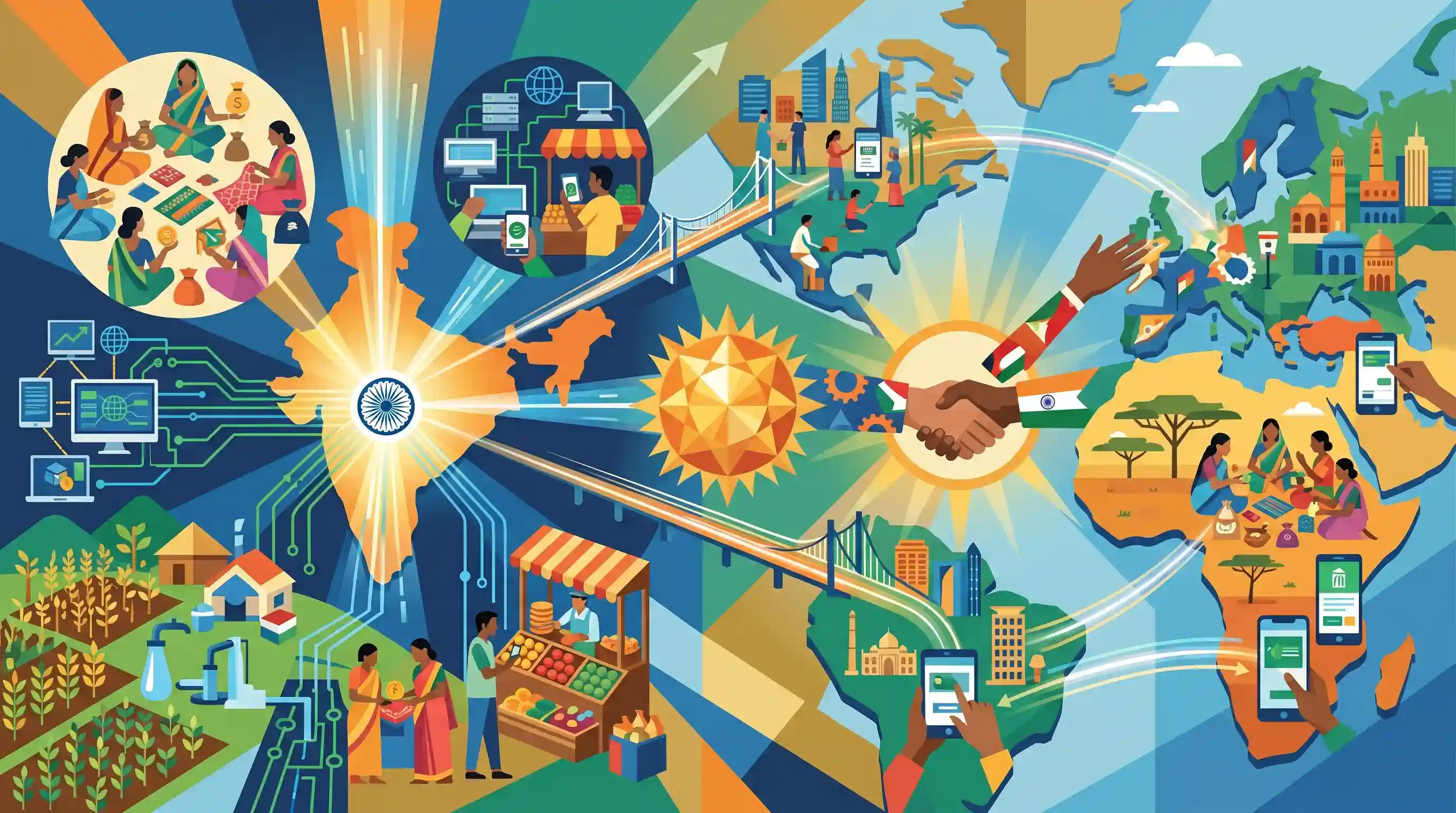
The article explores how India's proven domestic rural development models are shaping its foreign policy and development diplomacy. By exporting successful, scalable grassroots solutions—such as Self-Help Group (SHG) networks, poverty alleviation programs, and Digital Public Infrastructure (DPI)—India is strengthening its partnerships across the Global South. This approach enhances India's soft power and fosters genuine South-South cooperation through capacity building and mutual co-development, contrasting with traditional top-down foreign aid mechanisms.
Key Points
- India is increasingly utilizing its successful domestic rural development models as key tools for its international development diplomacy.
- Grassroots initiatives, such as Self-Help Groups (SHGs) and rural livelihood missions, are being shared with other developing nations as templates for poverty alleviation and women's empowerment.
- Cost-effective innovations, particularly India's Digital Public Infrastructure (DPI) which facilitates rural financial inclusion, form a core part of technology transfer to the Global South.
- This strategy reinforces South-South cooperation, shifting the narrative from a traditional donor-recipient dynamic to mutual co-development and long-term institutional partnerships.
Important Terms
Digital Public Infrastructure (DPI)

Shared digital systems like Aadhaar and UPI that provide foundational services at societal scale. Built on open standards, they enable secure, interoperable service delivery to foster financial inclusion and innovation.
UPSC context
GS-II/GS-III; tests India’s leadership in digital public goods and global digital governance.
Indian Technical and Economic Cooperation (ITEC)
A flagship 1964 program for capacity building in developing nations. It shares India’s technical expertise through training and projects, serving as a primary tool for South-South cooperation and diplomacy.
UPSC context
GS-II (International Relations); focuses on India’s development diplomacy and soft power.
Self-Help Groups (SHGs)
Informal voluntary associations, primarily of rural women, who pool savings to provide collateral-free credit to members. They promote self-employment, social empowerment, and collective action against grassroots issues.
UPSC context
GS-II (Social Justice); critical for understanding grassroots development and women-led financial inclusion.
National Rural Livelihoods Mission (NRLM)
A flagship scheme that aims to reduce poverty by organizing rural households into SHGs and providing them with credit, skills, and sustainable livelihood opportunities.
UPSC context
GS-II (Welfare Schemes); tests knowledge of institutional platforms for poverty alleviation.
Kudumbashree
Kerala’s women-led mission for poverty eradication, operating through a three-tier federated structure. It is globally recognized as a best-practice model for participatory democracy and decentralized development.
UPSC context
GS-II (Governance); highlights successful local self-government and women-centric grassroots models.
Prelims Trap
"ITEC is a newly launched initiative by India to export Digital Public Infrastructure and counter China."
ITEC is actually India's oldest flagship capacity-building program, instituted in 1964, long before modern digital diplomacy or China's BRI.
Static Concepts Connected
What is the SHG-Bank Linkage Programme (SBLP)?
- Origins: Launched by NABARD in 1992 as a pilot project to integrate informal rural savings groups with the formal banking sector.
- Mechanism: Provides collateral-free micro-credit to SHGs based on mutual trust, peer pressure, and group guarantee mechanisms.
- Diplomatic Utility: It acts as a sustainable, non-Western template for women-led financial inclusion, now heavily promoted in India's diplomacy.
What are the core pillars of India's Development Diplomacy?
- Capacity Building: Anchored by ITEC (1964), focusing on training, skill transfer, and capacity building for professionals in 160+ partner countries.
- Concessional Finance: Executed via Lines of Credit (LoCs) routed through EXIM Bank for developmental projects in the Global South.
- Technology Transfer: Exporting scalable, low-cost domestic innovations like Digital Public Infrastructure (DPI) to foster mutual co-development.
Cross-Topic Patterns
Digital Diplomacy + Soft Power
DPI (UPI/Aadhaar) has evolved from a domestic GS-3 Tech tool to a major GS-2 IR mechanism, differentiating India's soft power from Western conditional aid and Chinese debt-trap loans.
Kudumbashree's Global Footprint
Domestic SHG successes like Kerala's Kudumbashree and NRLM are no longer just internal policies; they are active diplomatic templates for poverty alleviation in African nations.

Expect a 2026 GS-2 Mains question linking India's domestic DPI/SHG successes to its emerging role as the Voice of the Global South.
Linked PYQs · 4
Linked PYQs · 4
- 2025MainsGS2
India-Africa digital partnership is achieving mutual respect, co-development and long-term institutional partnerships. Elaborate.
- 2020MainsGS2
Micro-Finance as an anti-poverty vaccine, is aimed at asset creation and income security of the rural poor in India". Evaluate the role of the Self Help Groups in achieving the twin objectives along with empowering women in rural India.
- 2017MainsGS2
The emergence of the Self-Help Groups (SHGs) in contemporary times points to the slow but steady withdrawal of the State from developmental activities." Examine the role of the SHGs in developmental activities and the measures taken by the Government of India to promote the SHGs.
- 2014MainsGS2
The penetration of Self Help Groups (SHGs) in rural areas in promoting participation in development programmes is facing socio-cultural hurdles. Examine.
