National Security Strategies Conference and Internal Security
Source:The Hindu ↗
Why It Matters
The Home Minister's address directly aligns with GS3 internal security topics. It highlights official priorities and countermeasures against LWE, narco-terrorism, terror financing, and the specific challenge of encrypted messaging apps, which are highly testable in Mains.
Summary
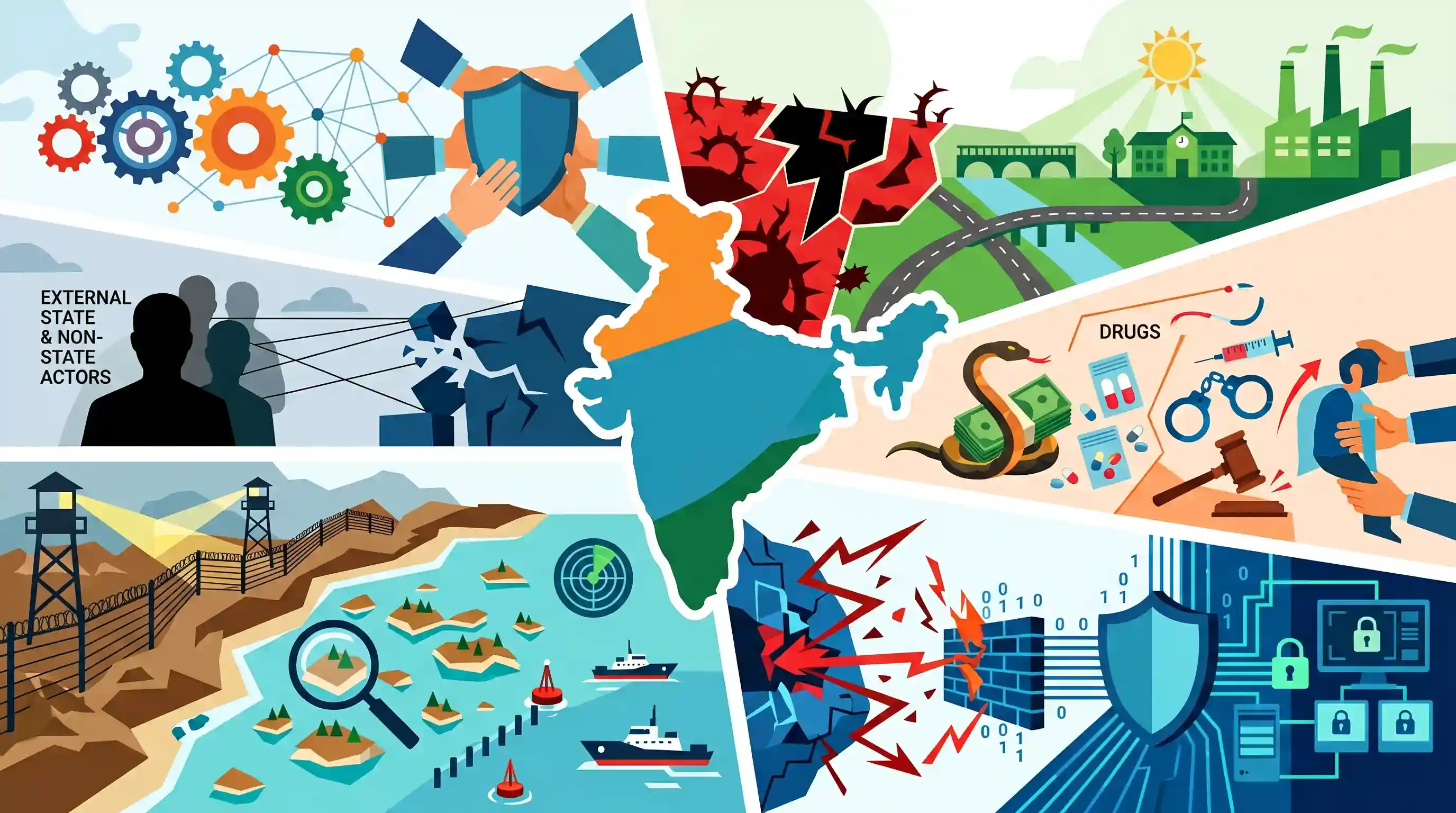
At the 8th National Security Strategies (NSS) Conference, Union Home Minister Amit Shah underscored that India's growing stature brings complex national security challenges. He advocated for seamless coordination between Central and State agencies under the motto 'Suraksha, Sajagta and Samanvay'. Key priorities include strict action against major drug cartels and the extradition of narco-offenders, eliminating Left-Wing Extremism (LWE) through robust development schemes, and addressing modern threats such as encrypted communications by terror groups, terror financing, and securing smaller seaports and uninhabited islands.
Key Points
- Home Minister Amit Shah highlighted that India's rising global stature will lead to dynamic national security challenges given its geopolitical neighborhood.
- He emphasized the motto 'Suraksha, Sajagta and Samanvay' (Security, Alertness, and Coordination) and called for homogenous teams of Central and State agencies.
- Focus areas include dismantling large drug cartels, pursuing the extradition of narco-offenders, and making police stations the focal point of intelligence.
- In Left-Wing Extremism (LWE) affected regions, the strategy combines security operations with grassroots development, coordinating around 300 Central and State schemes.
- Emerging threats discussed include the misuse of encrypted communication apps by terror networks, terror financing, and vulnerabilities of smaller seaports and uninhabited islands.
Important Terms
National Security Strategies (NSS) Conference

An annual forum organized by the Intelligence Bureau for senior police leadership and experts to deliberate on emerging security challenges and formulate collaborative, technology-driven solutions.
UPSC context
GS Paper III: Institutional mechanisms and inter-agency coordination for managing internal security.
Left-Wing Extremism (LWE)
A Maoist-inspired armed insurgency in India's 'Red Corridor' that seeks to overthrow the state through violence, rooted in socio-economic disparities and tribal displacement.
UPSC context
GS Paper III: Internal security challenges, developmental gaps, and the 'SAMADHAN' strategy.
Terror Financing
The provision of funds to individual terrorists or organizations via illicit channels like hawala, narcotics, and counterfeit currency to sustain recruitment, training, and attacks.
UPSC context
GS Paper III: Financial security, role of FATF, and linkages between organized crime and terrorism.
Narco-Terrorism
The symbiotic nexus between drug trafficking and terrorism, where proceeds from the narcotics trade are utilized to fund insurgent activities and destabilize the state.
UPSC context
GS Paper III: Organized crime, border management, and the 'Golden Crescent/Triangle' influence.
Coastal Security
A multi-layered protection framework involving the Indian Navy, Coast Guard, and Marine Police to safeguard India's 7,516 km coastline from infiltration and maritime threats.
UPSC context
GS Paper III: Border management and security challenges in maritime domains and uninhabited islands.
Suraksha, Sajagta and Samanvay
A motto meaning 'Security, Alertness, and Coordination' used to emphasize the need for seamless synergy between Central and State agencies in addressing national security.
UPSC context
GS Paper III: Internal security; highlights federal cooperation and 'Team India' approach in law enforcement.
Prelims Trap
"All seaports, including non-major seaports, are exclusively regulated by the Central government for national security."
Major ports are under the Union List. Non-major ports are in the Concurrent List, governed by State Maritime Boards, which creates coastal security vulnerabilities due to varied state capacities.
Static Concepts Connected
How are seaports categorized and administered in India?
- Major Ports: Governed by the Central Government under the Union List (Major Port Authorities Act, 2021).
- Non-Major Ports: Placed in the Concurrent List, administered and regulated by respective State Maritime Boards.
What is India's three-tier Coastal Security Architecture?
- Marine Police: State Marine Police forces patrol shallow coastal waters and inland water bodies up to 12 nautical miles.
- Coast Guard: Patrols the territorial waters and the Exclusive Economic Zone (12 to 200 nautical miles).
- Indian Navy: Responsible for overall maritime security, deeper water patrols, and operations beyond 200 nautical miles.
Cross-Topic Patterns
Encryption (S&T) + Law Enforcement
Terror networks using encrypted apps brings GS3 cyber security into direct conflict with GS2 governance, specifically the 'traceability' mandate of the Information Technology Rules 2021.
Asymmetric federalism in policing
Amit Shah's call for homogenous Central-State agencies touches GS2 Federalism. 'Police' is a State subject, requiring Central coordination mechanisms (like NIA and SRE schemes) to bridge security gaps.

Expect a GS3 Mains question in 2026 linking non-major port vulnerabilities with narco-terrorism and the need for a federal security grid.
Linked PYQs · 5
Linked PYQs · 5
- 2020MainsGS3
What are the determinants of left-wing extremism in Eastern part of India? What strategy should Government of India, civil administration and security forces adopt to counter the threat in the affected areas?
- 2022MainsGS3
Naxalism is a social, economic and developmental issue manifesting as a violent internal security threat. In this context, discuss the emerging issues and suggest a multilayered strategy to tackle the menace of Naxalism.
- 2025MainsGS3
The Government of India recently stated that Left Wing Extremism (LWE) will be eliminated by 2026. What do you understand by LWE and how are the people affected by it? What measures have been taken by the government to eliminate LWE?
- 2022MainsGS3
Discuss the types of organised crimes. Describe the linkages between terrorists and organised crime that exist at the national and transnational levels.
- 2024MainsGS3
Explain how narco-terrorism has emerged as a serious threat across the country. Suggest suitable measures to counter narco-terrorism.
