Electronic waste management gaps and extended producer responsibility
Source:The Hindu ↗
Why It Matters
E-waste management is a critical environmental challenge for India. The UPSC frequently tests concepts like Extended Producer Responsibility, the R2 Code, and circular economy principles in both Prelims and Mains (GS3 Environment). Understanding the gaps in the E-Waste Rules 2022 and the socio-economic dynamics of the informal recycling sector is crucial for policy analysis.
Summary
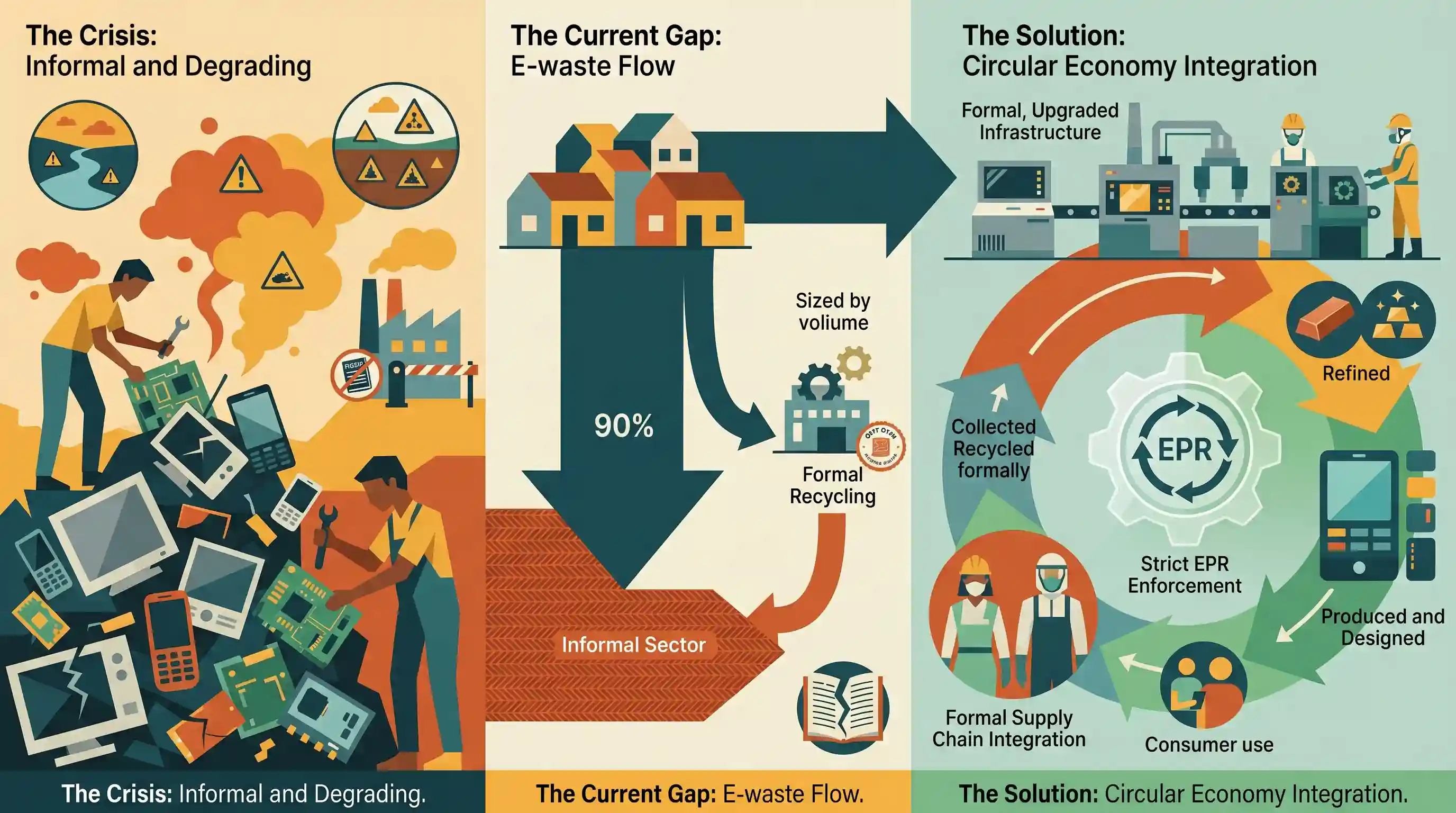
India faces an escalating e-waste crisis that demands an overhaul of its current management strategies. Despite the existence of the E-Waste (Management) Rules, 2022, which mandate Extended Producer Responsibility (EPR), the overwhelming majority of electronic waste continues to flow into the informal sector. Unscientific recycling practices in this sector pose severe risks to both human health and the environment. To effectively address this issue, the article emphasizes the necessity of moving beyond mere regulatory compliance to genuinely integrating circular economy principles. This entails upgrading recycling infrastructure, formally integrating informal workers into safe supply chains, and ensuring strict enforcement of EPR obligations.
Key Points
- India is grappling with a rapidly growing volume of e-waste, driven by increasing digital penetration and shorter lifespans of electronic devices.
- While the E-Waste (Management) Rules, 2022 introduced a stringent Extended Producer Responsibility (EPR) framework, enforcement and implementation challenges remain significant.
- The informal sector dominates e-waste processing in India, utilizing unsafe and unscientific extraction methods that lead to severe environmental pollution and health hazards.
- There is a critical need to transition towards a circular economy, which involves better product design for recyclability, formalizing the informal sector, and establishing robust collection and recycling infrastructure.
Important Terms
E-Waste (Management) Rules, 2022

Notified by MoEFCC, these regulations mandate registration for producers, recyclers, and refurbishers on a central portal, replacing the previous authorization system to ensure scientific disposal and resource recovery.
UPSC context
GS-3: Environment; essential for questions on legislative frameworks for pollution control and waste-to-wealth initiatives.
Extended Producer Responsibility (EPR)
A policy approach where producers bear financial and physical responsibility for the post-consumer stage of a product's life cycle, including collection, recycling, and environmentally sound disposal.
UPSC context
GS-3: Environment; often tested in Prelims (e.g., 2019) and Mains regarding corporate environmental accountability.
Circular Economy
An economic model designed to eliminate waste by keeping products and materials in use through repair, reuse, and recycling, transitioning away from the linear 'take-make-dispose' model.
UPSC context
GS-3: Economy/Environment; crucial for discussing sustainable development, resource efficiency, and India's 'LiFE' movement.
Informal Sector
The unorganized segment—often comprising scrap dealers and manual dismantlers—that processes ~90-95% of India's e-waste using hazardous, unscientific methods like acid leaching and open burning.
UPSC context
GS-3: Environment/Social Justice; tested regarding the 'just transition' of workers and health impacts of pollution.
Central Pollution Control Board (CPCB)
A statutory body under MoEFCC that implements e-waste rules by managing the EPR registration portal, setting recycling targets, and determining environmental compensation for non-compliance.
UPSC context
GS-2: Governance; GS-3: Environment; tests knowledge of regulatory bodies and their enforcement powers under the Environment Protection Act.
Ministry of Environment, Forest and Climate Change (MoEFCC)
The nodal ministry responsible for planning, promoting, and coordinating India's environmental policies and notifying rules related to hazardous waste and climate change.
UPSC context
GS-2: Governance; frequently appears in questions regarding the executive role in environmental standard-setting.
Prelims Trap
"Solar photovoltaic modules and panels are exempt from E-Waste Rules as they fall under renewable energy frameworks."
The E-Waste (Management) Rules, 2022 specifically expanded their scope to include solar photo-voltaic modules and panels under the strict EPR framework for the first time.
Static Concepts Connected
What is Extended Producer Responsibility (EPR) under Indian environmental law?
- Core Principle: EPR shifts the physical and/or financial responsibility for waste management upstream to the producer, moving away from local municipalities.
- Market Mechanism: The E-Waste Rules 2022 introduced a digital portal for EPR certificates, allowing producers to buy/sell certificates to meet their statutory recycling targets.
- Nodal Agency: The Central Pollution Control Board (CPCB) regulates EPR implementation, oversees the trading portal, and monitors producer compliance.
Which toxic heavy metals are most commonly released from unscientific e-waste recycling?
- Lead (Pb): Found in cathode ray tubes and solder; causes neurological damage and impairs the central nervous system.
- Mercury (Hg): Used in flat-screen monitors and switches; highly toxic to the brain and kidneys, famous for causing Minamata disease.
- Cadmium (Cd): Present in chip resistors and older rechargeable batteries; accumulates in kidneys and severely degrades bone structure (Itai-Itai disease).
Cross-Topic Patterns
Urban Mining and Critical Mineral Security
India's green transition hinges on critical minerals. Urban mining of e-waste offers a vital domestic secondary source for lithium, cobalt, and rare earths to reduce import dependence.
Just Transition for the Informal Economy
E-waste processing is 90% informal. Modern environmental policies must incorporate a 'just transition' framework to formalize these workers into safe supply chains without destroying their livelihoods.

E-Waste Rules 2022 (focusing on solar panel inclusion & EPR certificate trading) + 'Urban Mining' is highly probable for 2026 Prelims.
Linked PYQs · 4
Linked PYQs · 4
- 2019PrelimsGS1
In India, 'extended producer responsibility' was introduced as an important feature in which of the following?
- 2021PrelimsGS1
'R2 Code of Practices' constitutes a tool available for promoting the adoption of
- 2025PrelimsGS1
Consider the following statements : Statement I: Circular economy reduces the emissions of greenhouse gases. Statement II: Circular economy reduces the use of raw materials as inputs. Statement III : Circular economy reduces wastage in the production process. Which one of the following is correct in respect of the above statements?
- 2019PrelimsGS1
As per the Solid Waste Management Rules, 2016 in India, which one of the following statements is correct?
