National Assessment of Floating Solar Potential in Indian Reservoirs
Source:The Hindu ↗
Why It Matters
Floating solar is emerging as a critical component in India's energy transition strategy. It directly addresses the land constraint issue for renewable expansion, presenting a highly relevant case study for Mains GS-3 (Infrastructure/Energy) and potential factual questions for Prelims on leading states or major operational parks like Omkareshwar.
Summary
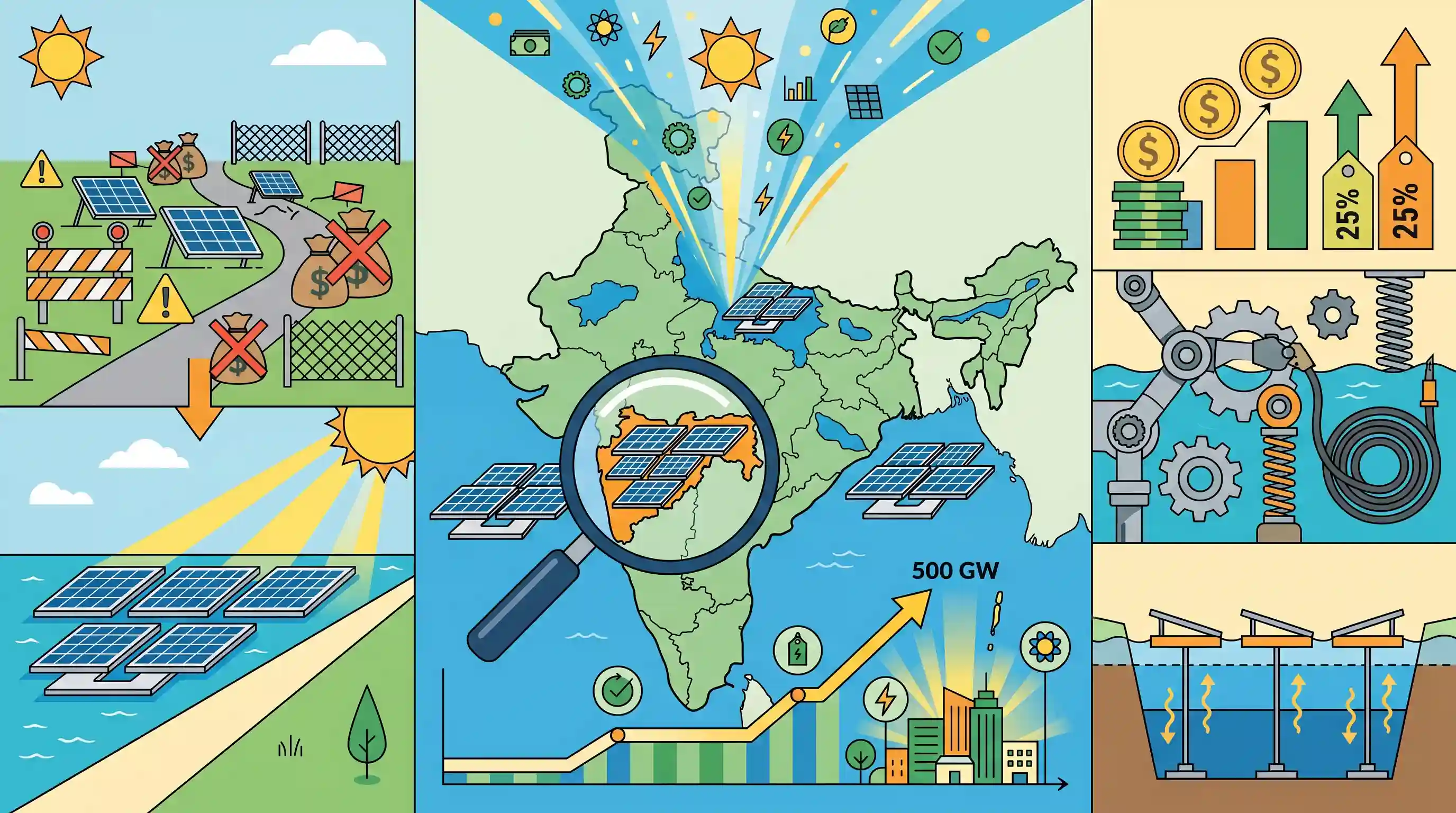
India's first national assessment by the National Institute of Solar Energy (NISE) reveals that the country's water reservoirs have the potential to host 102 GW of floating solar capacity. This 'land-neutral' approach is crucial for achieving India's target of 500 GW of non-fossil electricity capacity by 2030, bypassing the hurdles and high costs of land acquisition for ground-mounted solar parks. Maharashtra leads the nation with 16.28 GW of potential capacity. While floating solar presents a spatially efficient alternative to traditional arrays, it faces challenges such as 25% higher upfront costs, engineering complexities regarding float joints and electric cables, and buoyancy issues driven by changing water levels.
Key Points
- India's water reservoirs hold a potential of 102 GW for floating solar power capacity, per the first national assessment conducted by the National Institute of Solar Energy (NISE).
- Floating solar PV installations can mitigate the intense land acquisition challenges associated with ground-mounted solar plants, which require 3 to 4 times the area per MW.
- Geospatial analysis filtered suitable water bodies by requiring a minimum area of 10 hectares, water presence for at least 11 months, depths of 3-30 meters, and proximity to substations and roads.
- Maharashtra has the highest theoretical floating solar potential (16.28 GW), followed by Madhya Pradesh, Karnataka, Odisha, and Telangana.
- The Omkareshwar floating solar park in Madhya Pradesh is currently the country’s largest at 278 MW, with plans to scale up to 600 MW.
- Operational challenges for floating solar include higher capital costs (up to 25% more than ground-mounted), structural stress on float joints, and maintaining buoyancy amid fluctuating water levels.
Important Terms
Panchamrit targets

Five climate commitments by India at COP26, including 500 GW non-fossil capacity and 50% renewable energy share by 2030, and reaching net-zero emissions by 2070.
UPSC context
GS Paper III (Environment/Energy); tests knowledge of India's international climate commitments and energy transition roadmap.
Floating Solar Photovoltaics (FSPV)
A solar power technology where photovoltaic panels are mounted on floating structures on water bodies (reservoirs, lakes), offering higher efficiency due to water's cooling effect.
UPSC context
GS Paper III (Infrastructure/Energy); relevant for questions on renewable energy innovations and land-use efficiency.
Land-neutral approach
A development strategy that utilizes existing water surfaces or structures instead of acquiring new land, bypassing high costs and conflicts associated with land use.
UPSC context
GS Paper III (Infrastructure); addresses the critical bottleneck of land acquisition in large-scale infrastructure and renewable projects.
National Institute of Solar Energy (NISE)
An autonomous apex R&D institution under the MNRE focused on solar research, technology development, testing, certification, and national potential assessments.
UPSC context
GS Paper III (Science & Technology); tests awareness of institutional frameworks driving India's solar energy mission.
Ministry of New and Renewable Energy (MNRE)
The nodal ministry responsible for policy formulation, scheme implementation (e.g., PM-KUSUM), and international cooperation in India's new and renewable energy sector.
UPSC context
GS Paper II (Governance) & GS Paper III (Energy); central to governance and policy-making for energy security.
Prelims Trap
Rajasthan possesses the highest theoretical floating solar potential in India.
While Rajasthan leads in overall and ground-mounted solar capacity due to vast wastelands, Maharashtra holds the highest floating solar potential due to its numerous dams.
Static Concepts Connected
What are the specific technical and ecological advantages of Floating Solar PV (FSPV)?
- Cooling Effect: The underlying water naturally cools the solar panels, preventing heat-induced degradation and increasing overall electricity conversion efficiency compared to ground arrays.
- Evaporation Control: Covering water surfaces with solar panels significantly reduces evaporation, conserving critical water levels in drought-prone multipurpose reservoirs.
- Grid Optimization: Deploying panels on existing hydroelectric reservoirs allows FSPV projects to plug directly into pre-existing grid-evacuation and transmission infrastructure, lowering costs.
What are the 2030 targets under India's Panchamrit climate strategy?
- Capacity Building: Increase the country's non-fossil energy capacity to 500 GW.
- Energy Mix: Meet 50% of the nation's energy requirements from renewable energy sources.
- Emission Reduction: Reduce the total projected carbon emissions by one billion tonnes from now onwards till 2030.
- Carbon Intensity: Reduce the carbon intensity of its economy by less than 45 percent.
Cross-Topic Patterns
FSPV + Multipurpose Reservoirs
Leveraging existing dams for floating solar creates hybrid hydro-solar models, optimizing existing grid evacuation infrastructure and balancing seasonal power variability between monsoon and summer months.
Land Acquisition vs. RE Targets
The push for 'land-neutral' solar directly bypasses protracted delays under the LARR Act, avoiding the socio-economic displacement conflicts that frequently stall mega ground-mounted solar parks.

A 2026 Prelims question will likely contrast geographical potential: matching Rajasthan for ground-solar vs. Maharashtra for floating-solar.
Linked PYQs · 4
Linked PYQs · 4
- 2022MainsGS3
Do you think India will meet 50 percent of its energy needs from renewable energy by 2030 ? Justify your answer. How will the shift of subsidies from fossil fuels to renewables help achieve the above objective ? Explain.
- 2020MainsGS3
Describe the benefits of deriving electric energy from sunlight in contrast to the conventional energy generation. What are the initiatives offered by our Government for this purpose?
- 2022PrelimsGS1
Consider the following statements: 1. Gujarat has the largest solar park in India. 2. Kerala has a fully solar powered International Airport. 3. Goa has the largest floating solar photovoltaic project in India. Which of the statements given above is/are correct?
- 2018MainsGS3
“Access to affordable, reliable, sustainable and modern energy is the sine qua non to achieve Sustainable Development Goals (SDGs).” Comment on the progress made in India in this regard.
