India R and D Funding Shortfall and Scientific Talent Absorption
Source:The Hindu ↗
Why It Matters
Addresses the critical gap between human capital generation in STEM fields and their economic absorption. It highlights systemic challenges in India's R&D funding and brain drain, essential for answers on innovation, employment, and demographic dividend in GS2 and GS3.
Summary
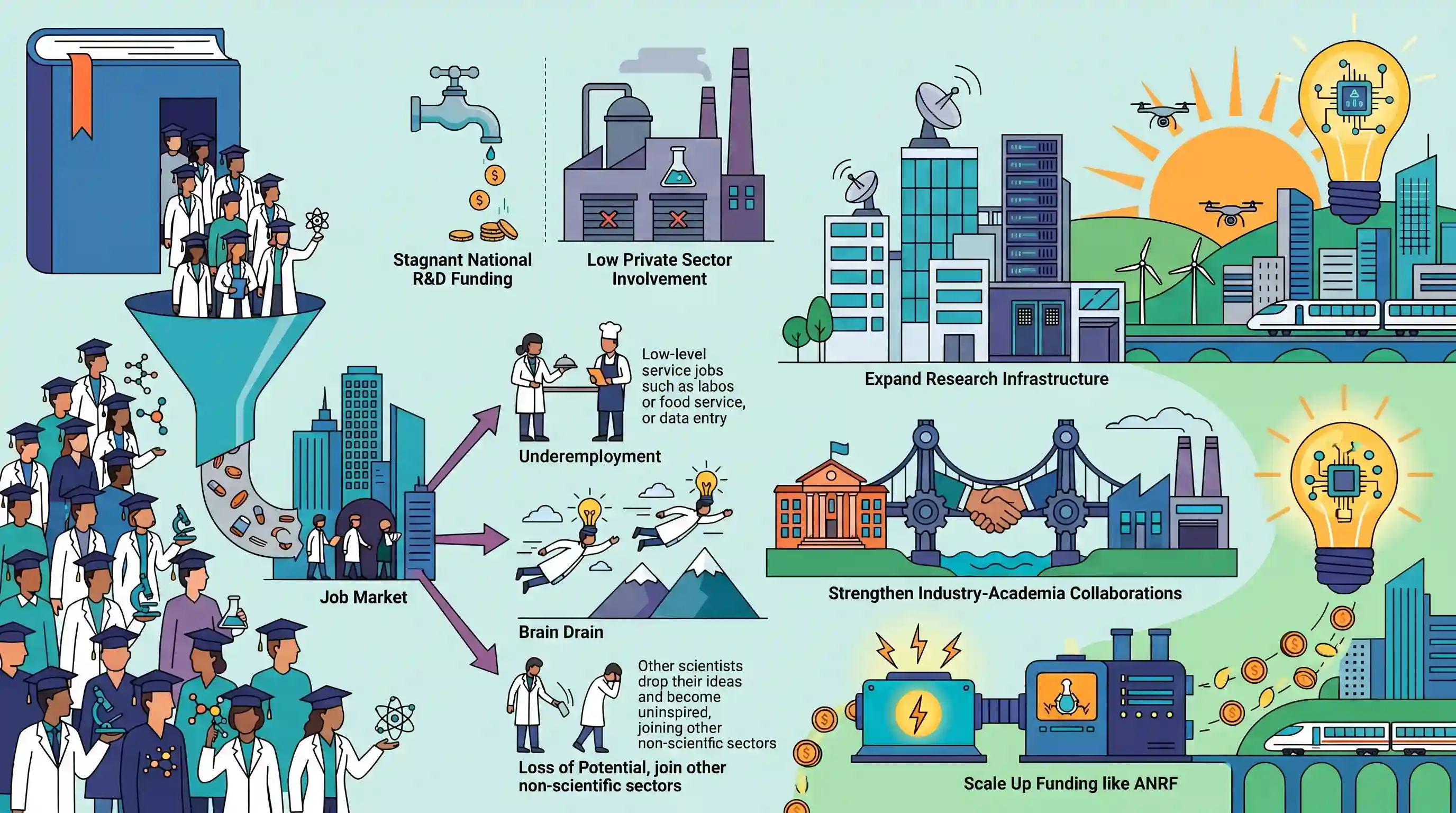
The article highlights India's 'research paradox,' wherein the country's higher education system is producing a high volume of STEM graduates and PhDs, but the job market and research ecosystem cannot absorb them. This mismatch results in widespread underemployment, a persistent brain drain, and the loss of scientific potential to non-research sectors. The root causes include stagnant national R&D funding (around 0.65% of GDP) and a lack of robust private sector involvement in scientific research. To leverage its demographic dividend and transition to an innovation-led economy, India must expand its research infrastructure, strengthen industry-academia collaborations, and scale up funding mechanisms like the Anusandhan National Research Foundation (ANRF).
Key Points
- India is producing STEM graduates and PhDs at a rapid pace, but the domestic research and industrial ecosystem lacks the capacity to absorb this scientific talent.
- The "research paradox" leads to underemployment among highly qualified professionals, exacerbating brain drain and pushing scientists into non-research roles.
- A major underlying cause is the chronically low expenditure on Research and Development (R&D), which remains stagnant at around 0.65% of GDP, with insufficient participation from the private sector.
- Bridging this gap requires structural reforms, better industry-academia linkage, and effective implementation of initiatives like the Anusandhan National Research Foundation (ANRF) to create viable scientific careers.
Important Terms
Anusandhan National Research Foundation (ANRF)

A statutory body established by the ANRF Act 2023 to provide high-level strategic direction for scientific research, enhance private sector R&D participation, and build research capacity in Indian universities.
UPSC context
GS3 (Science & Tech); tests institutional reforms and funding mechanisms for achieving a self-reliant, innovation-led economy.
Gross Expenditure on Research and Development (GERD)
The total R&D spending in a country across public and private sectors. India’s GERD has stagnated at approximately 0.64–0.65% of GDP, significantly lower than global leaders like South Korea.
UPSC context
GS3 (Economy/S&T); evaluates India’s innovation capacity and investment gaps crucial for transition to a knowledge-based economy.
National Education Policy (NEP) 2020
A 2020 policy framework aiming to transform India into a 'global knowledge superpower' through multidisciplinary learning, holistic education, and the establishment of an apex National Research Foundation.
UPSC context
GS2 (Education/Human Resources); evaluates policy vision for human capital development and alignment with Sustainable Development Goal 4.
STEM Education
An interdisciplinary approach to education in Science, Technology, Engineering, and Mathematics. India produces the world's second-largest volume of STEM graduates but faces high underemployment and migration rates.
UPSC context
GS2 (Human Resources) & GS3 (S&T); relates to the demographic dividend, skill-mismatch, and global competitiveness.
Brain Drain
The emigration of highly skilled professionals (scientists, engineers, doctors) to advanced economies, resulting in a loss of intellectual capital and public investment in education for the home country.
UPSC context
GS2 (Diaspora) & GS3 (Human Capital); examines loss of talent and the need for 'brain gain' through repatriation schemes.
Indian Institutes of Technology (IITs)
A group of premier public technical universities designated as 'Institutes of National Importance,' serving as the cornerstone of India's engineering education and scientific research output.
UPSC context
GS3 (S&T/Indigenization); benchmarks India's top-tier research capabilities and their role in global technological leadership.
Prelims Trap
"The private sector drives the majority of Gross Expenditure on Research and Development (GERD) in India."
Aspirants confuse global innovation trends (where the private sector contributes >70% to R&D) with India, where the government/public sector bears the vast majority of R&D costs.
Static Concepts Connected
What are the key features of the Anusandhan National Research Foundation (ANRF) Act?
- Objective: Replaces the Science and Engineering Research Board (SERB) to seed, grow, and promote R&D across universities and colleges.
- Funding Model: Allocates ₹50,000 crore over 5 years (2023-28), aiming to raise over 70% from non-government and private industry sources.
- Leadership: The Prime Minister acts as the ex-officio President of its Governing Board.
What characterizes India's Gross Expenditure on R&D (GERD)?
- Stagnant Ratio: Has stagnated around 0.65% to 0.7% of GDP for over a decade, well below the global average and innovation-driven economies like South Korea (4.8%).
- Public Dominance: Driven largely by central government entities (DRDO, ISRO, ICAR, CSIR), causing a massive gap in applied, industry-led commercial research.
Cross-Topic Patterns
Jobless Growth & STEM Brain Drain
The S&T 'research paradox' directly fuels GS3 economy debates on jobless growth and demographic disaster, as unabsorbed high-skill human capital is forced to emigrate or take non-research roles.
NEP 2020 & University Research
NEP’s vision for multidisciplinary research universities relies heavily on ANRF's success in democratizing R&D funding, shifting it from a few premier institutes (like IITs) to state universities.

Expect a GS3 Mains question evaluating ANRF’s reliance on private funding (70%) against India's historically low private R&D participation.
Linked PYQs · 3
Linked PYQs · 3
- 2014MainsGS3
Scientific rescarch in Indian universities is declining, because a career in science is not as attractive as are business professions, engineering or administration, and the universities are becoming consumer-oriented. Critically comment.
- 2014MainsGS3
While we flaunt India's demographic dividend, we ignore the dropping rates of employability. What are we missing while doing so? Where will the jobs that India desperately needs come from? Explain.
- 2023MainsGS2
Skill development programmes have succeeded in increasing human resources supply to various sectors. In the context of the statement analyse the linkages between education, skill and employment.
