India R and D Spending Crosses 0.8 Percent of GDP
Source:The Hindu ↗
Why It Matters
GERD as a percentage of GDP is a critical macro-indicator of a nation's innovation capacity and economic trajectory. India’s historical struggle with low private sector investment in R&D has been repeatedly highlighted in Economic Surveys. This data reveals a turning point, providing crucial evidence for GS3 answers on science policy, indigenization of technology, and resource mobilization.
Summary
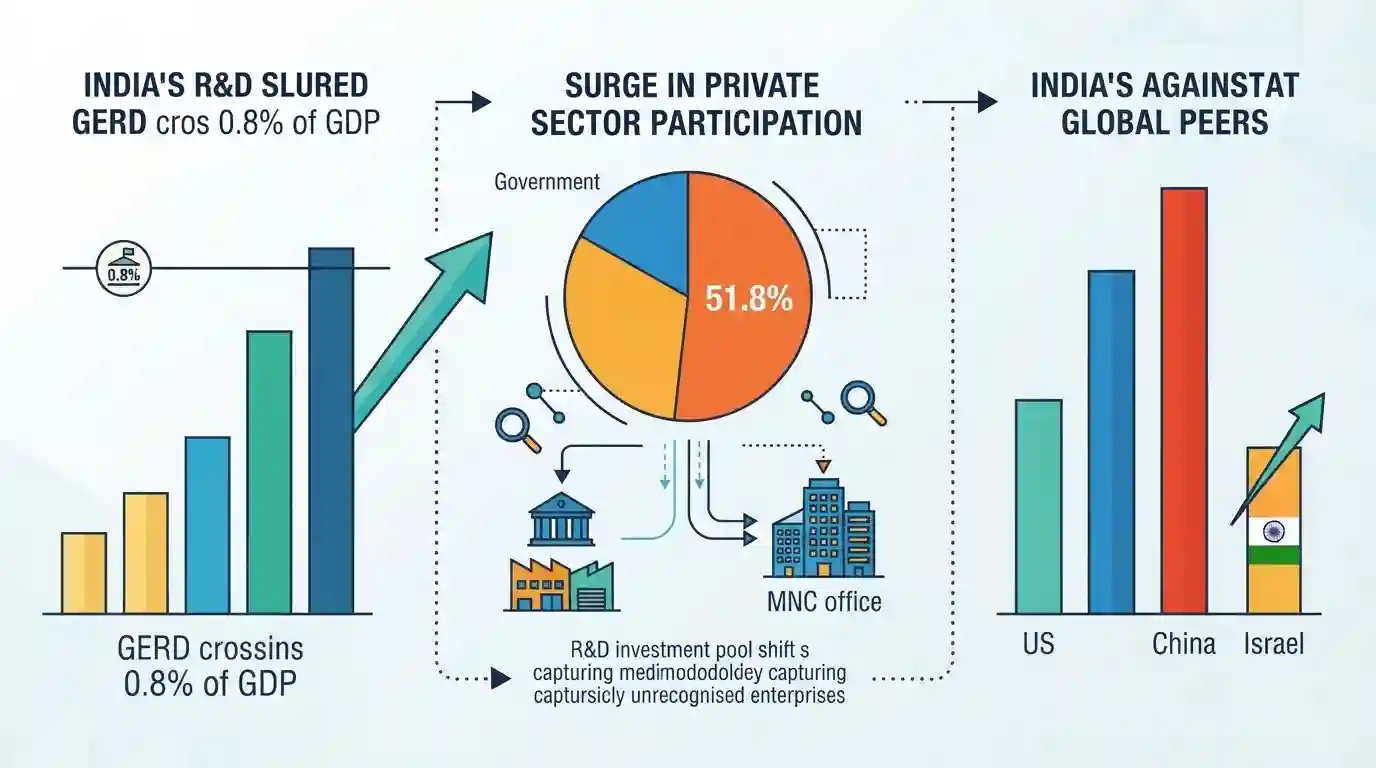
India’s gross expenditure on research and development (GERD) crossed 0.8% of its GDP for the first time in over a decade, hitting 0.83% in 2021-22. According to data from the Department of Science and Technology (DST), this milestone was driven not by increased government allocations, but by a substantial surge in private industry R&D investments. Private sector contribution, historically low in India, grew to an estimated 51.8% of total national R&D spending by 2023-24. A more comprehensive methodology adopted by the NSTMIS to track unrecognised R&D enterprises and MNCs helped capture this shift. However, India continues to lag behind global peers like the US, China, and Israel in terms of R&D as a percentage of overall GDP.
Key Points
- India's Gross Expenditure on Research and Development (GERD) reached 0.83% of GDP in 2021-22, surpassing the 0.8% mark for the first time since 2009-10.
- Absolute GERD jumped 53% to ₹1.95 lakh crore in 2021-22 from ₹1.27 lakh crore in 2020-21, and further to ₹2.45 lakh crore in 2023-24.
- A major structural shift occurred as private sector R&D spending grew to 45.5% in 2021-22 and an estimated 51.8% in 2023-24, surpassing government expenditure for the first time.
- The data compilation by NSTMIS was expanded to align with UNESCO and OECD definitions, successfully capturing R&D spending by multinational corporations and firms outside the DSIR recognition scheme.
- Despite this progress, India's R&D intensity remains lower than global leaders (in 2020-21, China was at 2.4%, the US at 3.5%, and Israel at ~5% of GDP).
Important Terms
Department of Science and Technology (DST)

A nodal department under India's Ministry of Science and Technology that promotes science and technology, formulates policy, and funds research initiatives to bolster the national innovation ecosystem.
UPSC context
GS Paper III (Science & Technology): Crucial for answers on S&T policy, institutional frameworks, and national R&D funding mechanisms.
National Science and Technology Management Information System (NSTMIS)
A division of India's DST tasked with gathering, analyzing, and disseminating official statistical databases on S&T resources, personnel, and institutional outputs.
UPSC context
GS Paper III (Science & Technology): Essential for evaluating India's S&T statistics, R&D metrics, and evidence-based science policy formulation.
Department of Scientific and Industrial Research (DSIR)
An Indian government department under the Ministry of Science and Technology that promotes industrial research, technology transfer, and commercialization of indigenous technologies.
UPSC context
GS Paper III (S&T and Economy): Crucial for analyzing industry-academia linkages, indigenization of technology, and growth of MSMEs through R&D.
OECD
An intergovernmental organization of 38 member countries that sets global R&D data standards, notably the Frascati Manual, to ensure cross-border comparability of research statistics.
UPSC context
GS Paper II (Global Groupings) & GS Paper III (Economy/S&T): Key for global S&T benchmarks, R&D metrics, and international standards.
UNESCO
A specialized UN agency that promotes international scientific cooperation, tracks global human capital development, and standardizes concepts and terminologies used in science statistics.
UPSC context
GS Paper II (International Institutions) & GS Paper III (S&T): Relevant for global innovation indices, human capital development, and UNESCO Science Reports.
Prelims Trap
The government continues to contribute the majority share of India's R&D expenditure, as private sector investment remains consistently below 40%.
Historically true, but a major structural shift occurred. Private sector R&D surpassed government expenditure in 2021-22 and reached an estimated 51.8% of total GERD by 2023-24.
Static Concepts Connected
What are the key features of the Anusandhan National Research Foundation (ANRF)?
- Governing structure: The Prime Minister is the ex-officio President of the Board, replacing the legacy Science and Engineering Research Board (SERB).
- Funding model: Designed to mobilize ₹50,000 crore over five years, with roughly 70% intended to be sourced from private industry and philanthropies.
How is Gross Expenditure on R&D (GERD) measured in India?
- Primary Agency: Compiled by the National Science and Technology Management Information System (NSTMIS) under the Department of Science and Technology.
- Global Alignment: Methodology aligns with UNESCO and OECD, capturing spending by public sector, private enterprises, higher education, and MNCs.
Cross-Topic Patterns
GCCs and revised R&D metrics
Aligning with OECD standards means capturing R&D by Global Capability Centers (GCCs), linking India's service-sector and FDI boom directly to its domestic innovation metrics.
Validation for ANRF's funding design
The Anusandhan NRF expects 70% of its funding from non-government sources. This data showing a majority-private GERD structurally validates that ambitious policy shift.

Expect a multi-statement Prelims question contrasting India's new private-majority R&D spending with historic trends and the ANRF Act.
Linked PYQs · 1
Linked PYQs · 1
- 2022PrelimsGS1
With reference to the expenditure made by an organisation or a company, which of the following statements is/are correct? 1. Acquiring new technology is capital expenditure. 2. Debt financing is considered capital expenditure, while equity financing is considered revenue expenditure. Select the correct answer using the code given below:
