India RD Ecosystem Reforms Needed for Knowledge Economy
Source:Indian Express ↗
Why It Matters
Understanding India's R&D ecosystem and its structural constraints is vital for aspirants writing answers on India's transition to a knowledge economy, achieving high-income status, and boosting industrial competitiveness through indigenous innovation.
Summary
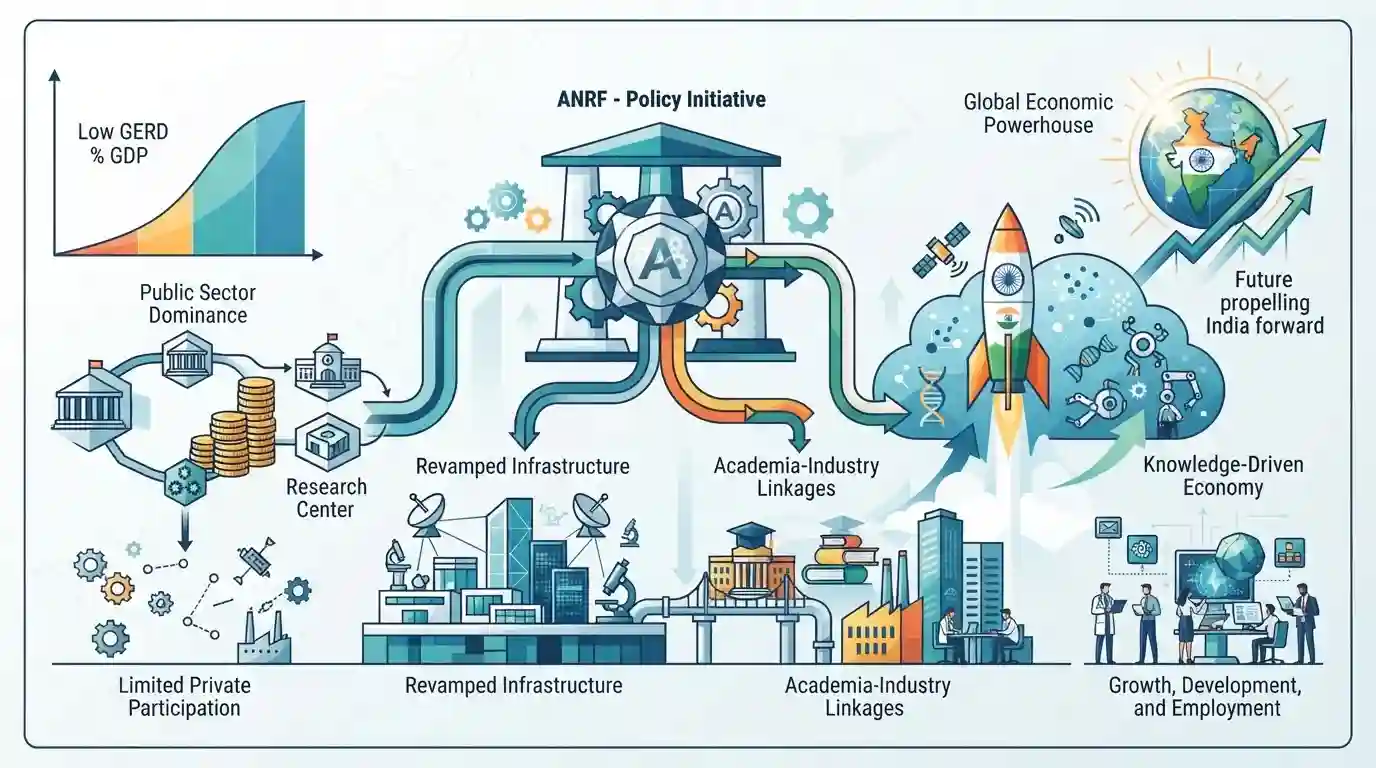
This article explores India's Research and Development (R&D) ecosystem, examining structural bottlenecks such as low Gross Expenditure on R&D (GERD) as a percentage of GDP, over-reliance on public sector funding, and limited private sector participation. It highlights policy initiatives like the Anusandhan National Research Foundation (ANRF) aimed at revamping research infrastructure, fostering academia-industry linkages, and propelling India toward becoming a knowledge-driven global economic powerhouse.
Key Points
- India's Gross Expenditure on R&D (GERD) as a percentage of GDP remains low compared to major global economies, hovering around 0.64%.
- A major structural challenge is the low contribution of the private sector to R&D funding, unlike developed nations where industry drives most innovation spending.
- The establishment of the Anusandhan National Research Foundation (ANRF) aims to bridge the gap between academic institutions, research labs, and industry by catalyzing research funding.
- Transitioning into a knowledge-driven economy requires strengthening intellectual property rights (IPR), improving STEM education, and fostering a culture of risk-taking and commercialization.
Important Terms
Anusandhan National Research Foundation (ANRF)

An apex statutory body established to provide high-level strategic direction for scientific research, innovation, and entrepreneurship across natural sciences, engineering, and technology while fostering academia-industry linkages.
UPSC context
Important for GS Paper III (Science & Technology - Policy and Developments); tests institutional frameworks driving R&D and private sector participation.
Anusandhan National Research Foundation Act
Legislation enacted in 2023 that established the ANRF as an apex research-funding organization, replacing and subsuming the erstwhile Science and Engineering Research Board (SERB).
UPSC context
Important for GS Paper III (S&T Governance and Legislation); tests knowledge of statutory reforms governing national research ecosystems.
Prelims Trap
Private sector contributions account for the bulk of India's Gross Expenditure on R&D (GERD).
Aspirants often assume the private sector contributes the majority of India's R&D funding, mirroring Western models, whereas public sector funding historically dominates.
Static Concepts Connected
What are the institutional mechanisms and objectives of the Anusandhan National Research Foundation (ANRF)?
- Statutory Basis: Established via the ANRF Act 2023, replacing the Science and Engineering Research Board (SERB).
- Primary Mandate: Aims to seed, grow, and promote R&D and foster a culture of research and innovation across universities and colleges.
- Funding Structure: Envisions a major financial outlay of Rs 50,000 crore over five years, with a significant portion sourced from non-governmental and philanthropic channels.
- Governance Setup: Chaired by the Prime Minister, with the Union Minister of Science & Technology and Minister of Education as Vice-Presidents.
Cross-Topic Patterns
R&D Investment and High-Tech Manufacturing Linkage
The push to boost GERD and private R&D spending directly feeds into India's export ambitions in high-tech manufactured goods under PLI schemes.
Intellectual Property Regimes and Global Trade
Transitioning to a knowledge-driven economy requires strengthening patents and technology transfer frameworks, intersecting with India's TRIPS flexibilities stance at the WTO.

ANRF funding mechanisms, private sector R&D contribution ratios, and structural bottlenecks in GERD are prime targets for Prelims statements.
