Global Gender Gap Index Rankings and Structural Disparities
Source:The Hindu ↗
Why It Matters
The Global Gender Gap Index is a crucial international benchmark used to assess structural gender disparities. India's stagnant ranking highlights persistent gaps in economic participation, political representation, and other dimensions, serving as an important input for policy critique and governance reforms toward gender parity.
Summary
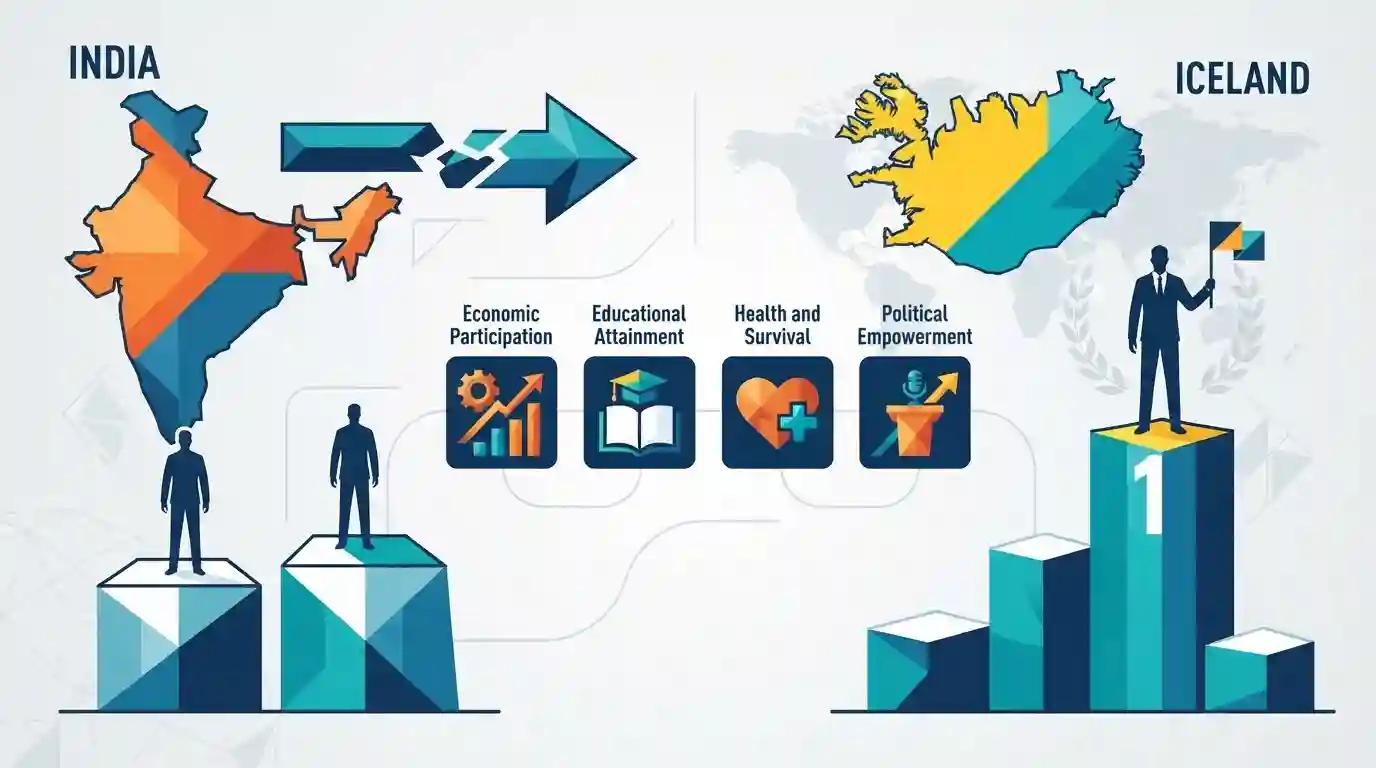
India's rank on the World Economic Forum's Global Gender Gap Index remained unchanged at 131, while Iceland retained its top position globally. The index evaluates countries across economic, educational, health, and political parameters.
Key Points
- India's rank on the Global Gender Gap Index remains unchanged at 131.
- Iceland retains the top spot as the most gender-equal country in the world.
- The index is published annually by the World Economic Forum (WEF) and measures gender parity across four key dimensions: Economic Participation and Opportunity, Educational Attainment, Health and Survival, and Political Empowerment.
Important Terms
Global Gender Gap Index

An annual index published by the World Economic Forum that benchmarks national gender parity across four key dimensions: economic participation, educational attainment, health, and political empowerment.
UPSC context
UPSC Prelims/Mains (GS Paper I - Social Justice & Women Empowerment). Tests knowledge of international indices, gender equality indicators, and India's performance.
World Economic Forum
An international lobbying organization based in Switzerland that engages political, business, and cultural leaders to shape global, regional, and industry agendas, best known for publishing annual indices like the Global Gender Gap Report.
UPSC context
UPSC Prelims/Mains (GS Paper II/III - International Organizations and Reports). Frequently asked about its reports, rankings, and global economic governance roles.
Prelims Trap
The Global Gender Gap Index is published annually by the United Nations Development Programme (UNDP).
Aspirants often assume the Global Gender Gap Index is published by the United Nations Development Programme (UNDP) or the World Bank due to its prominence, but it is exclusively a WEF publication.
Static Concepts Connected
What are the four pillars of the World Economic Forum's Global Gender Gap Index?
- Economic Participation: Measures the percentage of women in the workforce, wage equality, and leadership roles.
- Educational Attainment: Tracks literacy rates and enrollment ratios across primary, secondary, and tertiary levels.
- Health and Survival: Evaluates sex ratio at birth and healthy life expectancy indicators.
- Political Empowerment: Measures the representation of women in legislative bodies and ministerial positions.
Cross-Topic Patterns
Gender Parity + Economic Growth Models
The persistent underrepresentation of women in Indian politics and corporate boards directly impacts domestic demand, labor force participation rates, and macroeconomic growth models evaluated in GS Paper III.
Global Indices + SDG 5 Implementation
International rankings by bodies like the WEF feed directly into policy debates surrounding conditional foreign aid, sustainable development goals (SDG 5), and diplomatic soft-power positioning.

Expect statement-based Prelims questions testing specific WEF report parameters or confusing the publisher with World Bank or UNDP equivalents.
Linked PYQs · 2
Linked PYQs · 2
- 2025MainsGS2
Women's social capital complements in advancing empowerment and gender equity. Explain.
- 2017PrelimsGS1
Which of the following gives 'Global Gender Gap Index' ranking to the countries of the world?
