Addressing Political Misinformation and Deepfakes in Elections
Source:The Hindu ↗
Why It Matters
The intersection of technology (AI, deepfakes) and elections is a critical emerging challenge for democratic integrity, making it highly relevant for UPSC questions on electoral reforms, the role of the ECI, and the regulation of social media.
Summary
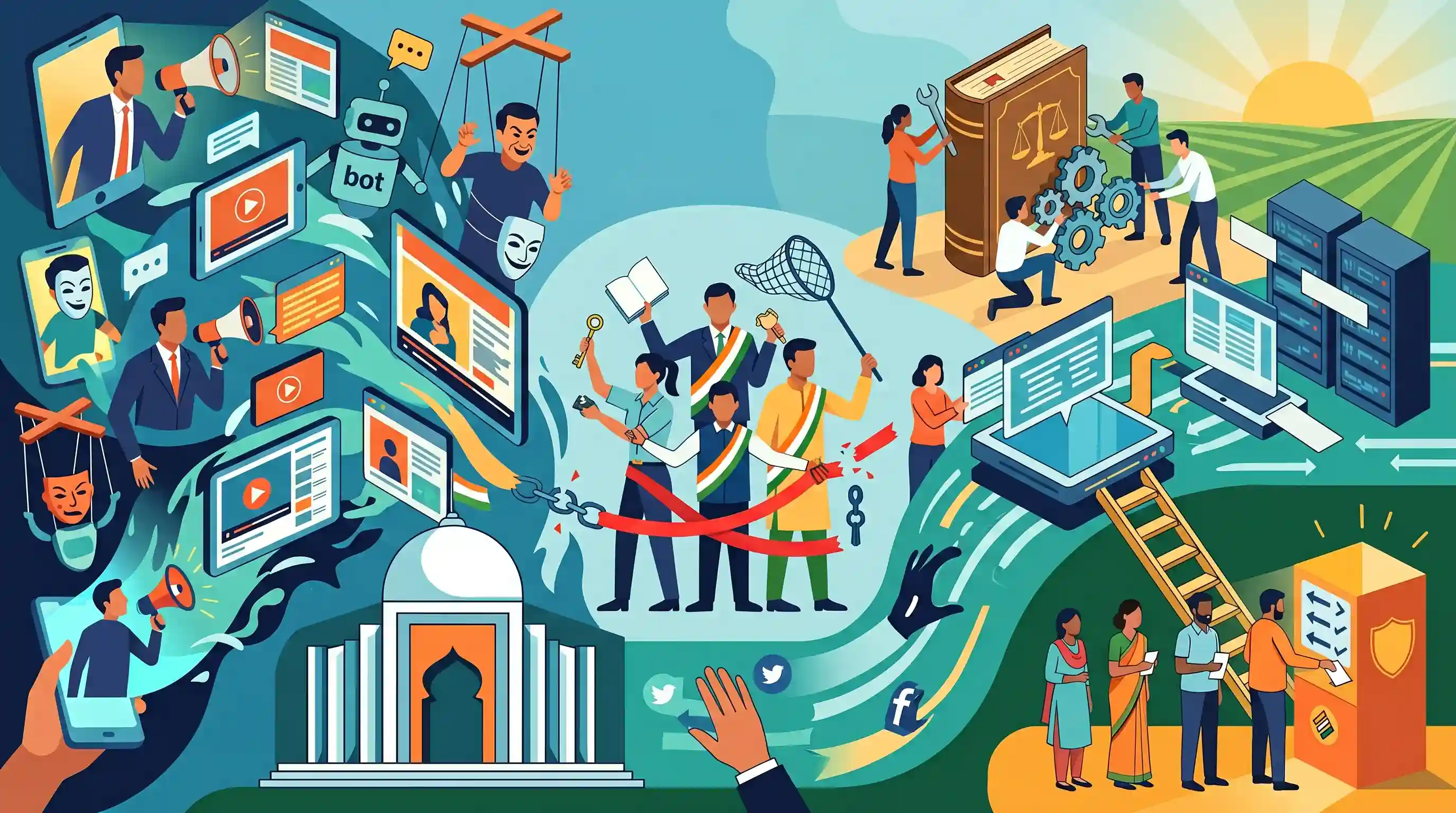
The article analyzes the growing phenomenon of a "political infodemic" observed during the recent assembly elections across five Indian states. It highlights how political campaigns are increasingly utilizing social media, fake news, and AI-driven deepfakes to manipulate public opinion and voter behavior. This digital transformation of electioneering presents significant regulatory challenges for the Election Commission of India (ECI), particularly in enforcing the Model Code of Conduct (MCC) online. The piece underscores the urgent need for comprehensive electoral reforms—including updating the Representation of the People Act—and enforcing stricter intermediary guidelines for tech platforms to safeguard the integrity of India's democratic processes.
Key Points
- Recent State Assembly elections witnessed a political "infodemic," characterized by the widespread use of misinformation, fake news, and deepfakes.
- The weaponization of Artificial Intelligence (AI) and targeted social media algorithms poses unprecedented threats to voter autonomy and the fairness of the democratic process.
- The Election Commission of India (ECI) faces mounting challenges in enforcing the Model Code of Conduct (MCC) within decentralized digital and social media ecosystems.
- There is a pressing need to update the Representation of the People Act, 1951 to regulate digital campaign financing, cyber-propaganda, and ensure greater accountability of tech platforms.
Important Terms
Election Commission of India (ECI)

A permanent constitutional body (Article 324) responsible for administering Union and State election processes, ensuring they are free, fair, and conducted with integrity.
UPSC context
GS Paper II (Constitutional Bodies); crucial for understanding the machinery of Indian democracy and electoral governance.
Representation of the People Act, 1951
The primary legislation governing the actual conduct of elections, candidate qualifications/disqualifications (Section 8), and the definition of corrupt practices (Section 123) in India.
UPSC context
GS Paper II (Polity/Elections); foundational for questions on candidate disqualification and legislative reforms.
Model Code of Conduct (MCC)
A set of consensus-based ethical guidelines issued by the ECI to regulate the behavior of political parties and candidates from the announcement of elections until results.
UPSC context
GS Paper II (Polity); tests understanding of non-statutory mechanisms for ensuring a level playing field in elections.
Information Technology (Intermediary Guidelines and Digital Media Ethics Code) Rules, 2021
Rules under the IT Act, 2000, mandating due diligence for social media intermediaries and digital media to curb misinformation, fake news, and unlawful content.
UPSC context
GS Paper II (Governance) & III (Internal Security); relevant to digital democracy and social media regulation.
Section 126 of RPA, 1951
A provision prohibiting public meetings and the display of 'election matter' via electronic media 48 hours before polling ends, known as the 'Silence Period.'
UPSC context
GS Paper II (Electoral Reforms); tests knowledge of legal gaps in regulating online campaigning and digital misinformation.
Deepfakes
AI-generated synthetic media that realistically replaces a person's likeness, often used in political campaigns to create deceptive content and manipulate voter behavior.
UPSC context
GS Paper III (Science & Tech) & II (Elections); addresses emerging technological threats to democratic integrity.
Prelims Trap
The ECI regulates AI deepfakes using specific statutory powers derived from the Model Code of Conduct (MCC).
The MCC is a consensus document with no statutory backing. The ECI regulates deepfakes using its plenary powers under Article 324 and the IT Rules 2021.
Static Concepts Connected
What defines "corrupt practices" under Section 123 of the RPA, 1951?
- False Statements: Publishing false information concerning the personal character or conduct of a candidate to prejudice their election prospects.
- Undue Influence: Any direct or indirect interference with the free exercise of any electoral right.
- Identity Appeals: Appealing to vote or refrain from voting on the grounds of religion, race, caste, community, or language.
How is the campaign "Silence Period" structured under Section 126 of the RPA, 1951?
- 48-Hour Ban: Prohibits displaying any election matter during the 48 hours ending with the hour fixed for the conclusion of polls.
- Mediums Covered: Legally covers television, cinematograph, and similar apparatus, leading to regulatory grey areas for decentralized social media platforms.
- Penalty: Violations are an electoral offence punishable by imprisonment of up to two years, a fine, or both.
Cross-Topic Patterns
Deepfakes + Internal Security
Deepfakes merge GS-2 electoral integrity with GS-3 internal security, frequently appearing as joint questions on cognitive warfare, cyber-propaganda, and voter manipulation.
IT Rules 2021 + Intermediary Liability
The ECI's mandate for 3-hour content takedowns bridges electoral management with the ongoing debates on intermediary liability, safe harbor, and Article 19(1)(a) restrictions.

Expect a multi-statement Prelims 2026 question linking ECI's Article 324 powers, RPA 1951 'corrupt practices', and AI deepfake regulation.
Linked PYQs · 4
Linked PYQs · 4
- 2018MainsGS2
In the light of recent controversy regarding the use of Electronic Voting Machines (EVM), what are the challenges before the Election Commission of India to ensure the trustworthiness of elections in India?
- 2022MainsGS2
Discuss the role of the Election Commission of India in the light of the evolution of the Model Code of Conduct.
- 2024MainsGS3
Social media and encrypting messaging services pose a serious security challenge. What measures have been adopted at various levels to address the security implications of social media? Also suggest any other remedies to address the problem.
- 2016MainsGS3
Use of Internet and social media by non-state actors for subversive activities is a major security concern. How have these been misused in the recent past? Suggest effective guidelines to curb the above threat.
