Natural Capital and Climate Risk Accounting for Blue Economy
Source:The Hindu ↗
ఇది ఎందుకు ముఖ్యం
Understanding natural capital accounting is crucial for aspirants to evaluate how economic metrics are evolving to incorporate environmental degradation, ecosystem services, and climate risks, particularly within vulnerable sectors like the blue economy.
సారాంశం
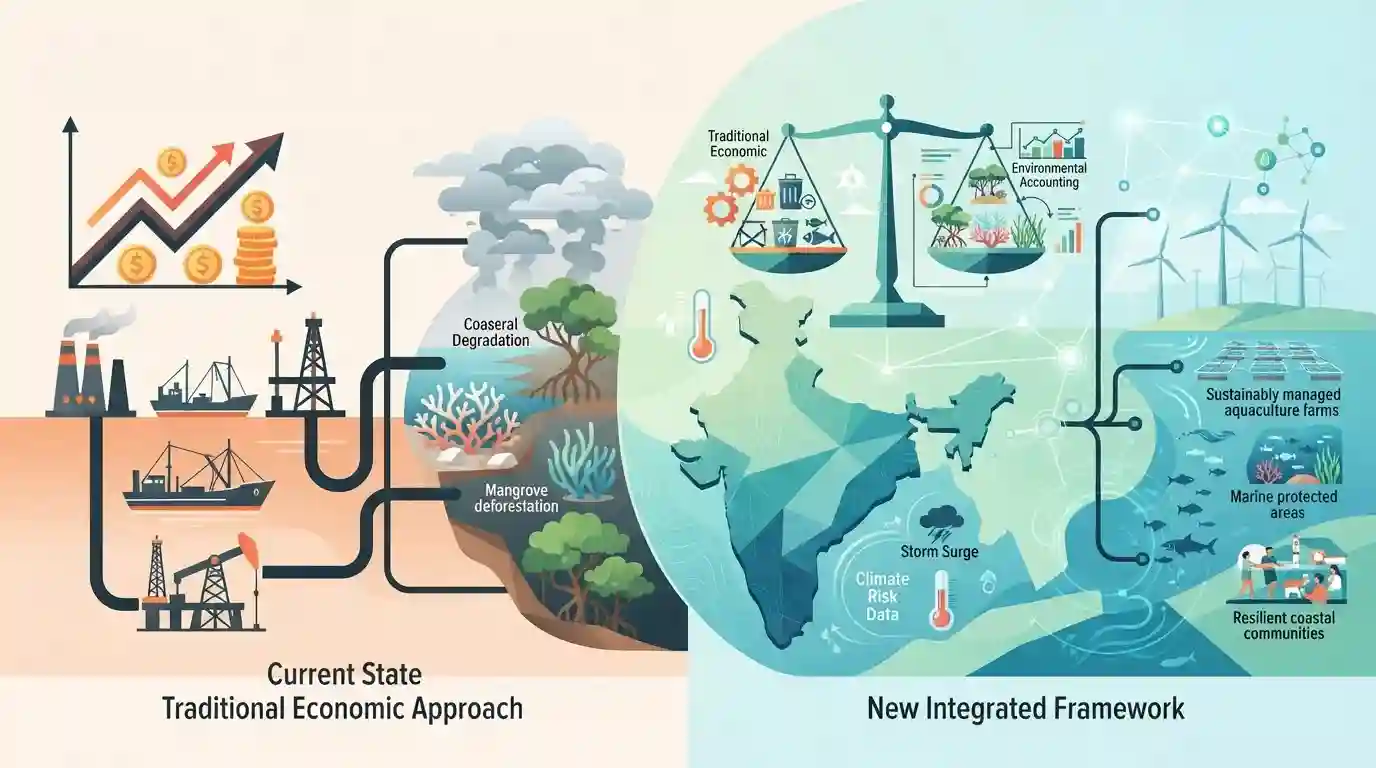
India's plan to integrate natural-capital and climate-risk accounting into its blue economy framework marks a shift toward sustainable economic planning. By factoring in the value of ecosystem services and climate vulnerabilities alongside traditional economic metrics, India aims to better manage its marine resources and protect coastal environments.
ముఖ్య అంశాలు
- India is initiating natural-capital and climate-risk accounting to comprehensively value its blue economy.
- Natural capital accounting moves beyond traditional GDP by assigning economic value to ecosystem services, marine resources, and natural assets.
- Climate-risk accounting helps assess vulnerability, potential economic losses, and adaptation requirements for coastal and marine zones.
- This framework aids policy formulation for sustainable development, balancing economic growth with ecological preservation.
ప్రిలిమ్స్ ఉచ్చు
Natural-capital accounting completely replaces traditional GDP metrics to measure the true national output.
Aspirants often assume natural capital accounting directly replaces GDP in official national income reporting. In reality, it runs parallel as experimental or satellite accounts alongside traditional GDP.
అనుసంధానమైన స్థిర భావనలు
What is the UN System of Environmental-Economic Accounting (SEEA)?
- Standard Framework: Framework integrates economic and environmental data to provide a comprehensive view of the interrelationship between the economy and the environment.
- Satellite Accounts: Developed by the UN Statistics Division, it creates satellite accounts alongside the System of National Accounts (SNA).
- Natural Assets: Measures stocks and flows of natural resources, including minerals, energy, timber, fish, and water ecosystems.
అంతర-అంశ నమూనాలు
Blue Economy + Indo-Pacific Strategic Security
India's blue economy framework connects maritime security (SAGAR, Indo-Pacific Oceans Initiative) with sustainable resource governance, linking economic milestones to strategic sea lines of communication.
Green Accounting + Directive Principles of State Policy
Natural-capital accounting implements the constitutional mandate of Article 48A (protection of environment and wildlife) within modern macroeconomic planning and fiscal policy frameworks.

Expect a statement-based prelims question on SEEA frameworks and Blue Economy dimensions (EEZ scale, MoSPI role, natural capital limits).
అనుసంధాన PYQలు · 1
అనుసంధాన PYQలు · 1
- 2019MainsGS3
Define the concept of carrying capacity of an ecosystem as relevant to an environment. Explain how understanding this concept is vital while planning for sustainable development of a region.
