Indias Strategic Role in the Emerging Global Energy Order
Source:The Hindu ↗
Why It Matters
Crucial for understanding India's balancing act between hydrocarbon dependence and renewable energy transition under evolving geopolitical constraints, directly aligning with GS3 syllabus requirements on energy security and climate change.
Summary
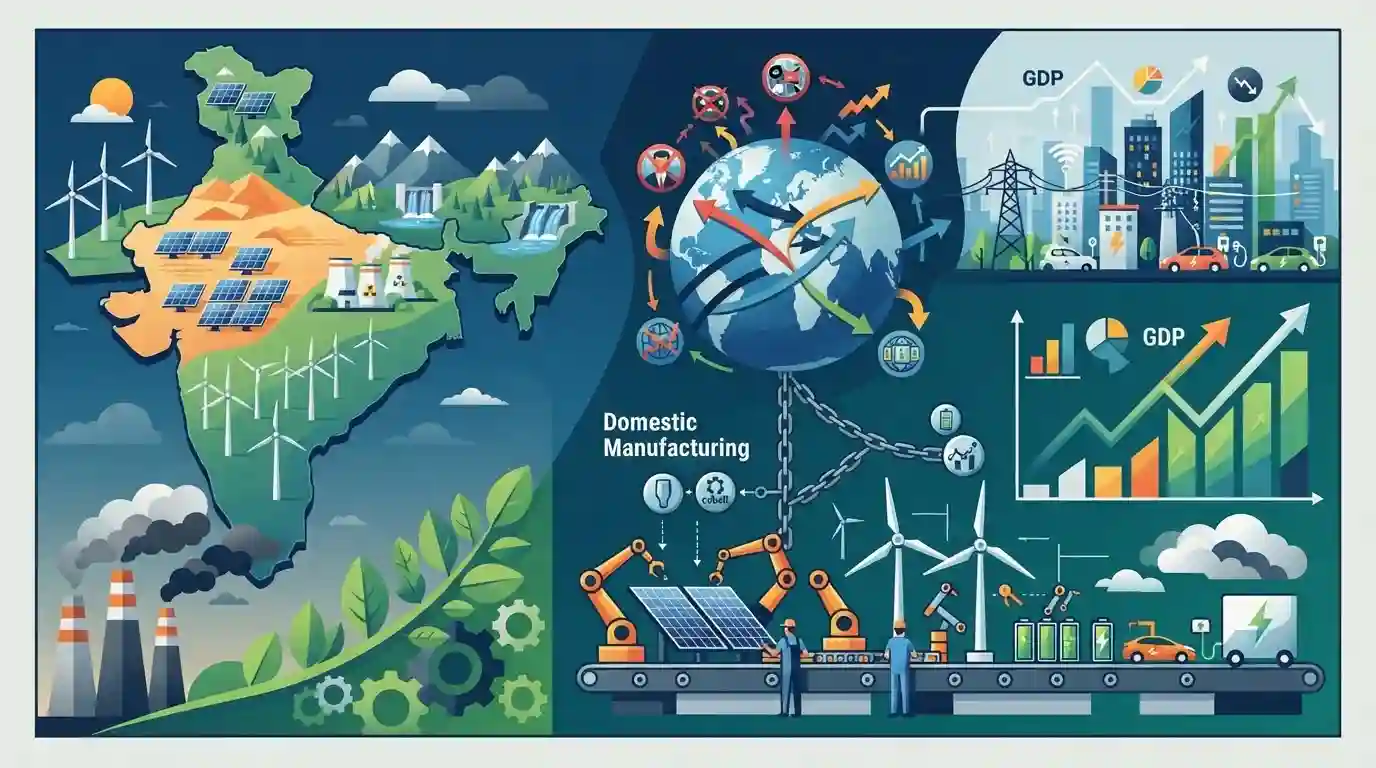
The article examines India's evolving strategic positioning within the shifting global energy order. It discusses how geopolitical volatility, climate imperatives, and the transition toward green technologies are reshaping international energy markets. For India, balancing immediate energy security and economic growth with long-term decarbonization goals necessitates a diversified energy matrix, resilient supply chains for critical minerals, and robust domestic manufacturing in renewables.
Key Points
- The global energy order is undergoing a structural shift from fossil fuel dependency to renewables, driven by climate change mitigation and geopolitical realignments.
- India occupies a central position in the emerging energy architecture, balancing its massive developmental energy demands with aggressive green transition targets like non-fossil fuel capacity goals.
- Energy security for India requires a diversified matrix, managing traditional hydrocarbon dependencies while scaling up domestic solar, wind, and green hydrogen manufacturing.
- Geopolitical fragmentation, critical mineral supply chains, and technological bottlenecks present major structural challenges for developing economies in navigating the global energy transition.
Important Terms
Paris Agreement

A landmark legally binding international treaty adopted at COP21 in Paris (2015), aiming to limit global warming to well below 2°C—preferably 1.5°C—compared to pre-industrial levels.
UPSC context
UPSC GS Paper III (Environment & Ecology); tests global climate governance frameworks, carbon mitigation targets, and India's nationally determined contributions (NDCs).
Long-Term Low Emission Development Strategy
India's strategic roadmap submitted to the UNFCCC outlining its long-term low-carbon pathway toward achieving net-zero emissions by 2070 while pursuing sustainable economic growth.
UPSC context
UPSC GS Paper III (Environment & Climate Change); tests India's official policy commitments and decarbonization trajectory for international climate negotiations.
International Solar Alliance
A treaty-based international organization headquartered in Gurugram, India, launched to mobilize clean energy investments and promote solar power deployment across tropical and member nations.
UPSC context
UPSC GS Paper II/III (International Relations & Renewable Energy); tests India's multilateral leadership in climate diplomacy and green energy cooperation.
OPEC
A permanent intergovernmental organization of 12 oil-producing developing nations that coordinates petroleum policies and influences global crude oil supply and price stability.
UPSC context
UPSC GS Paper II (International Relations) & Paper III (Energy Security); tests geopolitical vulnerabilities affecting India's import-dependent energy matrix and inflation.
Prelims Trap
India's commitment to achieving net-zero emissions by 2030 through 500 GW non-fossil capacity.
Aspirants often assume India has completely phased out fossil fuel imports or committed to absolute net-zero emissions by 2030, whereas India's target is 2070 net-zero with an interim 2030 non-fossil capacity goal.
Static Concepts Connected
What are India's key international climate and renewable energy institutional initiatives?
- International Solar Alliance: ISA is a joint initiative launched by India and France at COP21 to promote solar energy deployment in resource-rich tropical nations.
- Coalition for Disaster Resilient Infrastructure: CDRI is a multi-stakeholder global partnership launched by India to promote resilient infrastructure against climate and disaster risks.
- Global Biofuels Alliance: GPFI and Global Biofuels Alliance launched during India's G20 presidency to advance sustainable energy transitions globally.
Cross-Topic Patterns
Critical Minerals & Indo-Pacific Geopolitics
Securing lithium, cobalt, and rare earth elements links clean energy manufacturing to both the Quad's critical mineral partnership and India's Act East/West Asian diplomatic outreach.
Energy Transition & WTO Trade Rules
India's non-fossil capacity goals and NDC emission intensity cuts intersect directly with WTO subsidy rules on domestic content requirements for solar manufacturing.

Critical minerals, 500 GW non-fossil target, and supply chain dependencies will likely feature as paired analytical statements in Prelims.
Linked PYQs · 3
Linked PYQs · 3
- 2022MainsGS3
Do you think India will meet 50 percent of its energy needs from renewable energy by 2030 ? Justify your answer. How will the shift of subsidies from fossil fuels to renewables help achieve the above objective ? Explain.
- 2025MainsGS3
How can India achieve energy independence through clean technology by 2047? How can biotechnology can play a crucial role in this endeavour?
- 2026PrelimsGS1
Consider the following statements with reference to India's response to climate change : I. India's Long-Term Low Emission Development Strategy (LT-LEDS) is a crucial tool for achieving net-zero emissions by 2070. II. India's 4th Biennial Update Report (BUR-4) submitted in December, 2024 recorded around 8% decrease in Greenhouse gas emissions in 2020 over 2019. III. Climate-resilient development necessarily depends on quick and short-term achievement of emission reduction targets. Which of the following relationships among the above statements is/are correct ? 1. Statement I is empirically supported by statement II. 2. Statement III contradicts the approach implicit in statement I. 3. Statement I and statement III together establish the premise of long-term sustainability. Select the answer using the code given below :
