India Industrial Decarbonization and Carbon Pricing Strategy
Source:The Hindu ↗
Why It Matters
Industrial decarbonization is central to India's 'Net Zero by 2070' commitment. Knowledge of carbon markets, the PAT scheme, and international mechanisms like CBAM is critical for GS3 (Environment and Economy) and understanding global trade dynamics.
Summary
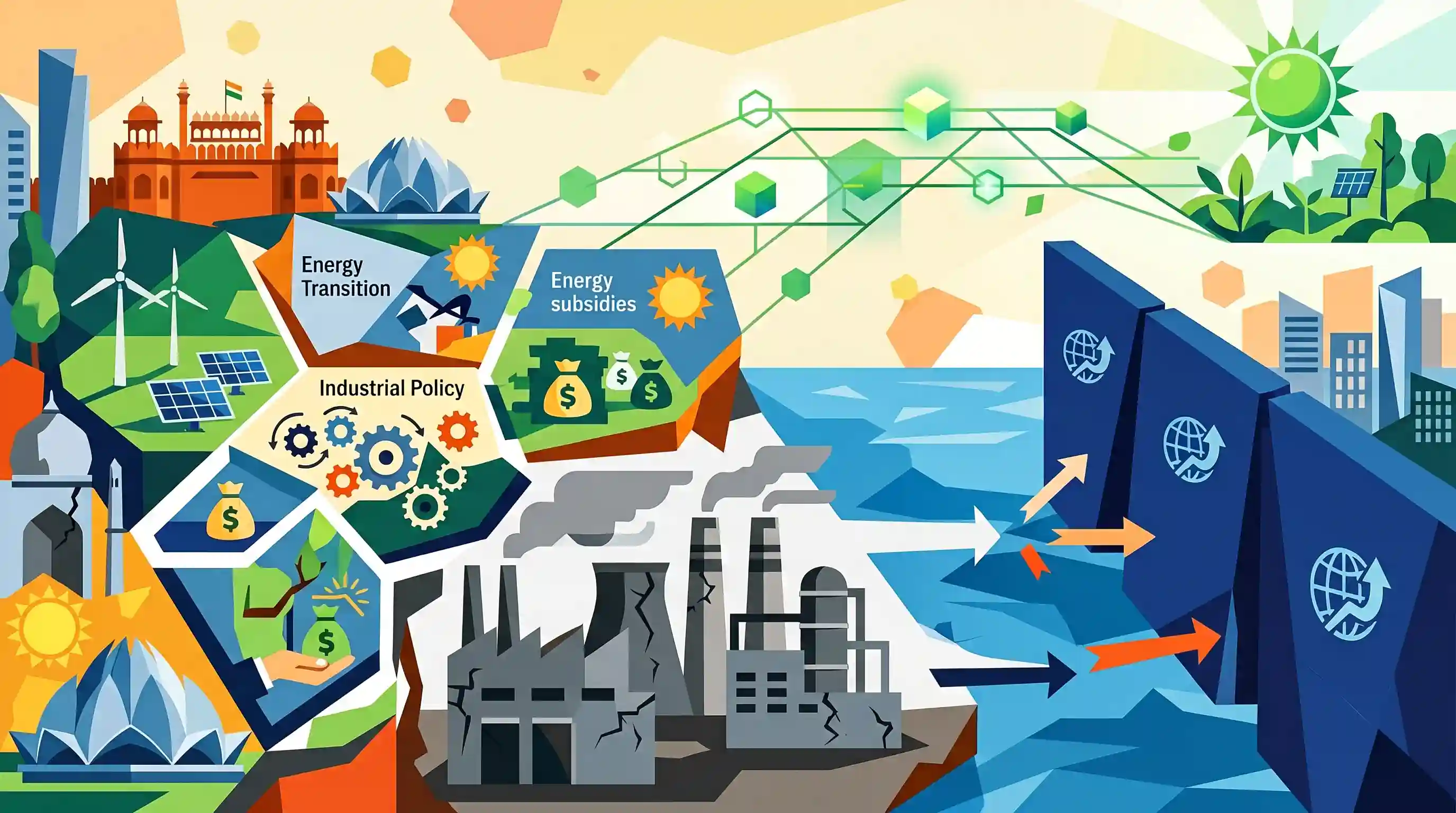
The article critically analyzes India's fragmented approach to industrial decarbonization. While initiatives like the Perform, Achieve and Trade (PAT) scheme and clean energy subsidies exist, the overall strategy lacks cohesive, cross-sectoral carbon pricing. This "patchy" policy framework leaves hard-to-abate sectors like steel and cement vulnerable, especially in the face of impending international trade barriers such as the EU's Carbon Border Adjustment Mechanism (CBAM). A unified carbon market and targeted support are essential for a successful green transition.
Key Points
- India lacks a unified carbon pricing mechanism, relying instead on fragmented policies like the PAT scheme for energy efficiency in industries.
- The upcoming Carbon Credit Trading Scheme (CCTS) requires careful integration with existing industrial policies to ensure a smooth transition.
- Hard-to-abate sectors like steel and cement need targeted support, technology transfer, and clear decarbonization pathways, which are currently insufficient.
- Export-oriented industries face imminent risks from international carbon taxes like the EU's CBAM, highlighting the urgent need for robust domestic carbon accounting and pricing.
Important Terms
Carbon Border Adjustment Mechanism (CBAM)

An EU policy imposing a carbon price on energy-intensive imports (like steel and cement) to prevent carbon leakage and ensure fair competition with EU producers.
UPSC context
GS III (Economy/Environment). Critical for global trade barriers, climate diplomacy, and impacts on Indian exports like steel and aluminum.
Carbon Credit Trading Scheme (CCTS)
India's 2023 framework for a domestic carbon market that issues tradeable Carbon Credit Certificates (CCCs) to entities meeting greenhouse gas emission intensity targets.
UPSC context
GS III (Climate Change). Tests India's evolution from energy efficiency to direct emission-reduction targets to meet NDC goals.
Perform Achieve and Trade (PAT) Scheme
A market-based mechanism where energy-intensive 'Designated Consumers' trade Energy Saving Certificates (ESCerts) to meet mandatory energy-intensity reduction targets.
UPSC context
GS III (Energy). A foundational climate mission currently being integrated into the broader Indian Carbon Market framework.
Bureau of Energy Efficiency (BEE)
A statutory body under the Ministry of Power (Energy Conservation Act, 2001) responsible for implementing energy efficiency policies and administering India's carbon market.
UPSC context
GS III (Institutional Framework). The primary agency driving industrial decarbonization and energy-saving standards in India.
Hard-to-Abate Sectors
Industries like steel, cement, and chemicals where emissions are difficult to eliminate due to reliance on high-temperature heat or specific chemical processes.
UPSC context
GS III (Environment/Industry). Tests understanding of technical barriers to net-zero and the need for CCUS or green hydrogen.
Carbon Pricing
A financial instrument that captures the external costs of greenhouse gas emissions by tying them to their source through a tax or market price.
UPSC context
GS III (Economics/Environment). Essential for evaluating the cost-effectiveness of climate tools like taxes versus cap-and-trade systems.
Prelims Trap
The PAT scheme allows industries to trade Carbon Credit Certificates (CCCs) to meet direct greenhouse gas emission targets.
PAT targets energy efficiency using Energy Saving Certificates (ESCerts). It is the new Carbon Credit Trading Scheme (CCTS) that targets direct GHG emissions using Carbon Credit Certificates (CCCs).
Static Concepts Connected
What is the Bureau of Energy Efficiency (BEE)?
- Statutory Body: Established under the Energy Conservation Act, 2001, functioning under the jurisdiction of the Ministry of Power.
- NMEEE Nodal Agency: Implements the National Mission for Enhanced Energy Efficiency (under NAPCC), executing the PAT scheme for energy-intensive industries.
Why are steel and cement termed 'hard-to-abate' sectors?
- Process Heat Needs: These industries require extremely high temperatures currently achieved primarily by burning fossil fuels like coal, making simple electrification insufficient.
- Inherent Byproducts: Carbon dioxide is an inherent chemical byproduct of the production process itself (e.g., calcination of limestone in cement), not just an energy-use emission.
Cross-Topic Patterns
CBAM + WTO Trade Principles
The EU's CBAM is frequently challenged by developing nations like India as a violation of the WTO's non-discrimination rules and the UNFCCC principle of Common But Differentiated Responsibilities (CBDR).
Green Hydrogen + Hard-to-Abate Sectors
Decarbonizing steel relies heavily on substituting coking coal with green hydrogen, linking industrial climate vulnerability directly to the success of India's National Green Hydrogen Mission.

CBAM + CCTS transition will likely form a dual-statement prelims question, testing the shift from energy efficiency to direct GHG capping.
Linked PYQs · 3
Linked PYQs · 3
- 2023PrelimsGS1
Consider the following statements: Statement-I: Carbon markets are likely to be one of the most widespread tools in the fight against climate change. Statement-II: Carbon markets transfer resources from the private sector to the State. Which one of the following is correct in respect of the above statements?
- 2025PrelimsGS1
Consider the following statements : Statement I: Article 6 of the Paris Agreement on climate change is frequently discussed in global discussions on sustainable development and climate change. Statement II: Article 6 of the Paris Agreement on climate change sets out the principles of carbon markets. Statement III : Article 6 of the Paris Agreement on climate change intends to promote inter-country non-market strategies to reach their climate targets. Which one of the following is correct in respect of the above statements?
- 2022MainsGS3
Do you think India will meet 50 percent of its energy needs from renewable energy by 2030 ? Justify your answer. How will the shift of subsidies from fossil fuels to renewables help achieve the above objective ? Explain.
