Indian Astronauts Issue Climate Warning During Orbital Call
Source:Indian Express ↗
Why It Matters
The article sits at the intersection of GS-3 Science & Technology (India's manned spaceflight progress via the Axiom-4 and Gaganyaan missions) and GS-3 Environment (using orbital observations to validate and warn about the realities of global climate change).
Summary
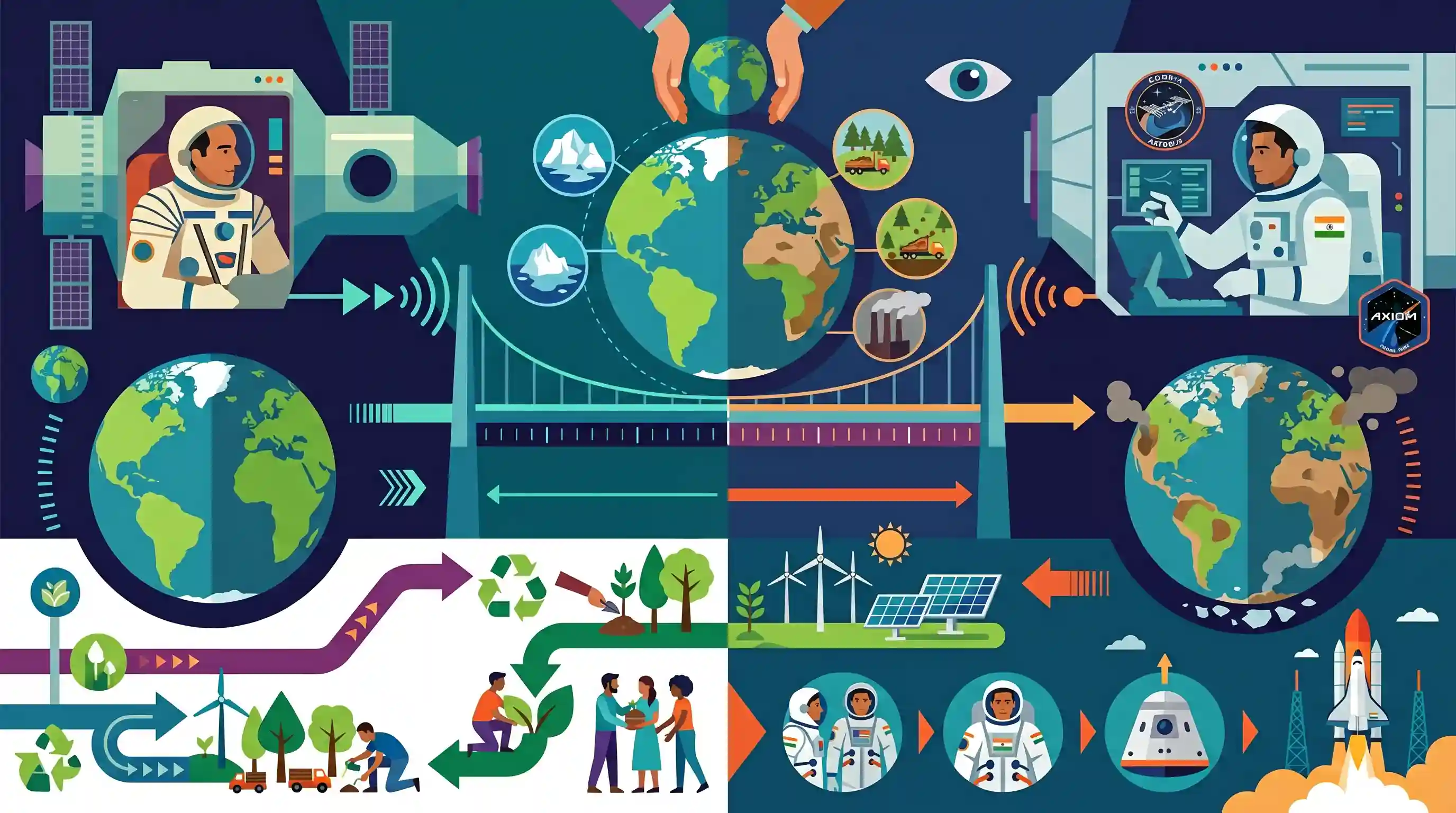
In a historic moment for India's space program, Group Captain Shubhanshu Shukla, operating aboard the International Space Station on the Axiom-4 mission, shared a call from orbit with Rakesh Sharma, India's first spacefarer from 1984. The conversation bridged a 40-year gap in Indian human spaceflight and served as a precursor to the upcoming Gaganyaan mission. Crucially, the two astronauts used the occasion to issue a stark warning about climate change. Comparing observations of the Earth from 1984 to the present, they discussed the 'overview effect' and highlighted visible environmental degradation, emphasizing the critical need for global climate action to protect our fragile planet.
Key Points
- A historic conversation took place between India's first astronaut, Rakesh Sharma, and Group Captain Shubhanshu Shukla, who recently reached the International Space Station (ISS) as part of the Axiom-4 mission.
- The dialogue bridges a 40-year gap in Indian human spaceflight, reflecting the nation's progress leading up to the indigenous Gaganyaan mission.
- Both astronauts discussed the 'overview effect', emphasizing how observing the Earth from space highlights the planet's fragility and lack of borders.
- Comparing Earth's appearance in 1984 to today, the spacefarers issued a stark warning regarding visible signs of climate change, deforestation, and environmental degradation.
- The interaction underscores the dual importance of human spaceflight: advancing technological capabilities and providing critical perspectives on global environmental crises.
Important Terms
Gaganyaan

India's flagship human spaceflight mission designed to send a crew to a 400 km orbit for three days and bring them back safely.
UPSC context
GS Paper 3 (Science & Tech); essential for topics on indigenous technology and India's space exploration milestones.
Axiom-4 Mission
A private astronaut mission to the ISS involving international collaboration. It serves as a precursor and training ground for Indian astronauts ahead of the Gaganyaan mission.
UPSC context
GS Paper 3 (Science & Tech); highlights international partnerships (ISRO-NASA-Axiom) and the commercialization of space.
Overview Effect
A cognitive shift in awareness reported by astronauts seeing Earth from orbit, leading to a profound realization of the planet's fragility and interconnectedness.
UPSC context
GS Paper 3 (Science/Environment); relevant for discussions on climate change awareness and the human psychological impact of spaceflight.
Shubhanshu Shukla
The mission pilot for Axiom-4 and a Group Captain in the Indian Air Force. He is the second Indian spacefarer after Rakesh Sharma.
UPSC context
Prelims (Personalities); important as the first Indian to operate as a pilot on an international space station mission.
Low Earth Orbit (LEO)
An orbit with an altitude between 160 to 2,000 kilometers. It is the operational zone for the International Space Station and the target for the Gaganyaan mission.
UPSC context
GS Paper 3 (Science & Tech); fundamental concept for satellite technology, space debris, and crewed missions.
ISRO (Indian Space Research Organisation)
India's premier space agency, responsible for the design and execution of the Gaganyaan mission and other planetary exploration projects like Chandrayaan.
UPSC context
GS Paper 3 (Science & Tech); core institution for India's technological self-reliance and global space standing.
Prelims Trap
Shubhanshu Shukla traveled to the International Space Station aboard India's indigenous Gaganyaan spacecraft.
Shukla reached the ISS on the commercial Axiom-4 mission via SpaceX. Gaganyaan is India's upcoming indigenous human spaceflight mission, for which this serves as a precursor.
Static Concepts Connected
What are the key historical milestones in Space Station development?
- Salyut 1 (1971): The first space station launched by the Soviet Union. Rakesh Sharma visited its successor, Salyut 7, in 1984.
- ISS (1998): A collaborative multinational project (NASA, Roscosmos, JAXA, ESA, CSA) located in Low Earth Orbit (LEO).
- Bharatiya Antariksha Station: India's planned indigenous space station, targeted to be established in orbit by 2035.
Why are space stations like the ISS placed in Low Earth Orbit (LEO)?
- Altitude Range: LEO is generally defined as an orbit with an altitude between 160 km and 2,000 km above the Earth's surface.
- Accessibility & Observation: It requires less energy for payload delivery, allows for rapid crew rotation, and is ideal for high-resolution Earth observation.
- Atmospheric Drag: Objects in LEO experience atmospheric drag from the thermosphere, requiring periodic orbital boosts to avoid orbital decay.
Cross-Topic Patterns
Axiom-4 + Space Sector Privatization
Shukla's flight on a commercial Axiom mission highlights the global shift towards public-private space exploration, mirroring India's own domestic space sector privatization and the creation of IN-SPACe.
Overview Effect + Global Commons Management
The visible climate degradation from LEO reinforces the concept of Earth as a 'Global Commons', linking space technology directly to macro-level environmental monitoring for UNFCCC climate goals.

Expect a multi-statement Prelims question in 2026 contrasting Rakesh Sharma's 1984 Soviet mission with the US-led Axiom-4 flight.
Linked PYQs · 4
Linked PYQs · 4
- 2025PrelimsGS1
Consider the following space missions : I. Axiom-4 II. SpaDeX III. Gaganyaan How many of the space missions given above encourage and support micro-gravity research?
- 2017MainsGS3
India has achieved remarkable successes in unmanned space missions including the Chandrayaan and Mars Orbitter Mission, but has not ventured into manned space missions. What are the main obstacles to launching a manned space mission, both in terms of technology and logistics? Examine critically.
- 2016MainsGS3
Discuss India's achievements in the field of Space Science and Technology. How the application of this technology has helped India in its socio-economic development?
- 2022MainsGS3
Discuss global warming and mention its effects on the global climate. Explain the control measures to bring down the level of greenhouse gases which cause global warming, in the light of the Kyoto Protocol, 1997.
