NGO Funding Challenges and Regulatory Compliance in India
Source:The Hindu ↗
Why It Matters
NGOs and civil society organizations are critical pillars of Indian governance, grassroots democracy, and inclusive development. Understanding their financial and regulatory challenges is vital for GS2 (Governance/Vulnerable Sections) and GS3 (Inclusive Growth/CSR).
Summary
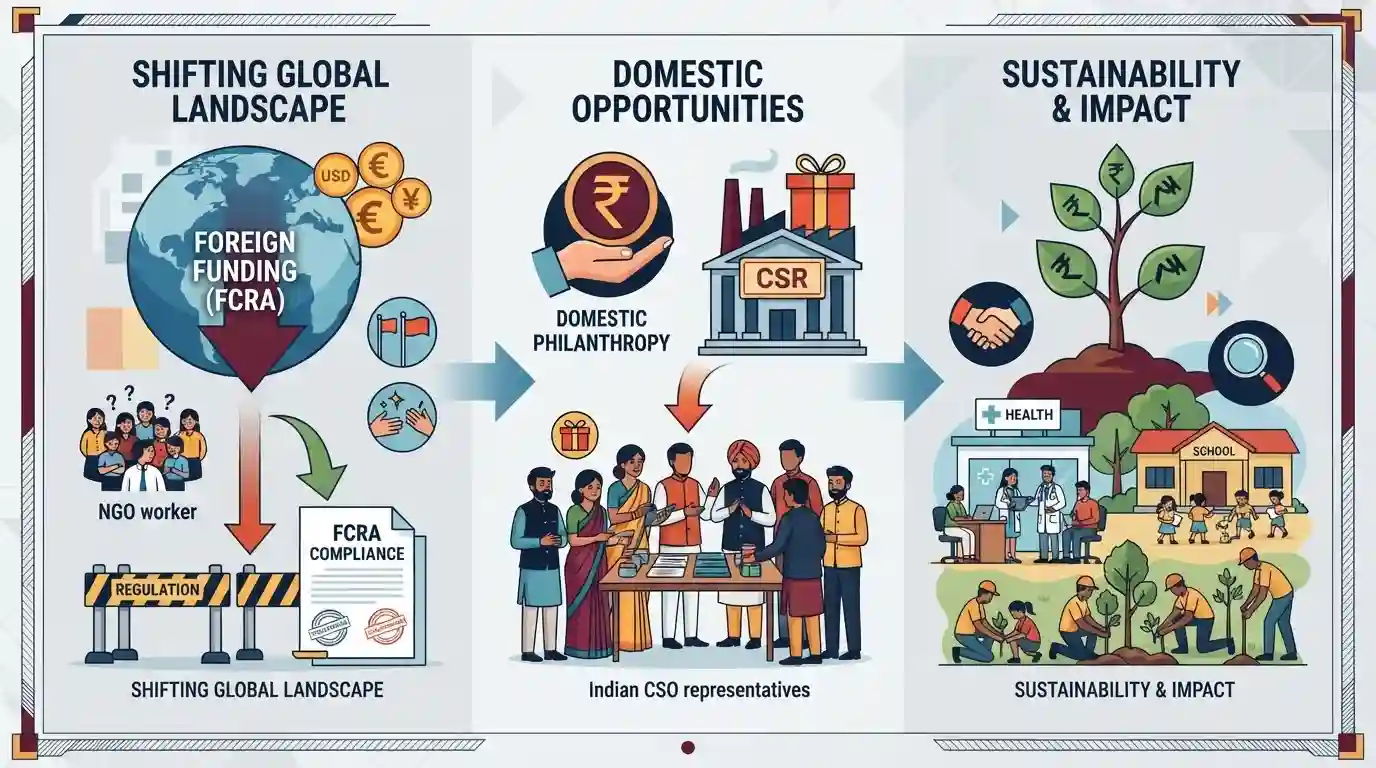
The article explores the evolving funding landscape for Non-Governmental Organizations (NGOs) in India, highlighting the structural shifts away from foreign contributions due to stricter FCRA regulations and changing global donor priorities. It underscores the critical need for Indian civil society organizations to diversify funding streams toward domestic philanthropy and CSR, while balancing compliance and grassroots independence.
Key Points
- Indian NGOs face a major funding crunch due to tightening regulatory frameworks like the FCRA, shifting global philanthropic priorities, and domestic economic shifts.
- Traditional reliance on foreign donor funds is declining, necessitating a pivot toward domestic philanthropy and Corporate Social Responsibility (CSR) funds.
- The regulatory landscape requires enhanced transparency, accountability, and compliance from civil society organizations (CSOs) to maintain operational legitimacy.
- A shift in funding sources impacts grassroots organizations disproportionately, threatening independent advocacy, human rights work, and localized social development.
Important Terms
Foreign Contribution (Regulation) Act (FCRA)

An Indian legislation enacted by the Ministry of Home Affairs to regulate the acceptance and utilization of foreign contributions by individuals, associations, and NGOs, safeguarding national security and transparency.
UPSC context
GS Paper 2 (Governance, Civil Society Organisations & NGOs). Essential for studying government regulation of foreign funds and civil society accountability.
Corporate Social Responsibility (CSR)
A statutory obligation under the Companies Act, 2013, requiring qualifying companies to spend 2% of their average net profits on specified social welfare and developmental activities.
UPSC context
GS Paper 2 & Paper 3 (Developmental Processes, Inclusive Growth). Tests how corporate funding supports social sector development and NGO financing.
Static Concepts Connected
What are the key regulatory provisions and restrictions governing foreign contributions to NGOs under the FCRA?
- Administering Ministry: Nodal Ministry: Administered exclusively by the Ministry of Home Affairs (MHA) to safeguard national security and public order.
- Mandatory SBI Account: Designated Account: All foreign contributions must be received only through a designated FCRA account at the State Bank of India, New Delhi.
- Administrative Limit: Administrative Cap: Recent amendments capped administrative expenses from foreign funds at 20% to ensure maximum resource utilization for core welfare objectives.
- Strict Prohibition: Non-transferability: Foreign contributions cannot under any circumstances be transferred to any other unregistered person or organization.
Cross-Topic Patterns
FCRA + CSR: Internal Security vs Corporate Compliance
FCRA compliance intersects with internal security and external sovereignty, while MCA's CSR-1 registry connects corporate governance directly to grassroots social welfare delivery.

Expect a statement-based prelims question pairing FCRA administrative caps (e.g., 20% limit) with MCA CSR-1 registration mandates.
Linked PYQs · 3
Linked PYQs · 3
- 2015MainsGS2
Examine critically the recent changes in the rules governing foreign funding of NGOs under the Foreign Contribution (Regulation) Act (FCRA), 1976.
- 2015MainsGS2
How can the role of NGOs be strengthened in India for development works relating to protection of the environment? Discuss throwing light on the major constraints.
- 2013MainsGS3
With a consideration towards the strategy of inclusive growth, the new Companies Bill, 2013 has indirectly made CSR a mandatory obligation. Discuss the challenges expected in its implementation in right earnest. Also discuss other provisions in the Bill and their implications.
