Funding Challenges and Regulatory Shifts for Indian NGOs
Source:The Hindu ↗
આ શા માટે મહત્વનું છે
It addresses the evolving financial and regulatory landscape of India's non-profit sector, which plays a pivotal role in inclusive growth, public service delivery, and participatory democracy, making it vital for GS2 governance and developmental issues.
સારાંશ
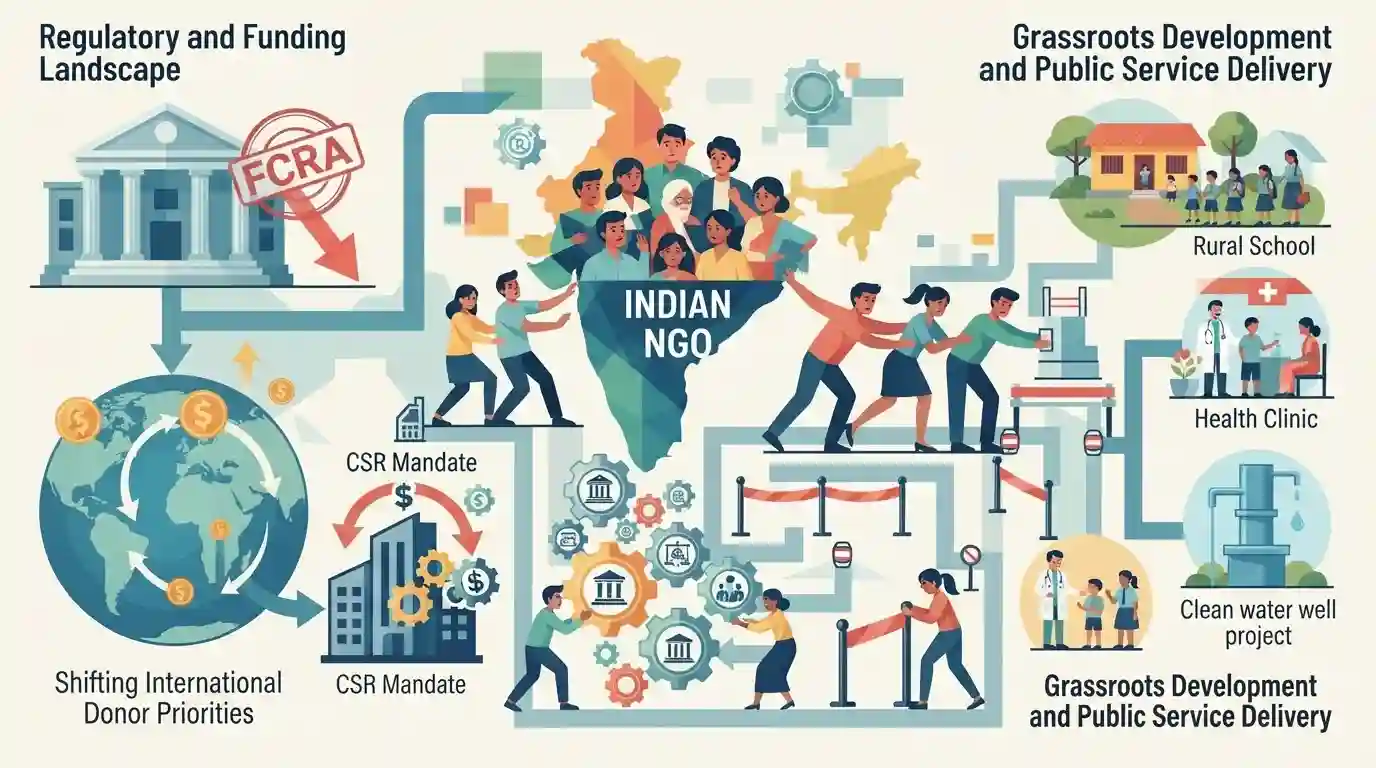
The article discusses the structural challenges confronting Indian Non-Governmental Organizations (NGOs) as they navigate shifting funding paradigms amidst stricter regulatory frameworks like the FCRA, evolving corporate social responsibility mandates, and changing international donor priorities, impacting their role in grassroots development and public service delivery.
મુખ્ય મુદ્દા
- India's NGOs are experiencing a critical funding transition, facing significant structural shifts in domestic and international financial support.
- Regulatory tightening, particularly under the Foreign Contribution (Regulation) Act (FCRA), has restricted foreign inflows, compelling NGOs to seek alternative domestic funding models.
- Corporate Social Responsibility (CSR) funding and local philanthropy face challenges, often leaning towards rigid corporate agendas rather than grassroots developmental needs.
- The financial squeeze threatens grassroots public service delivery, advocacy, and social development initiatives that complement state actions.
મહત્વપૂર્ણ શબ્દો
Foreign Contribution (Regulation) Act (FCRA)

A statutory enactment regulating the acceptance and utilization of foreign funds by individuals, associations, and NGOs in India to safeguard national security and public interest.
UPSC context
UPSC GS Paper II (Governance and Transparency): Important for questions on NGO regulation, foreign funding oversight, civil society autonomy, and internal security.
Corporate Social Responsibility (CSR)
A statutory mandate under Section 135 of the Companies Act, 2013, requiring eligible corporate entities to spend 2% of their average net profits on specified social development activities.
UPSC context
UPSC GS Paper II / III (Governance & Economy): Evaluates public-private partnerships, inclusive growth, corporate accountability, and complementary funding for social sectors.
Non-Governmental Organizations (NGOs)
Non-profit, voluntary civil society entities operating independently of government to deliver grassroots public services, champion human rights, and promote policy advocacy.
UPSC context
UPSC GS Paper II (Governance & Social Justice): Assesses the role of voluntary sector agencies, accountability frameworks, and grassroots development models.
પ્રિલિમ્સ ટ્રેપ
FCRA registration once granted is perpetual and permits domestic sub-granting of foreign funds to smaller unregistered entities.
Aspirants often assume FCRA registration is permanent or can be renewed automatically; however, recent amendments mandate regular five-year renewals and prohibit any sub-granting of foreign funds.
સંલગ્ન સ્થિર ખ્યાલો
What are the key regulatory provisions and restrictions governing Foreign Contributions in India under the FCRA?
- Eligible Entities: Foreign contributions can only be received by associations with a definite cultural, economic, educational, religious, or social programme, registered or granted prior permission under the FCRA, 2010.
- Sub-granting Ban: The 2020 Amendment Act completely prohibited the transfer (sub-granting) of foreign contributions to any other person or NGO, restricting funds strictly to the declared purpose.
- Mandatory SBI Account: All FCRA-designated foreign contributions must be received exclusively through a designated FCRA account at the State Bank of India (SBI), Main Branch, New Delhi.
આંતર-વિષય પેટર્ન
FCRA regulatory tightening vs FEMA inflows
The tightening of FCRA regulations and MCA Form CSR-1 mandates interact directly with FEMA provisions on cross-border capital flows and international development aid.
NGO funding squeeze vs DPSP social welfare
As state capacity shifts toward private and corporate philanthropy, the constitutional role of civil society in upholding Directive Principles of State Policy is transformed.

FCRA registration cancellations + CSR-1 compliance + Schedule VII priorities are prime candidates for a multi-statement Prelims MCQs.
સંલગ્ન PYQ · 4
સંલગ્ન PYQ · 4
- 2015MainsGS2
Examine critically the recent changes in the rules governing foreign funding of NGOs under the Foreign Contribution (Regulation) Act (FCRA), 1976.
- 2021MainsGS2
Can Civil Society and Non-Governmental Organizations present an alternative model of public service delivery to benefit the common citizen? Discuss the challenges of this alternative model.
- 2022MainsGS2
Do you agree with the view that increasing dependence on donor agencies for development reduces the importance of community participation in the development process ? Justify your answer.
- 2024MainsGS2
Public charitable trusts have the potential to make India's development more inclusive as they relate to certain vital public issues. Comment.
