Energy Transition Towards Electrification and Decarbonisation Policy
Source:The Hindu ↗
Why It Matters
Understanding the shift from 'molecules to electrons' is vital for GS3 (Energy, Environment, and Economy). It touches on India's energy security, technological indigenisation, climate change mitigation (net-zero 2070), and how industrial policy must adapt to green technology transitions.
Summary
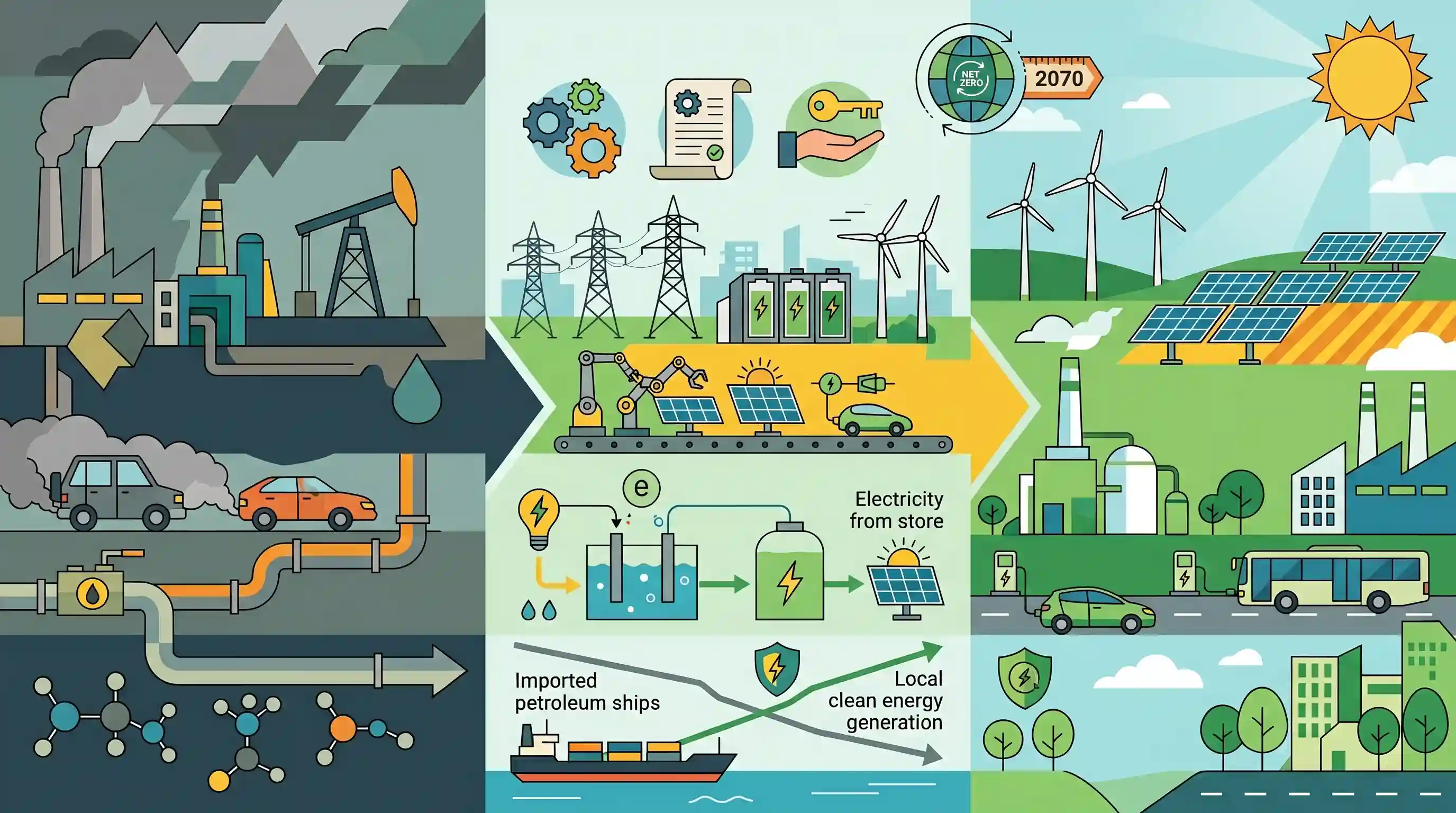
The article highlights a fundamental transition in India's industrial and energy landscape—moving away from molecule-based systems (fossil fuels, internal combustion engines) toward electron-based technologies (renewable electricity, electric vehicles, and green hydrogen). This structural shift is essential for decarbonizing the economy, enhancing energy security by reducing petroleum imports, and modernizing industrial manufacturing. To successfully pivot towards an 'electron-driven' economy, India must heavily prioritize grid infrastructure, battery storage ecosystems, and targeted industrial policies like PLIs and the National Green Hydrogen Mission, aligning its economic growth with long-term climate commitments like the net-zero target by 2070.
Key Points
- The phrase 'electrons over molecules' represents a paradigm shift in industrial and energy sectors, transitioning from fossil fuel combustion (molecules) to clean electricity (electrons).
- In the mobility sector, this shift is manifested in the accelerated adoption of Electric Vehicles (EVs) over traditional Internal Combustion Engine (ICE) vehicles, drastically cutting crude oil import dependence.
- For hard-to-abate sectors like steel and fertilizers, green hydrogen (produced via electron-driven electrolysis) serves as a crucial replacement for carbon-intensive fuels.
- Achieving this transition requires massive investments in renewable energy grids, battery energy storage systems (BESS), and domestic manufacturing capabilities through PLI schemes.
- This industrial shift is central to meeting India's Panchamrit targets, including 500 GW of non-fossil fuel capacity by 2030 and net-zero emissions by 2070.
Important Terms
National Green Hydrogen Mission

A flagship initiative (2023) by the Ministry of New and Renewable Energy to make India a global hub for green hydrogen production, usage, and export by 2030.
UPSC context
GS Paper 3 (Energy/Environment); tests clean energy targets, decarbonization strategies, and industrial self-reliance.
PLI Scheme for Advanced Chemistry Cell (ACC) Battery Storage
A ₹18,100 crore incentive program to establish 50 GWh of domestic giga-scale battery manufacturing capacity, reducing import dependence for electric vehicles and renewable energy storage.
UPSC context
GS Paper 3 (Economy/Science & Tech); tests industrial policy, supply chain resilience, and storage technologies.
FAME India Scheme
The Faster Adoption and Manufacturing of Electric Vehicles scheme provides subsidies and financial incentives to accelerate electric mobility transition and establish nationwide charging infrastructure.
UPSC context
GS Paper 3 (Infrastructure/Energy); relevant for sustainable transport, pollution control, and national mobility missions.
Paris Agreement
A legally binding international treaty (2015) aimed at limiting global warming; India’s commitments include 50% non-fossil fuel capacity by 2030 and net-zero by 2070.
UPSC context
GS Paper 2 (International Relations) and GS Paper 3 (Environment); central to climate governance and India’s Panchamrit goals.
NITI Aayog
India’s premier policy think tank providing strategic advice; it currently coordinates sectoral roadmaps and multi-sectoral committees to achieve the national net-zero target.
UPSC context
GS Paper 2 (Governance); tests the role of executive institutions in planning and cooperative federalism.
International Energy Agency (IEA)
An autonomous intergovernmental organization providing energy data and policy analysis; India is an associate member currently seeking full membership.
UPSC context
GS Paper 2 (International Institutions); relevant for global energy security and India’s role in energy governance.
Prelims Trap
India's Panchamrit target aims to achieve 500 GW of renewable energy capacity by 2030.
The target specifically mandates 500 GW of *non-fossil fuel* capacity. This is a crucial distinction because non-fossil includes nuclear energy and large hydro, not just solar or wind (renewables).
Static Concepts Connected
What is the mechanism behind Green Hydrogen production?
- Water Electrolysis: It utilizes an electrolyzer to pass an electric current through water (H2O), splitting it into hydrogen and oxygen.
- Renewable Pre-requisite: The electricity used for electrolysis must be generated entirely from renewable sources (solar, wind) for the resulting hydrogen to be classified as 'green'.
- Hard-to-Abate Utility: It serves as a clean molecule alternative for sectors where direct electrification (electrons) is technically or economically unfeasible, such as steelmaking and fertilizers.
What defines Advanced Chemistry Cell (ACC) Battery Storage?
- Electrochemical Storage: ACCs are the new generation of advanced storage technologies that can store electric energy either as electrochemical or as chemical energy.
- High Energy Density: They offer significantly higher energy density and longer life cycles compared to traditional lead-acid batteries, making them essential for EVs and grid stabilization.
- Import Dependency: India currently relies heavily on imports for ACCs; the PLI scheme attempts to build domestic cell manufacturing capabilities from scratch.
Cross-Topic Patterns
Critical Minerals & Geopolitics
The shift to batteries replaces crude oil reliance with critical mineral (Lithium, Cobalt, Nickel) dependency, tying India's domestic energy security directly to geopolitics and Quad supply-chain partnerships.
Green Hydrogen & EU's CBAM
Decarbonizing hard-to-abate sectors like steel via green hydrogen is essential for Indian manufacturers to remain globally competitive and bypass the EU's impending Carbon Border Adjustment Mechanism (CBAM).

Expect a multi-statement question blending PLI for Advanced Chemistry Cells, Green Hydrogen utility, and critical mineral supply in 2026.
Linked PYQs · 3
Linked PYQs · 3
- 2022MainsGS3
Do you think India will meet 50 percent of its energy needs from renewable energy by 2030 ? Justify your answer. How will the shift of subsidies from fossil fuels to renewables help achieve the above objective ? Explain.
- 2023MainsGS3
The adoption of electric vehicles is rapidly growing worldwide. How do electric vehicles contribute to reducing carbon emissions and what are the key benefits they offer compared to traditional combustion engine vehicles?
- 2018MainsGS3
“Access to affordable, reliable, sustainable and modern energy is the sine qua non to achieve Sustainable Development Goals (SDGs).” Comment on the progress made in India in this regard.
