India R and D Innovation Scaling and Commercialization Hurdles
Source:The Hindu ↗
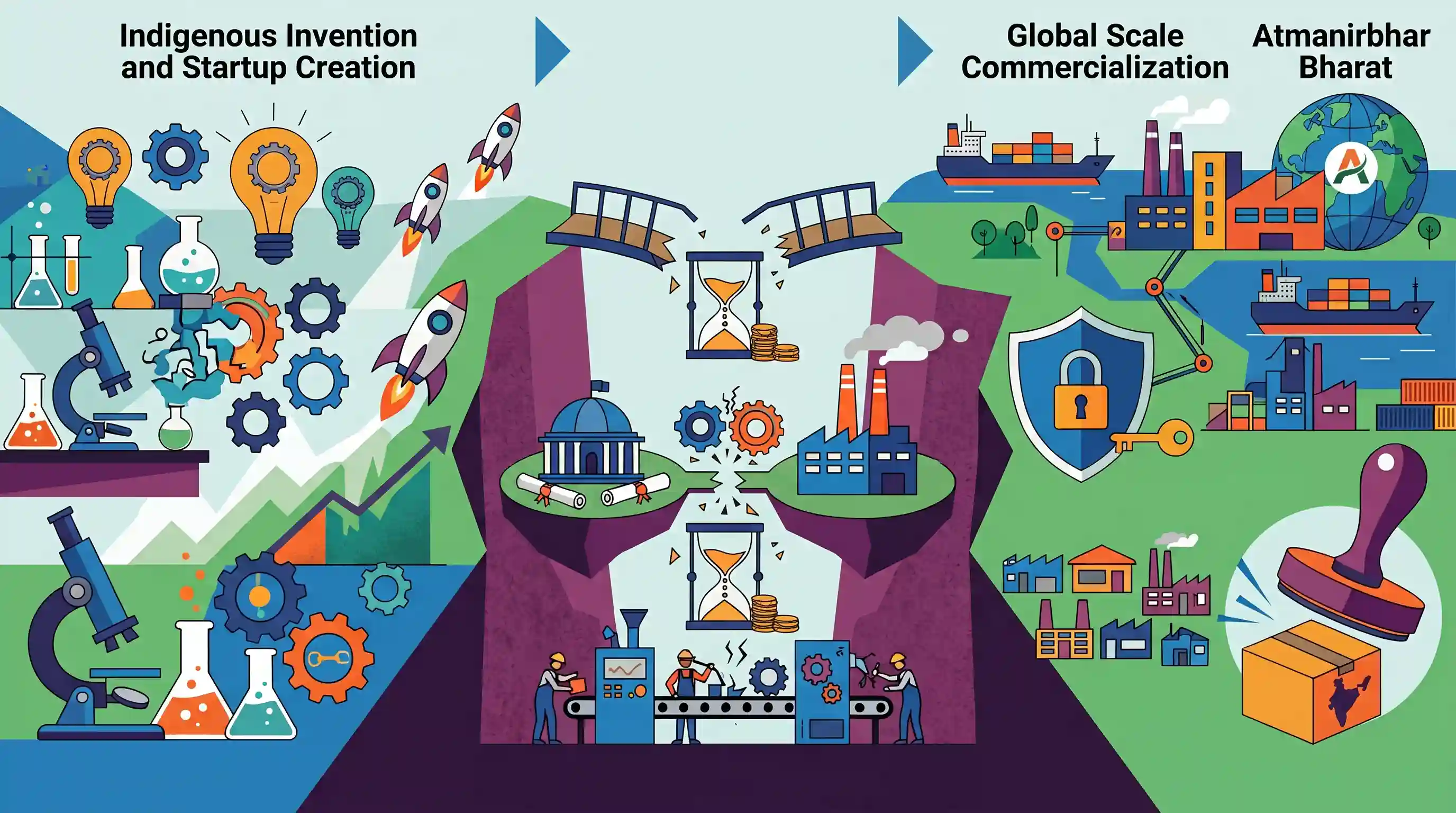
Why It Matters
The gap between patent filing and commercialization is a direct theme in recent UPSC Mains (e.g., 2024 GS3). Understanding the structural barriers to scaling up technologies—such as funding deficits, tech-transfer bottlenecks, and manufacturing hurdles—is crucial for answering questions on India's R&D ecosystem, economic growth, and self-reliance (Atmanirbhar Bharat).
Summary
The article analyzes a critical bottleneck in India's innovation ecosystem: the transition from indigenous invention to global-scale commercialization. While India has made significant strides in patent filings and startup creation, bridging the 'valley of death' between a lab prototype and a globally competitive product remains a formidable challenge. Key hurdles include the dearth of long-term 'patient capital' for deep-tech ventures, weak industry-academia linkages for technology transfer, and systemic challenges in hardware manufacturing. To realize the vision of Atmanirbhar Bharat, the ecosystem requires strategic policy interventions, including risk-tolerant funding mechanisms, robust Intellectual Property Rights (IPR) enforcement, targeted support for MSMEs, and enhanced public procurement of domestic innovations.
Key Points
- Patent vs. Commercialization Gap: Despite ranking highly in patent filings and boasting a robust startup ecosystem, India struggles to translate domestic inventions into globally competitive commercial products.
- The 'Valley of Death': Many promising indigenous technologies fail during the scaling phase due to a lack of 'patient capital,' particularly in capital-intensive deep-tech sectors like hardware, semiconductors, and biotechnology.
- Industry-Academia Disconnect: Research in academic and public institutions often remains siloed; there is a critical need for stronger institutional frameworks to facilitate technology transfer and market-driven R&D.
- Manufacturing and Supply Chain Realities: Scaling software is fundamentally different from scaling hardware. Global scaling requires robust advanced manufacturing capabilities, integration of MSMEs, and resilient supply chains.
- Policy Imperatives: Fostering scale requires strategic government procurement of indigenous tech, stronger Intellectual Property Rights (IPR) enforcement, regulatory sandboxes, and operationalizing initiatives like the ANRF.
Important Terms
Anusandhan National Research Foundation (ANRF)

A statutory apex body established under the ANRF Act, 2023, to provide high-level strategic direction for scientific research, promote industry-academia collaboration, and oversee R&D funding in India.
UPSC context
GS-III (S&T). Tests knowledge of R&D governance, funding mechanisms, and bridging the gap between basic research and commercial innovation.
National Deep Tech Startup Policy (NDTSP)
A policy framework targeting startups with significant scientific or engineering breakthroughs. It focuses on addressing bottlenecks like patient capital, Intellectual Property (IP) protection, and high-cost R&D infrastructure.
UPSC context
GS-III (S&T/Economy). Relevant for questions on deep-tech ecosystems, technological indigenization, and long-term risk-tolerant funding.
Atmanirbhar Bharat
A flagship campaign launched in 2020 to achieve self-reliance via five pillars: Economy, Infrastructure, Technology-driven Systems, Vibrant Demography, and Demand, aiming to integrate India more strongly into global supply chains.
UPSC context
GS-III (Economy/S&T). The core theme for self-reliance, domestic manufacturing, and reducing import dependency in critical sectors.
Startup India
A flagship initiative launched in 2016 to foster a robust startup culture through simplified compliance, financial incentives (like tax exemptions), and enhanced industry-academia partnerships.
UPSC context
GS-III (Economy). Central to discussions on entrepreneurship, ease of doing business, and job-creating economic transitions.
Department for Promotion of Industry and Internal Trade (DPIIT)
The nodal department under the Ministry of Commerce and Industry responsible for industrial policy, internal trade, Startup India, and the overall Intellectual Property Rights (IPR) regime in India.
UPSC context
GS-III (Economy/IPR). Key regulatory body tested in contexts of industrial growth, FDI, and intellectual property management.
MSMEs (Micro, Small and Medium Enterprises)
Enterprises classified by a composite criterion of investment and turnover (revised in 2020). They are considered the "backbone" of the economy for their role in manufacturing and employment.
UPSC context
GS-III (Economy/Manufacturing). Essential for questions on inclusive growth, formalization of the economy, and domestic scaling of innovations.
Prelims Trap
"The Anusandhan National Research Foundation (ANRF) corpus is entirely funded by the Central Government."
A major feature of ANRF is that roughly 72% (₹36,000 crore) of its ₹50,000 crore corpus is explicitly expected to be mobilized from the private sector.
Static Concepts Connected
How does DPIIT classify deep-tech startups differently?
- Standard limit: Usually, an entity is a startup up to 10 years from incorporation with a turnover cap of ₹100 crore.
- Deep-tech relaxation: Due to high gestation periods, recognized age limits for deep-tech are extended to 20 years and turnover caps raised to ₹300 crore.
- Valley of Death: These relaxations help deep-tech survive the lab-to-market gap where capital-intensive hardware prototyping often stalls without long-term tax benefits.
What is the Public Procurement Order 2017?
- Core mandate: Mandates a purchase preference for local suppliers in government tenders based on a specified percentage of local content.
- Innovation support: Acts as a crucial demand-side intervention, ensuring early-market access and initial revenue lifelines for indigenous tech and MSMEs.
Cross-Topic Patterns
Public Procurement as Innovation Policy
Moves beyond supply-side PLI schemes by leveraging massive government buying power to de-risk early-stage domestic deep-tech hardware and ensure guaranteed early revenue.
Patient Capital vs Traditional VC
Software startups scale quickly, but hardware and biotech rely on 'patient capital'—long-term, risk-tolerant equity that standard 5-year VC funds cannot provide.

Expect a 2026 Prelims trap testing the 72% private funding ratio of ANRF, or a Mains question on the deep-tech 'patient capital' deficit.
Linked PYQs · 3
Linked PYQs · 3
- 2024MainsGS3
What is the present world scenario of intellectual property rights with respect to life materials? Although, India is second in the world to file patents, still only a few have been commercialized. Explain the reasons behind this less commercialization.
- 2023MainsGS3
Faster economic growth requires increased share of the manufacturing sector in GDP, particularly of MSMEs. Comment on the present policies of the Government in this regard.
- 2014MainsGS3
In a globalized world, Intellectual Property Rights assume significance and are a source of litigation. Broadly distinguish between the terms-Copyrights, Patents and Trade Secrets.
