India AI governance guidelines and light touch regulation
Source:The Hindu ↗
Why It Matters
This article provides critical insights into India's evolving stance on AI regulation. Understanding the shift towards a pro-innovation framework and the proposed integration of AI with Digital Public Infrastructures (DPI) provides strong vocabulary and specific examples (e.g., seven AI principles) for GS3 answers on emerging technologies and GS2 answers on e-governance.
Summary
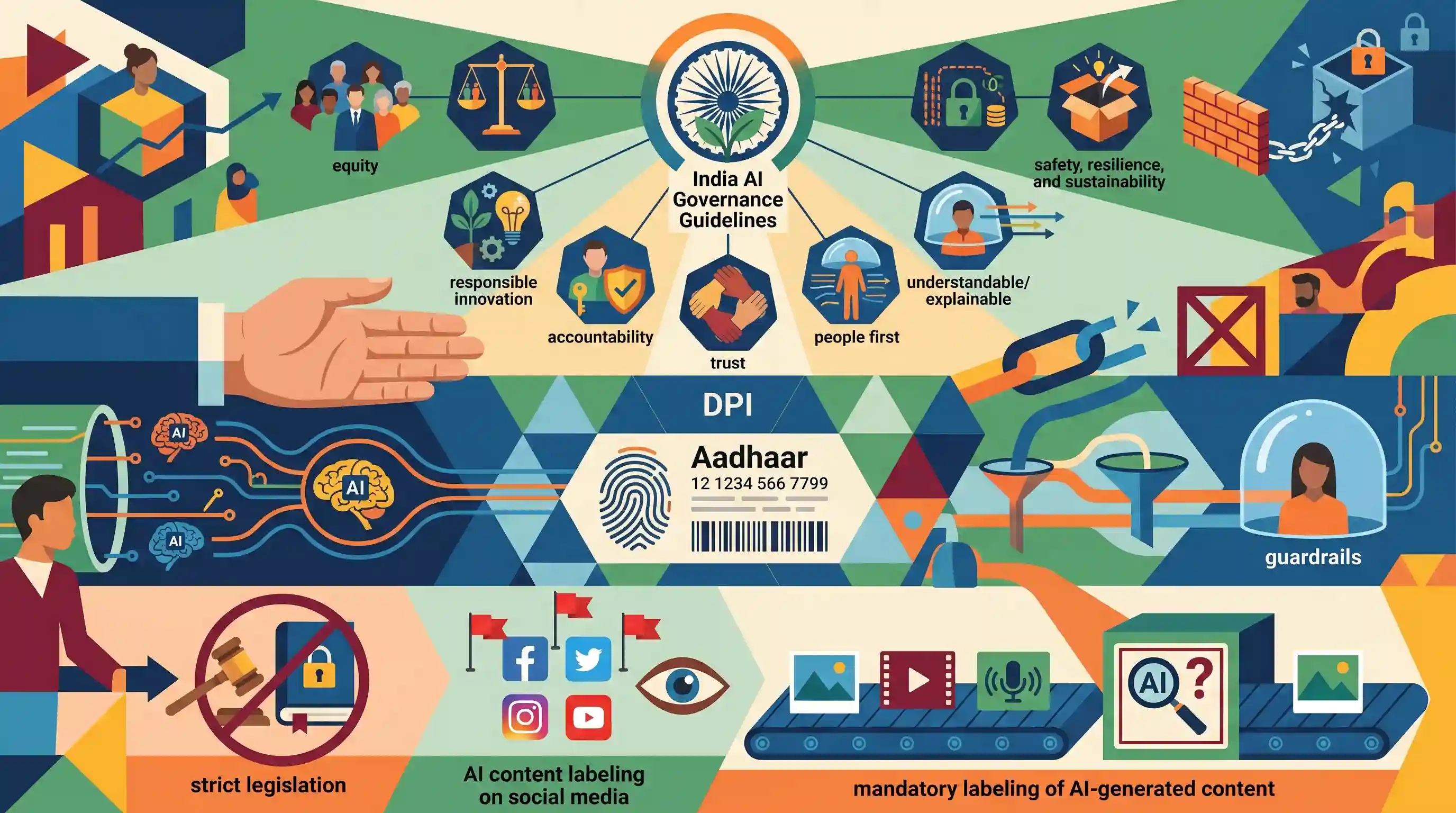
The Ministry of Electronics and Information Technology (MeitY) has introduced the 'India AI Governance Guidelines', reflecting a strategic shift towards a 'hands-off' regulatory approach to promote AI innovation. Drafted by a committee headed by Balaraman Ravindran, the guidelines lay out seven core principles focusing on responsible innovation, equity, and accountability. Distancing itself from earlier risk-averse frameworks, the model aims to foster AI integration with Digital Public Infrastructures (DPIs) like Aadhaar while maintaining safety guardrails. The government currently has no plans for strict AI legislation, though separate rules are being formulated to mandate labelling of AI-generated content on social media.
Key Points
- MeitY released the 'India AI Governance Guidelines', advocating a hands-off approach to encourage AI innovation with necessary guardrails, avoiding restrictive regulations that could throttle adoption.
- The framework is based on seven core principles: trust, people-centricity, responsible innovation, equity, accountability, understandability of LLMs, and safety, resilience, and sustainability.
- The new guidelines mark a shift away from previous, more risk-averse drafts and frameworks inspired by NITI Aayog and OECD models.
- Short-to-medium-term recommendations include establishing governance institutions, developing India-specific risk frameworks, operationalizing AI incident systems for cybersecurity, and integrating AI with Digital Public Infrastructures (DPIs) like Aadhaar.
- There are no immediate plans for a standalone AI law; however, a separate amendment to the IT Rules, 2021 is undergoing consultation to mandate the labelling of AI-generated content on social media.
Important Terms
India AI Governance Guidelines

A 2025/26 framework released by MeitY adopting a 'hands-off,' principle-based approach to regulate AI. It emphasizes seven 'Sutras' (e.g., 'Do No Harm', Accountability) to balance innovation with safety safeguards.
UPSC context
GS Paper III: Science & Technology and GS Paper II: Governance. Relevant for debates on innovation vs. regulation.
Digital Public Infrastructure (DPI)
Shared digital building blocks (like Aadhaar and UPI) that enable population-scale service delivery. Integration with AI (DPI x AI) aims to democratize access to compute and datasets for public benefit.
UPSC context
GS Paper III: Economy and S&T. Central to India's digital sovereignty and e-governance strategy.
Ministry of Electronics and Information Technology (MeitY)
The nodal central ministry for IT policy and internet governance. It oversees the IndiaAI Mission and recently notified amendments for AI content labeling and faster content takedowns.
UPSC context
GS Paper II: Statutory/Regulatory bodies. Tests knowledge of departmental roles in digital regulation.
IT Rules, 2021
Regulatory framework for digital platforms, amended in 2026 to mandate labeling of AI content and reduce takedown timelines for illegal material (deepfakes) to 2-3 hours.
UPSC context
GS Paper III: Cybersecurity and GS Paper II: Social Media. Crucial for legal measures against misinformation.
Synthetically Generated Information (SGI)
Legal term introduced in IT Rule amendments (2026) for audio, visual, or audio-visual content artificially created or modified by AI to appear realistic and authentic.
UPSC context
GS Paper III: S&T and Ethics. Important for understanding terminology related to deepfakes and AI safety.
IndiaAI Mission
A comprehensive national program aimed at building India's AI stack, including compute infrastructure (GPUs), data platforms (AIKosh), and support for indigenous AI model development.
UPSC context
GS Paper III: S&T. Tests knowledge of state-led technological capacity building and 'AI for All'.
Prelims Trap
"The India AI Governance Guidelines are statutory rules enacted to strictly regulate AI models like the EU AI Act."
India's new guidelines are non-statutory principles advocating a 'hands-off' approach. India does not currently have a standalone AI law, unlike the EU.
Static Concepts Connected
What constitutes India's Digital Public Infrastructure (DPI)?
- Digital Identity: Aadhaar provides a foundational, biometric-backed digital identity for targeted service delivery and authentication.
- Digital Payments: UPI enables seamless, interoperable, real-time digital financial transactions across the economy.
- Data Exchange: DEPA (Data Empowerment and Protection Architecture) allows secure, consent-based sharing of user data.
What are the key compliance mandates under IT Rules, 2021?
- Safe Harbour: Intermediaries must strictly follow due diligence to retain immunity under Section 79 of the IT Act.
- Grievance Redressal: Significant intermediaries must appoint resident grievance, compliance, and nodal contact officers in India.
- Traceability: Messaging platforms must enable the identification of the first originator of flagged malicious information.
Cross-Topic Patterns
AI integration with India Stack
India is positioning its Digital Public Infrastructure (Aadhaar, UPI, Bhashini) as foundational datasets for AI innovation, shifting focus from pure risk-regulation to public service delivery.
Deepfakes, IT Rules & Internal Security
Amending IT Rules 2021 to mandate AI-generated content labeling directly connects S&T advancements (LLMs) with Internal Security, cyber hygiene, and electoral integrity.

Expect a comparative Prelims question contrasting India's 'hands-off/DPI-led' AI approach with the EU's statutory, risk-based AI Act.
Linked PYQs · 3
Linked PYQs · 3
- 2023MainsGS3
Introduce the concept of Artificial Intelligence (AI). How does Al help clinical diagnosis? Do you perceive any threat to privacy of the individual in the use of Al in healthcare?
- 2024MainsGS2
e-governance is not just about the routine application of digital technology in service delivery process. It is as much about multifarious interactions for ensuring transparency and accountability. In this context evaluate the role of the 'Interactive Service Model' of e-governance.
- 2024MainsGS3
Social media and encrypting messaging services pose a serious security challenge. What measures have been adopted at various levels to address the security implications of social media? Also suggest any other remedies to address the problem.
