India Foreign Policy Shift and Historical Stance on Palestine
Source:The Hindu ↗
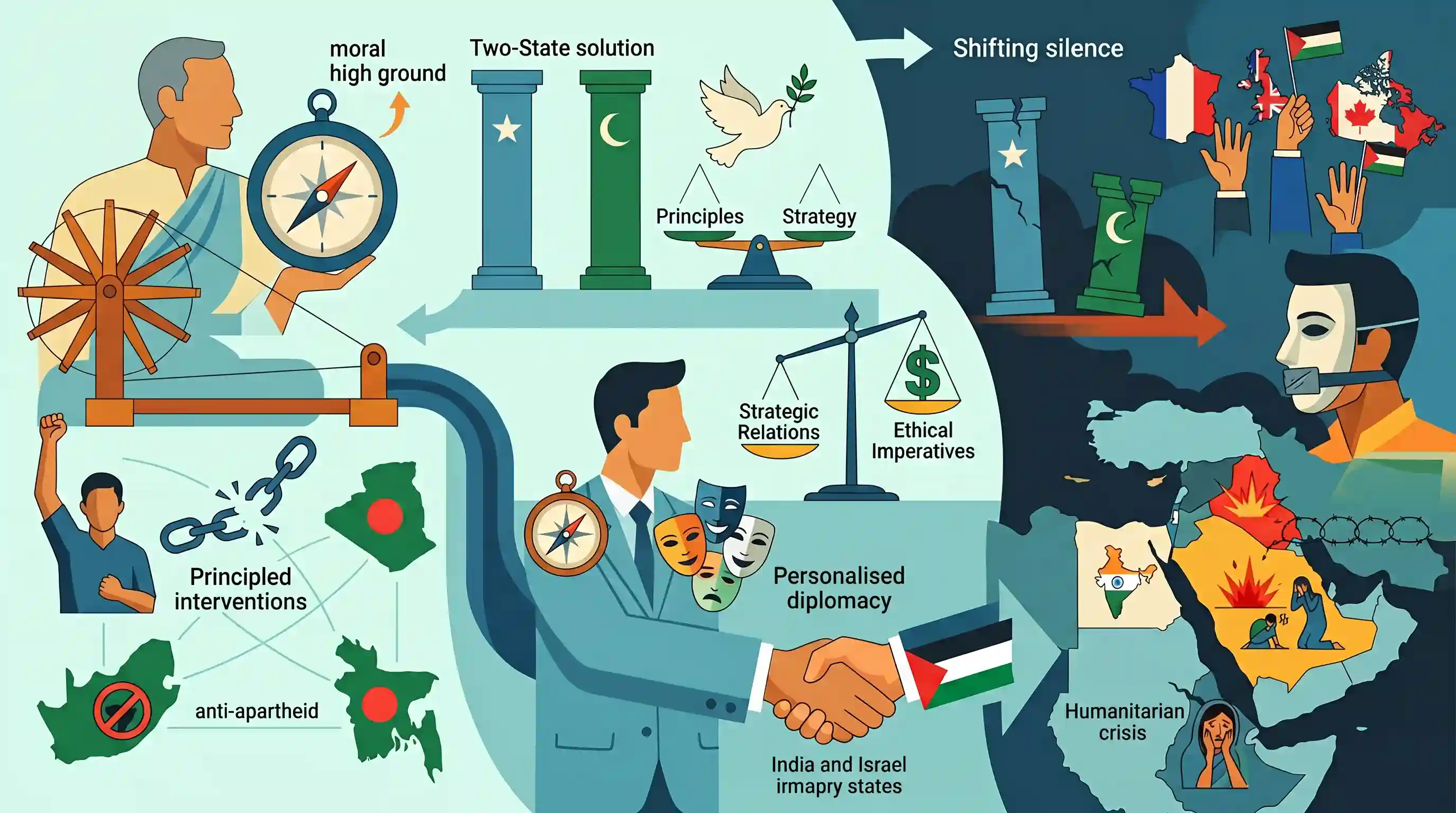
Why It Matters
The article provides a critical evaluation of the shift in India's foreign policy from ideological Non-Alignment to pragmatic/personalized diplomacy. This is highly relevant for GS2 (Bilateral Relations, Foreign Policy) and GS4 (Ethics in International Relations), providing excellent arguments on the role of moral clarity, humanitarian aid, and historical empathy in global diplomacy.
Summary
This opinion piece by Sonia Gandhi critiques India's shifting foreign policy regarding the Israel-Palestine conflict, asserting that India has abandoned its historical moral clarity and commitment to a two-state solution. While nations globally (including France, the UK, and Canada) are recognizing Palestinian statehood, India remains conspicuously silent, driven by what the author terms "personalised diplomacy" rather than enduring constitutional values. Emphasizing India's legacy of anti-colonialism and principled interventions (such as in apartheid South Africa, Algeria, and Bangladesh), the article argues that India must balance strategic relations with ethical imperatives, and that its current muteness amid the humanitarian crisis in Gaza equates to complicity.
Key Points
- India historically championed moral clarity in international relations, becoming one of the first countries to recognize the PLO (1974) and Palestinian statehood (1988) rooted in anti-colonial solidarity.
- Sonia Gandhi criticizes the current Indian government's "muted" response to the Israel-Gaza conflict, arguing that India has shifted toward a "personalised diplomacy" driven by leadership friendships rather than constitutional values or strategic interests.
- More than 150 UN member states, alongside recent additions like France, the UK, Canada, and Australia, have recognized Palestinian statehood—highlighting a global momentum toward the two-state solution that India has historically supported.
- The article underscores an ethical imperative in foreign policy, arguing that in the face of widespread humanitarian catastrophe in Gaza, "silence is not neutrality—it is complicity."
Important Terms
Oslo Accords

A series of 1990s agreements between Israel and the PLO that established a peace process and created the Palestinian Authority for limited self-governance in the West Bank and Gaza.
UPSC context
GS-II (Bilateral Relations); crucial for understanding the diplomatic framework that allowed India to normalize ties with Israel while supporting Palestine.
Palestine Liberation Organisation (PLO)
Founded in 1964 to represent the Palestinian people; India was the first non-Arab state to recognize it (1974) as their sole legitimate representative.
UPSC context
GS-II (India's Foreign Policy); demonstrates India’s historical leadership in the Global South and its early commitment to Palestinian statehood.
Non-Aligned Movement (NAM)
A forum of 120 developing nations not formally aligned with major power blocs; it has historically served as the primary platform for India’s anti-colonial pro-Palestine stance.
UPSC context
GS-II (International Groupings); tests knowledge of India’s legacy of "principled" diplomacy and its transition toward strategic autonomy.
Hamas
A Palestinian political and militant organization that has governed the Gaza Strip since 2007; its 2023 attack on Israel prompted a significant shift in India’s diplomatic rhetoric.
UPSC context
GS-II/GS-III (Security/International Relations); relevant for discussing terrorism, humanitarian ethics, and India’s evolving "balanced" Middle East policy.
1947 UN Partition Plan
UN Resolution 181 which proposed dividing Mandatory Palestine into independent Arab and Jewish states; India notably voted against it in 1947, favoring a federal state.
UPSC context
GS-II (International Relations); essential for understanding the origins of the conflict and the historical foundations of India’s voting record.
Organisation of Islamic Cooperation (OIC)
A 57-member intergovernmental body representing the 'collective voice of the Muslim world'; it frequently advocates for Palestinian rights and occasionally critiques India on Kashmir.
UPSC context
GS-II (Regional Groupings); important for India’s diplomatic balancing act and energy security interests in the West Asian region.
United Nations (UN)
The primary multilateral organization where India has historically supported Palestinian causes, including recognition as a non-member observer state and calls for humanitarian ceasefires.
UPSC context
GS-II (Global Institutions); tests India’s role in multilateralism and its adherence to international law regarding sovereignty and human rights.
Prelims Trap
India revoked its recognition of Palestine to align its foreign policy with the I2U2 grouping.
India still officially recognizes Palestinian statehood (since 1988) and supports a two-state solution at the UN, even though its diplomatic tone has shifted towards pragmatism.
Static Concepts Connected
What is India's 'De-hyphenation' policy in West Asia?
- Independent Ties: Engaging with Israel and Palestine independently based on mutual interests, rather than viewing relations with one through the lens of the other.
- Diplomatic Shift: Ended the traditional practice of balancing official visits; PM Modi's standalone visit to Israel in 2017 formalized this pragmatic approach.
How did India historically approach the Palestine question?
- 1947 UN Vote: India voted against the 1947 UN Partition Plan that divided Mandatory Palestine into Arab and Jewish states.
- 1974 PLO Recognition: Became the first non-Arab state to recognize the PLO as the sole legitimate representative of the Palestinian people.
- 1988 Statehood: India was among the first countries globally to officially recognize the independent State of Palestine, driven by anti-colonial solidarity.
Cross-Topic Patterns
Ethics vs. Realpolitik (GS4)
The shift from moral anti-colonial solidarity (NAM era) to pragmatic "de-hyphenation" is a classic GS4 case study on national interest versus ethical diplomacy and human rights.
I2U2, IMEC & Strategic Constraints
India's integration into US-backed tech, trade, and transit corridors (IMEC, I2U2) structurally anchors its strategic ties to Israel, altering its historical diplomatic maneuverability.

Expect a GS2/GS4 mains question contrasting India's historical moral leadership in NAM with its current 'de-hyphenated' realpolitik.
Linked PYQs · 4
Linked PYQs · 4
- 2018MainsGS2
“India’s relations with Israel have, of late, acquired a depth and diversity, which cannot be rolled back.” Discuss.
- 2022MainsGS2
How will I2U2 (India, Israel, UAE and USA) grouping transform India's position in global politics?
- 2020MainsGS4
‘The will to power exists, but it can be tamed and be guided by rationality and principles of moral duty.’ Examine this statement in the context of international relations.
- 2023MainsGS4
International aid' is an accepted form of helping 'resource-challenged' nations. Comment on 'ethics in contemporary international aid'. Support your answer with suitable examples.
