India Copyright Regime Needs Balance Between Rights and Public Access
Source:The Hindu ↗
Why It Matters
Intellectual Property Rights (IPR) are a core component of the GS3 syllabus. The delicate balance between enforcing copyright protection and preserving public access to knowledge is a recurring theme in UPSC exams. Furthermore, the intersection of copyright law with emerging technologies like Artificial Intelligence adds a contemporary layer highly relevant for both Prelims (factual questions on TRIPS/WIPO) and Mains (analytical questions on policy impacts).
Summary
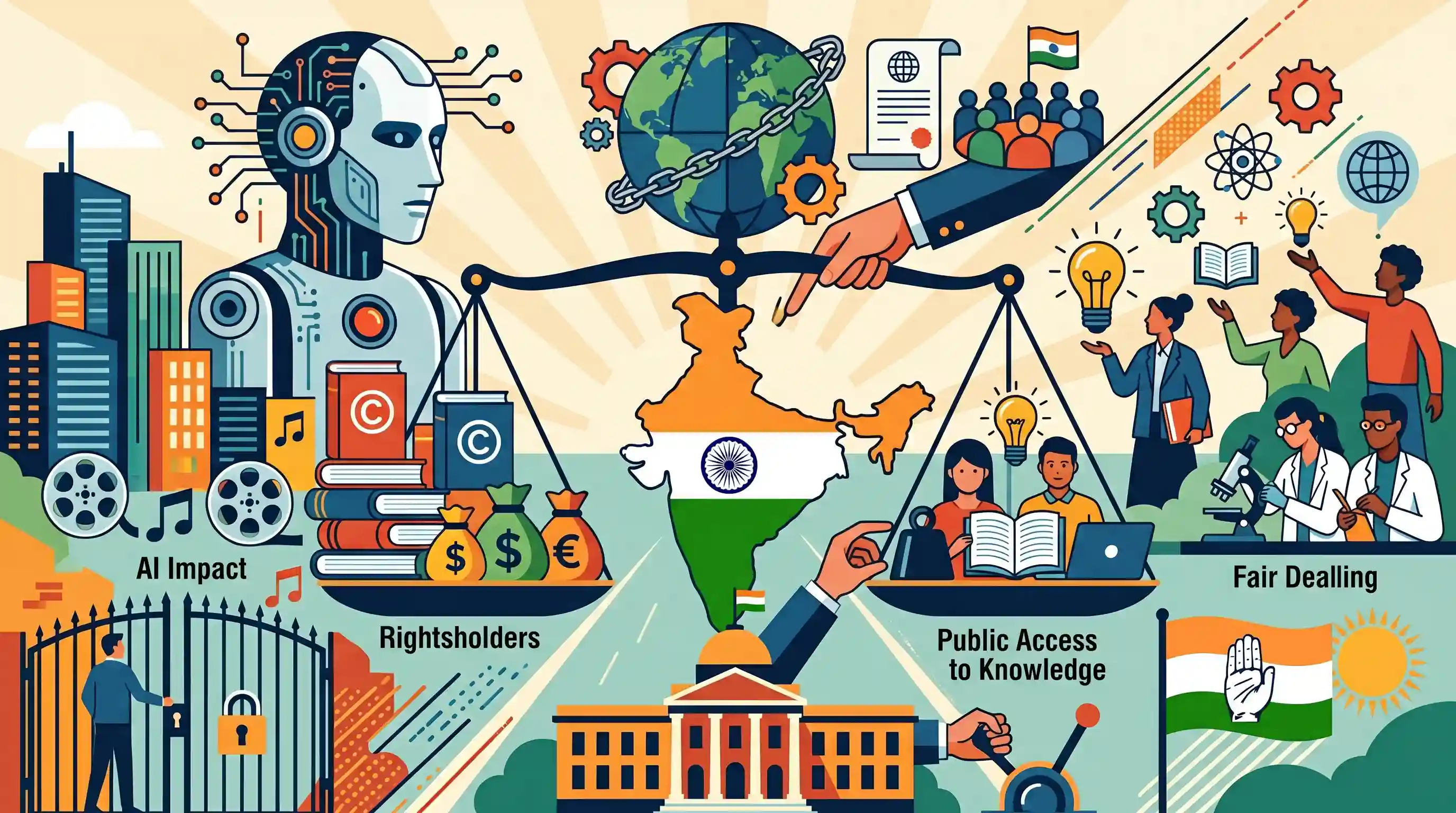
The article advocates for restoring equilibrium in India's copyright regime, highlighting the tension between the commercial interests of rightsholders and the public’s fundamental right to access knowledge. It explores ongoing debates surrounding Intellectual Property Rights (IPR), particularly the impact of Artificial Intelligence and digital technologies on copyright, statutory licensing, and exceptions for fair dealing. The piece emphasizes the need to align copyright legislation with India's unique socio-economic realities, ensuring that international obligations under treaties like WIPO and TRIPS do not disproportionately restrict access to educational materials, research, and cultural innovation.
Key Points
- Highlights the necessity to balance the economic rights of creators with the broader public interest, particularly concerning access to knowledge and education.
- Discusses the implications of international agreements, such as the TRIPS Agreement and WIPO treaties, on India's domestic copyright framework.
- Examines the novel challenges posed by emerging digital technologies and Artificial Intelligence, including text and data mining (TDM), and the adequacy of fair dealing exceptions under the Copyright Act of 1957.
- Stresses that India’s unique socio-economic context necessitates robust public-interest exceptions, avoiding overly restrictive models that could stifle domestic innovation.
- Emphasizes the significance of statutory licensing, fair use protections, and safeguarding the public domain to foster an equitable intellectual property environment.
Important Terms
Copyright Act 1957

The primary legislation governing copyright in India, protecting original literary, artistic, and musical works. It includes 'fair dealing' exceptions (Section 52) to balance creator rights with public access for education and research.
UPSC context
GS Paper 2/3: Essential for understanding India's legal framework for IPR, digital rights, and the 'fair use' doctrine in judicial precedents.
TRIPS Agreement
A comprehensive WTO agreement setting global minimum standards for IP protection. It provides flexibilities for member nations to balance intellectual property rights with public health and socio-economic development needs.
UPSC context
GS Paper 3: Crucial for evaluating India's international obligations versus domestic developmental priorities and access to knowledge.
World Intellectual Property Organization (WIPO)
A UN specialized agency that acts as a global forum for IP services, policy, and cooperation. It administers international treaties to promote innovation while safeguarding public interest through balanced IP rules.
UPSC context
GS Paper 2: Key international organization for topics on global governance, innovation policy, and multilateral IP treaties.
National Intellectual Property Rights (IPR) Policy 2016
India’s first unified vision document for intellectual property, aiming to foster innovation and streamline administration. It emphasizes 'Creative India; Innovative India' while maintaining compliance with international TRIPS standards.
UPSC context
GS Paper 3: Vital for discussing government interventions in science, technology, and economic growth through a robust IP ecosystem.
World Trade Organization (WTO)
The global organization regulating international trade. It administers the TRIPS agreement, linking intellectual property protection to trade obligations and providing a mechanism for resolving IP-related trade disputes.
UPSC context
GS Paper 2/3: Significant for studying global trade dynamics, international relations, and the enforcement of multilateral IP standards.
Prelims Trap
"The Indian Copyright Act explicitly exempts Text and Data Mining (TDM) for commercial AI model training."
India lacks an explicit TDM exception for AI. We use a narrow 'fair dealing' doctrine (Section 52), unlike the broader, more flexible US 'fair use' doctrine.
Static Concepts Connected
What constitutes 'Fair Dealing' under Section 52 of India's Copyright Act?
- Private Research: Use of copyrighted material for private or personal research, including for academic and educational purposes.
- Criticism & Review: Using necessary excerpts for reviewing, criticizing, or commenting on the work itself or another related work.
- Current Events: Utilization of works for reporting current events and affairs, including public lectures.
What are the key 'TRIPS flexibilities' used by developing nations?
- Compulsory Licensing: Permits governments to authorize third parties to produce a patented product/process without the owner's consent during national emergencies.
- Parallel Imports: Importing a legitimately patented product from another country where it is cheaper, without the patent holder's direct permission.
- Doha Declaration: The 2001 agreement affirming that TRIPS should not prevent members from taking measures to protect public health and socio-economic needs.
Cross-Topic Patterns
Gen-AI: Copyright meets Data Privacy
AI web scraping creates dual vulnerabilities: intellectual property infringement under the Copyright Act, and non-consensual processing of personal data regulated by the DPDP Act.
Compulsory Licensing: Pharma to AI
TRIPS flexibilities, historically tested in UPSC regarding life-saving drugs and compulsory licensing (Section 84 of the Patents Act), are now entering the digital and AI technology space.

Expect a multi-statement Prelims question comparing India's narrow 'Fair Dealing' vs the broader US 'Fair Use' doctrine in AI contexts.
Linked PYQs · 4
Linked PYQs · 4
- 2014MainsGS3
In a globalized world, Intellectual Property Rights assume significance and are a source of litigation. Broadly distinguish between the terms-Copyrights, Patents and Trade Secrets.
- 2002PrelimsGS1
Consider the following statements: 1. The World Intellectual Property Organisation (WIPO) is a specialised agency of United Nations System of Organisations 2. WIPO has its headquarters at Rome 3. The Trade Related Aspects of Intellectual Property Rights (TRIPS) Agreement is binding on all WTO members 4. Least developed country members of WTO are not required to apply the provisions of TRIPS Agreements for a period of 20 years from the general date of application of the Agreement Which of these statements are correct?
- 2017PrelimsGS1
With reference to the 'National Intellectual Property Rights Policy', consider the following statements: 1. It reiterates India's commitment to the Doha Development Agenda and the TRIPS Agreement. 2. Department of Industrial Policy and Promotion is the nodal agency for regulating intellectual property rights in India. Which of the above statements is/are correct?
- 2023MainsGS3
Introduce the concept of Artificial Intelligence (AI). How does Al help clinical diagnosis? Do you perceive any threat to privacy of the individual in the use of Al in healthcare?
