Climate Change Preparedness and National Security Challenges for India
Source:Indian Express ↗
Why It Matters
Highlights the intersection of environmental issues and national security, a critical interdisciplinary theme for Mains GS3. Candidates must understand how non-traditional threats like climate change directly impact military operational readiness, border infrastructure, and disaster management protocols.
Summary
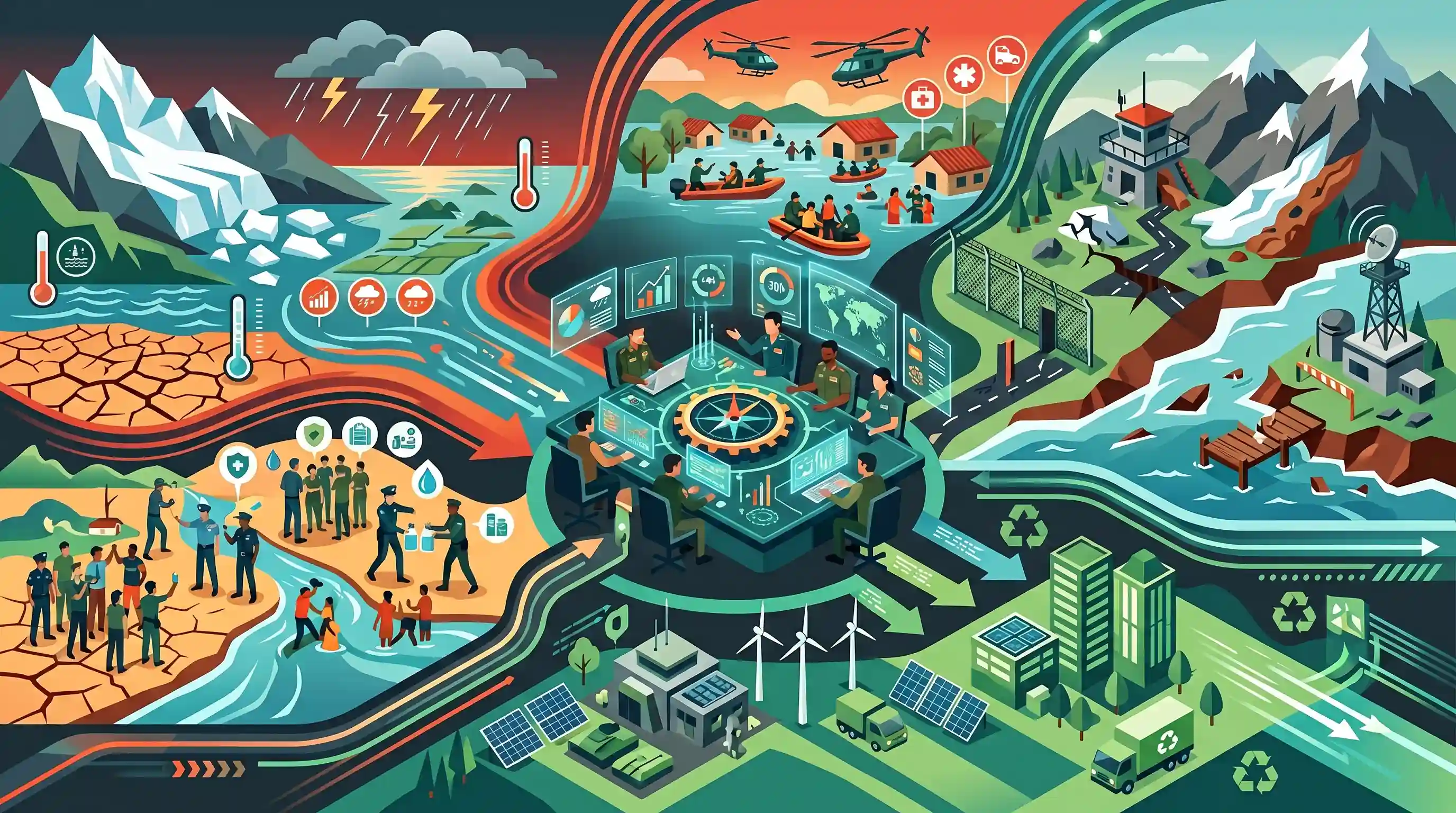
The article emphasizes the urgent need for India's military to prepare for the multifaceted impacts of climate change. As extreme weather events become more frequent, the armed forces are increasingly diverted toward Humanitarian Assistance and Disaster Relief (HADR) operations, potentially straining core defense readiness. Furthermore, climate shifts—such as glacial melting in the Himalayas and rising sea levels in the Indian Ocean—pose direct threats to border infrastructure, coastal security, and logistics. The military must integrate climate risk assessments into strategic planning, build resilient infrastructure, and adopt sustainable practices to maintain operational effectiveness in a changing environment.
Key Points
- Climate change acts as a 'threat multiplier' that exacerbates existing national security vulnerabilities.
- The rising frequency of natural disasters increases the demand for military-led Humanitarian Assistance and Disaster Relief (HADR) missions, potentially straining core combat readiness.
- Border security in the Himalayas and coastal defense face distinct physical threats from glacial retreats, extreme weather, and sea-level rise.
- The armed forces need to embed climate resilience into their supply chains, infrastructure planning, and operational doctrines.
- Adopting sustainable technologies and reducing the military's carbon footprint can offer long-term strategic and logistical advantages.
Important Terms
Humanitarian Assistance and Disaster Relief (HADR)

Coordinated civil-military operations conducted to respond to natural or man-made disasters. These missions provide immediate relief, search and rescue, and essential service restoration in affected regions, both domestically and internationally.
UPSC context
GS Paper 3 (Disaster Management/Security). Tests the military's role as a net security provider and its capacity for non-traditional security operations.
Border Management
A multifaceted strategy to secure frontiers against infiltration, smuggling, and terrorism while facilitating legitimate trade. It involves specialized forces, technology like CIBMS, and infrastructure adapted to diverse terrains like glaciers and coasts.
UPSC context
GS Paper 3 (Internal Security). Focuses on terrain-specific security challenges and the impact of environmental changes on border infrastructure.
Glacial Lake Outburst Flood (GLOF)
A catastrophic flood occurring when the natural dam containing a glacial lake fails, suddenly releasing massive volumes of water. Triggers include rapid glacial melting, avalanches, or seismic activity, primarily in the Himalayas.
UPSC context
GS Paper 1 (Geography) and GS Paper 3 (Disaster Management). Highly relevant for Himalayan security and disaster risk reduction (DRR).
Indian Ocean Region (IOR)
A strategic maritime expanse spanning the Indian Ocean, vital for global trade (SLOCs) and energy security. India views this region as central to its SAGAR vision and maritime security strategy.
UPSC context
GS Paper 2 (International Relations) and GS Paper 3 (Security). Tests awareness of maritime geopolitics and non-traditional threats like sea-level rise.
Intergovernmental Panel on Climate Change (IPCC)
The United Nations body (est. 1988) responsible for assessing the science related to climate change. It provides policymakers with regular scientific assessments, potential risks, and options for adaptation and mitigation.
UPSC context
GS Paper 3 (Environment/International Organizations). Essential for understanding global climate policy and its influence on national strategic planning.
Indian Armed Forces
The primary defense organization consisting of the Army, Navy, and Air Force. They are increasingly integrating climate risk assessments into strategy to address threats to logistics, border stability, and resource security.
UPSC context
GS Paper 3 (Security). Tests knowledge of defense strategy, modernization, and the military's adaptation to evolving global challenges.
Prelims Trap
"Apashisht Mukt Sainya Abhiyan (AMSA) is a Swachh Bharat sub-scheme for civilian border villages."
AMSA is exclusively an Indian Army initiative aimed at making military stations landfill-free by 2027 to reduce the armed forces' ecological footprint.
Static Concepts Connected
What is the statutory role of Armed Forces in India's Disaster Management?
- Secondary Responders: Under the Disaster Management Act 2005, the Armed Forces are called 'in aid to civil authorities' only when civilian resources (NDRF/SDRF) are overwhelmed.
- First Responder Doctrine: Internationally, the Indian Navy proactively executes HADR missions in the Indian Ocean Region, cementing India's strategic positioning under the SAGAR vision.
How do Glacial Lake Outburst Floods (GLOFs) threaten Himalayan borders?
- Moraine Failure: GLOFs occur when water dammed by a glacier or moraine is suddenly released, usually triggered by avalanches, earthquakes, or rapid global-warming-induced melting.
- Infrastructure Threat: These unpredictable flash floods routinely wash away strategic bridges, forward roads maintained by the BRO, and communication lines along the LAC and LoC.
Cross-Topic Patterns
Climate as a 'Threat Multiplier'
Climate shifts cause resource scarcity, agrarian distress, and mass migration (climate refugees), severely straining border management frameworks and potentially fueling internal unrest.
Green Tech in Forward Military Bases
The integration of hydrogen fuel cell microgrids at forward bases like Chushul ties India's National Green Hydrogen Mission directly to high-altitude logistical resilience.

Expect a GS-3 Mains 2026 question assessing climate change as a 'threat multiplier' to India's border infrastructure and combat readiness.
Linked PYQs · 4
Linked PYQs · 4
- 2017MainsGS3
'Climate change' is a global problem. How India will be affected by climate change? How Himalayan and coastal states of India will be affected by climate change?
- 2023MainsGS3
The Intergovernmental Panel on Climate Change (IPCC) has predicted a global sea level rise of about one metre by AD 2100. What would be its impact in India and the other countries in the Indian Ocean region?
- 2019MainsGS3
Vulnerability is an essential element for defining disaster impacts and its threat to people. How and in what ways can vulnerability to disasters be characterized? Discuss different types of vulnerability with reference to disasters.
- 2024MainsGS3
India has a long and troubled border with China and Pakistan fraught with contentious issues. Examine the conflicting issues and security challenges along the border. Also give out the development being undertaken in these areas under the Border Area Development Programme (BADP) and Border Infrastructure and Management (BIM) Scheme.
