Addressing India mental health crisis through systemic policy reforms
Source:The Hindu ↗
Why It Matters
Mental health has emerged as a critical component of India's public health challenge, directly impacting the country's demographic dividend and socioeconomic progress. Understanding the intersection of public policy, healthcare infrastructure, and societal attitudes toward mental illness is crucial for civil servants to design inclusive and effective interventions.
Summary
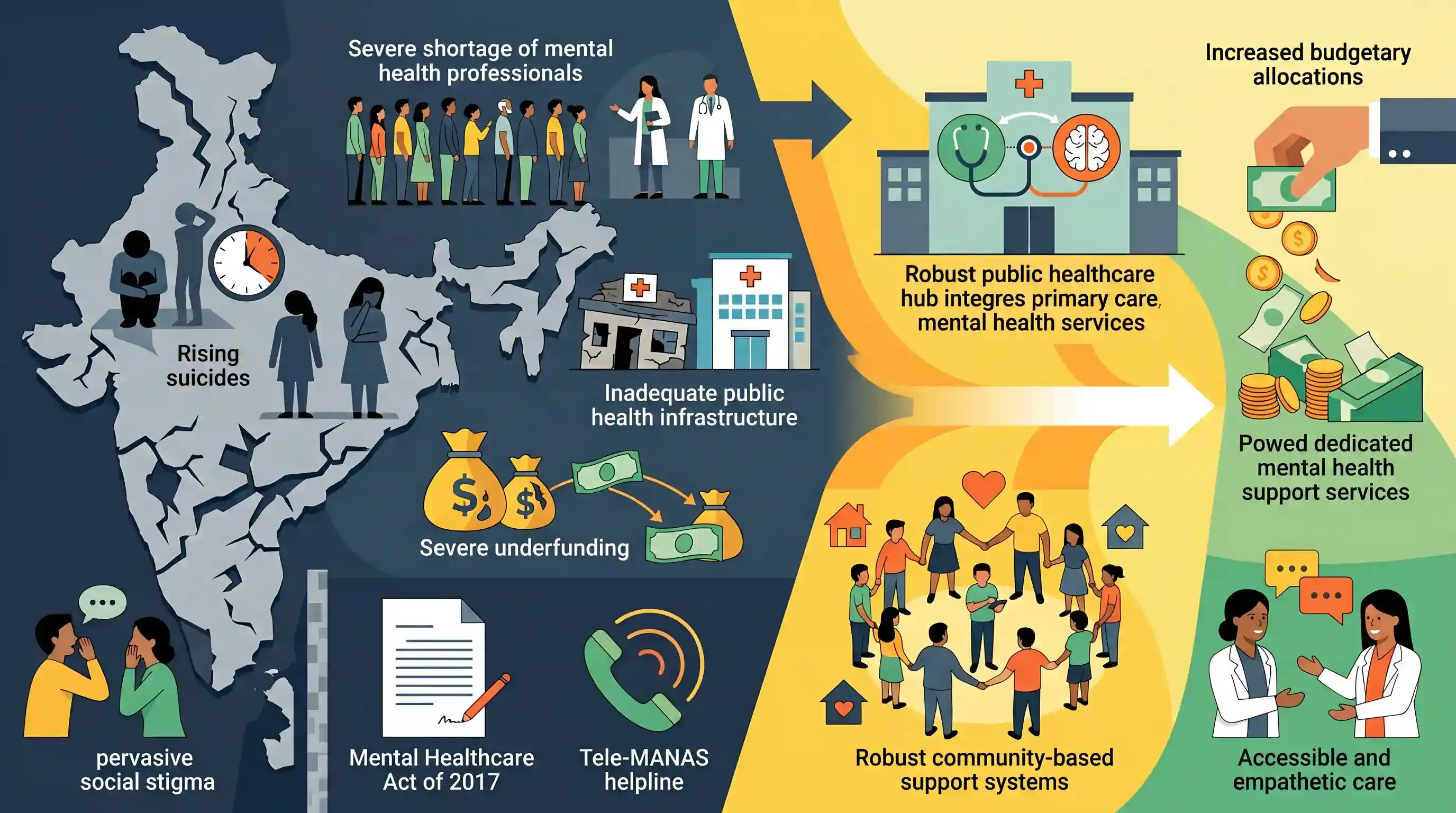
The article sheds light on the worsening mental health crisis in India, highlighting the devastating impact of rising suicides, particularly among the youth and young women. It underscores systemic failures, such as the acute shortage of mental health professionals, inadequate public health infrastructure, and severe underfunding, which together create a massive treatment gap. Furthermore, pervasive social stigma exacerbates the suffering of affected individuals by deterring them from seeking help. While acknowledging policy measures like the Mental Healthcare Act of 2017 and the Tele-MANAS helpline, the article advocates for a paradigm shift—urging the integration of mental health into primary healthcare, boosting budgetary allocations, and fostering robust community-based support systems to provide accessible and empathetic care.
Key Points
- India faces an escalating mental health crisis marked by rising rates of depression, anxiety, and a particularly high incidence of suicide among the youth and young women.
- The crisis is worsened by a severe shortage of trained mental health professionals, including psychiatrists and clinical psychologists, leading to a massive treatment gap.
- Deep-rooted societal stigma and lack of awareness prevent individuals from seeking timely clinical intervention and community support.
- Although government initiatives like the Mental Healthcare Act, 2017, and the national telemental health service (Tele-MANAS) are positive steps, they suffer from inadequate budgetary allocations and implementation bottlenecks.
- Effectively tackling the issue requires integrating mental health services into the primary healthcare system, promoting community-based rehabilitation, and significantly increasing public health funding.
Important Terms
Mental Healthcare Act, 2017

Enacted to provide mental healthcare services and protect the rights of persons with mental illness, it notably decriminalizes suicide attempts and introduces "Advance Directives" for treatment preferences.
UPSC context
GS Paper II: Health/Governance. Crucial for questions on rights-based legislation and decriminalizing mental health issues.
Tele-MANAS
A 24/7 toll-free tele-mental health helpline (14416) launched in 2022 to provide universal, affordable, and quality mental health care through a two-tier digital networking system.
UPSC context
GS Paper II: Social Sector/Health. Tests knowledge of digital health interventions and accessibility in remote areas.
NIMHANS
The apex medical institution in Bengaluru specializing in mental health and neurosciences; it serves as the nodal center for Tele-MANAS and an Institute of National Importance.
UPSC context
GS Paper II: Health Infrastructure. Relevant for roles of statutory bodies and apex research institutions.
National Mental Health Programme (NMHP)
Launched in 1982 to ensure accessible mental healthcare by integrating it into general health services; it operates primarily through the District Mental Health Programme (DMHP).
UPSC context
GS Paper II: Social Justice/Health. Important for understanding the evolution of public health policy and primary care integration.
World Health Organization (WHO)
The specialized agency of the United Nations responsible for international public health, which sets global standards like the Mental Health Action Plan and SDG 3.4.
UPSC context
GS Paper II: International Relations/Health. Tests awareness of global health benchmarks and India's international commitments.
Ministry of Health and Family Welfare
The nodal central ministry responsible for formulating and implementing national health policies, including the administration of mental health schemes and statutory bodies like NIMHANS.
UPSC context
GS Paper II: Governance. Tests understanding of executive roles in health sector development and management.
Prelims Trap
The Mental Healthcare Act, 2017 struck down Section 309 of the IPC, completely removing suicide from criminal law.
The Act creates a presumption of severe stress, effectively exempting the person from punishment, but it did not formally repeal or strike down Section 309 of the IPC.
Static Concepts Connected
What are the key rights and protections under the Mental Healthcare Act, 2017?
- Advance Directive: Individuals can legally specify in advance how they wish to be treated (or not treated) during future episodes of severe mental illness.
- Decriminalized Suicide: Attempts to commit suicide are presumed to be under severe stress, exempting the individual from trial and punishment under Section 309 of the IPC.
- ECT Restrictions: Electroconvulsive therapy (ECT) is strictly banned for minors and requires the use of muscle relaxants and anesthesia for adults.
How does the District Mental Health Programme (DMHP) utilize the 'Bellary Model'?
- Primary Care Integration: Shifts mental healthcare away from specialized psychiatric asylums by embedding basic diagnosis and care within primary health centres (PHCs) and district hospitals.
- Capacity Building: Focuses on training general medical officers and frontline health workers to identify and manage common mental disorders at the grassroots level.
Cross-Topic Patterns
Demographic dividend at risk
Rising youth suicides and untreated anxiety directly threaten India's demographic dividend by shrinking the productive workforce and increasing disability-adjusted life years (DALYs).
Digital public infra integration
Tele-MANAS leverages India's DPI, raising critical ethical debates about data privacy when integrating sensitive psychiatric diagnostic records into Ayushman Bharat Health Accounts (ABHA).

Expect a GS2 mains question linking India's 83% mental health treatment gap with the operational failures of primary health care integration.
Linked PYQs · 3
Linked PYQs · 3
- 2023MainsGS1
Explain why suicide among young women is increasing in Indian society.
- 2024MainsGS2
In a crucial domain like the public healthcare system the Indian State should play a vital role to contain the adverse impact of marketisation of the system. Suggest some measures through which the State can enhance the reach of public healthcare at the grassroots level.
- 2023MainsGS1
Child cuddling is now being replaced by mobile phones. Discuss its impact on the socialization of children.
