India Manufacturing Sector Growth Slows to Three Month Low
Source:The Hindu ↗
Why It Matters
PMI is a key leading macroeconomic indicator. Understanding its fluctuations and the impact of input cost inflation is essential for analyzing industrial growth trends, evaluating economic health, and understanding the challenges facing India's manufacturing sector in the context of GS3.
Summary
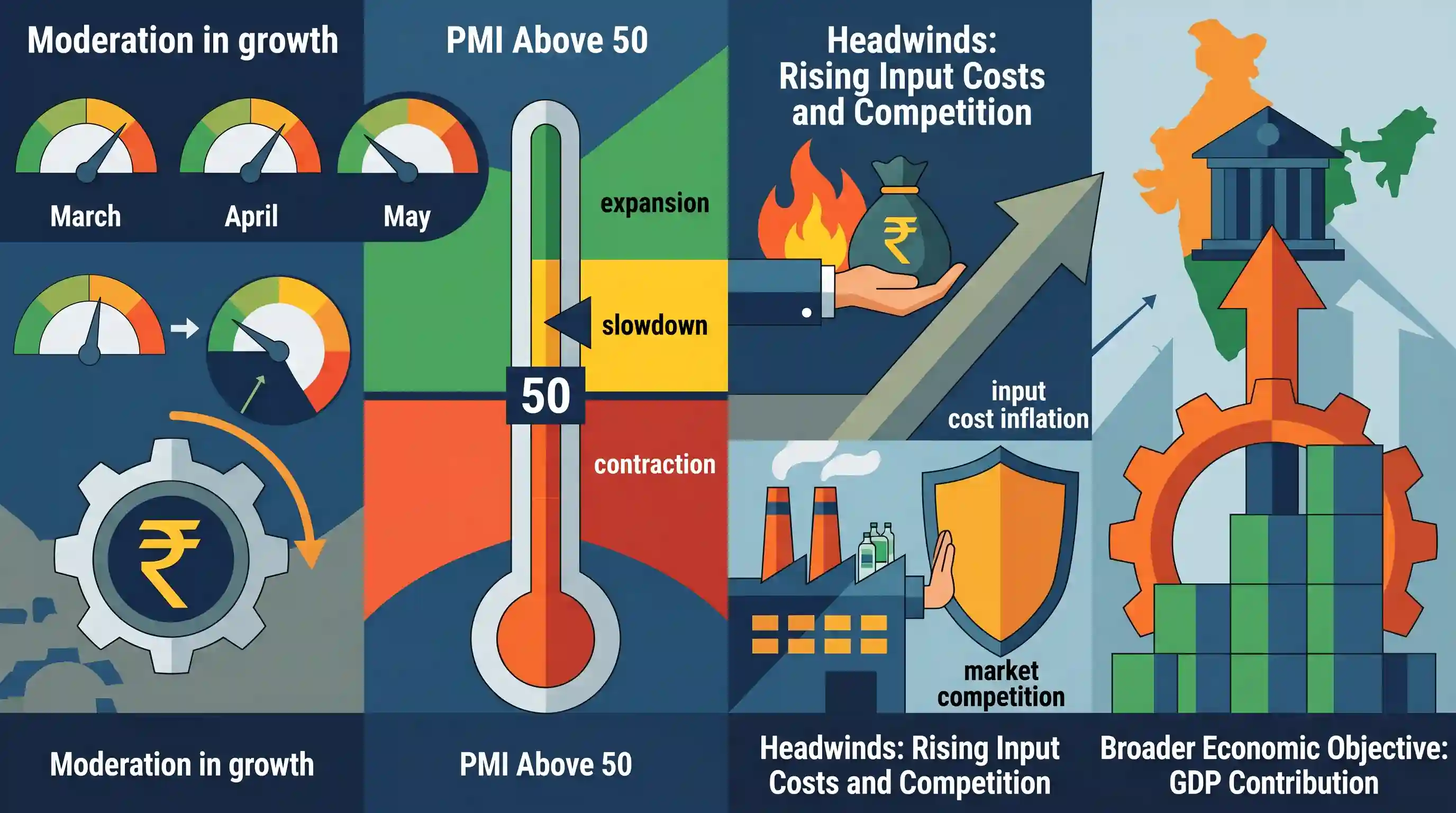
India's manufacturing sector experienced a moderation in growth, hitting a three-month low in May according to the latest Purchasing Managers' Index (PMI) data. Although the sector remains in expansion territory with a PMI reading above 50, the slowdown reflects headwinds such as rising input cost inflation and market competition. This deceleration highlights the ongoing challenges in sustaining high industrial growth rates, which is crucial for achieving the broader economic objective of increasing the manufacturing sector's contribution to the national GDP.
Key Points
- India's manufacturing sector growth slowed to a three-month low in May, as indicated by the dip in the Purchasing Managers' Index (PMI).
- Despite the deceleration, the PMI remains above the 50-mark threshold, indicating that the sector is still in an expansionary phase.
- Rising input cost inflation and intense market competition present ongoing challenges to manufacturing margins and overall momentum.
- PMI serves as a vital leading indicator for assessing industrial health, aligning with broader economic goals to increase manufacturing's share in GDP.
Important Terms
Purchasing Managers’ Index (PMI)

A survey-based economic indicator measuring business activity in manufacturing and services. A reading above 50 signifies expansion, while below 50 indicates contraction relative to the previous month.
UPSC context
GS Paper III (Economy). Tested as a leading indicator of industrial health and high-frequency economic trends.
Manufacturing Sector
The secondary sector of the economy involved in converting raw materials into finished products. India aims to increase its GDP contribution to 25% via initiatives like 'Make in India'.
UPSC context
GS Paper III (Industrial Policy). Key for discussions on job creation, export potential, and Atmanirbhar Bharat.
Input Cost Inflation
A rise in the cost of production factors—such as raw materials, energy, and labor—which increases the total manufacturing cost and may lead to cost-push inflation.
UPSC context
GS Paper III (Inflation). Crucial for understanding supply-side constraints and their impact on monetary policy and industrial margins.
S&P Global
A global financial analytics firm that compiles and publishes the PMI data for over 40 economies, providing vital high-frequency data for investors and policymakers.
UPSC context
Prelims (Economic Organizations). Important as the primary source of private-sector industrial data alongside government indices.
HSBC
A multinational financial services company that currently sponsors and co-brands the India Manufacturing and Services PMI reports, providing insights into the country's economic momentum.
UPSC context
Prelims (Economy). Relevant as the institutional sponsor associated with India's leading industrial performance indicators.
GDP (Gross Domestic Product)
The total market value of all final goods and services produced within a country's borders in a specific time frame, used as the primary measure of economic health.
UPSC context
GS Paper III (National Income). The fundamental metric for assessing growth targets and sectoral performance in the Indian economy.
Prelims Trap
A decline in the PMI index month-on-month indicates a contraction in the manufacturing sector.
A falling PMI still indicates expansion as long as the absolute value remains above 50. It signifies growth is decelerating, not that the sector is shrinking.
Static Concepts Connected
How does the PMI differ from the Index of Industrial Production (IIP)?
- Nature of index: PMI is a qualitative, forward-looking survey of purchasing managers; IIP measures actual physical volume of production over a period.
- Sectoral coverage: PMI covers both manufacturing and services (tracked separately); IIP strictly covers mining, manufacturing, and electricity sectors.
- Releasing agency: PMI is released earlier in the month by private agencies (S&P Global), whereas IIP is published by the NSO (MoSPI).
What is the fundamental difference between cost-push and demand-pull inflation?
- Cost-push inflation: Driven by a decrease in aggregate supply due to increased costs of inputs like raw materials, energy, or wages.
- Demand-pull inflation: Driven by an increase in aggregate demand outpacing supply, often due to expansionary fiscal or monetary policies increasing the money supply.
Cross-Topic Patterns
PMI deceleration + RBI Monetary Policy
Persistent input cost inflation in manufacturing restricts the RBI's ability to cut the repo rate, as these cost-push pressures often spill over into broader retail and core inflation metrics.
Manufacturing stagnation + PLI Schemes
Despite massive Production Linked Incentive (PLI) outlays and Make in India, manufacturing's GDP share remains stagnant at 17%, making policy efficacy a prime GS-3 analytical target.

Expect a Prelims question comparing PMI and IIP components, or a GS3 Mains question on why manufacturing GDP share is stuck at 17%.
Linked PYQs · 3
Linked PYQs · 3
- 2023MainsGS3
Faster economic growth requires increased share of the manufacturing sector in GDP, particularly of MSMEs. Comment on the present policies of the Government in this regard.
- 2020PrelimsGS1
Consider the following statements: 1. The weightage of food in Consumer Price Index (CPI) is higher than that in Wholesale Price Index (WPI). 2. The WPI does not capture changes in the prices of services, which CPI does. 3. Reserve Bank of India has now adopted WPI as its key measure of inflation and to decide on changing the key policy rates. Which of the statements given above is/are correct?
- 2021PrelimsGS1
With reference to Indian economy, demand-pull inflation can be caused/ increased by which of the following? 1. Expansionary policies 2. Fiscal stimulus 3. Inflation-indexing wages 4. Higher purchasing power 5. Rising interest rates Select the correct answer using the code given below.
