India Logistics Cost Reduction Targets and Multi Modal Infrastructure
Source:The Hindu ↗
Why It Matters
Logistics costs are a major bottleneck for Indian manufacturing and exports. Reducing these costs below 10% aligns with the goals of the National Logistics Policy, directly impacting GDP growth and export competitiveness. Furthermore, the shift to biofuels and EVs is a core component of India's energy security and climate commitments.
Summary
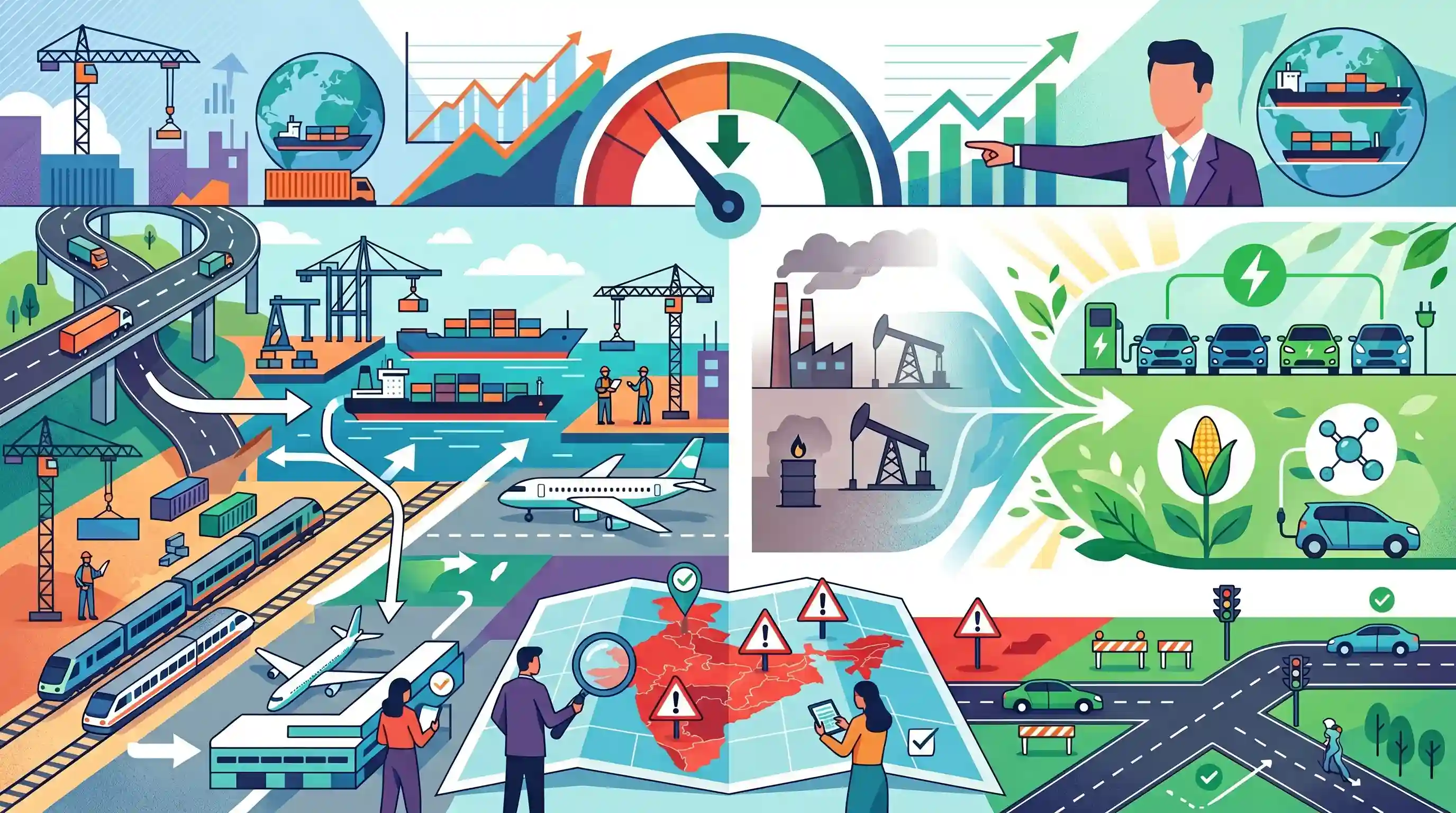
Union Minister Nitin Gadkari announced that India's logistics cost is expected to fall below 10% by December, a move that will significantly enhance the country's economic competitiveness globally. The strategy to reduce logistics expenses involves a dual approach: aggressively expanding multi-modal infrastructure such as highways and sea ports, and accelerating the transition toward green mobility options including electric vehicles, ethanol-blended biofuels, and hydrogen fuel. Additionally, the government highlighted the critical need for robust road safety audits and district-level planning to curb the high rate of highway accidents, specifically noting concerns in Andhra Pradesh.
Key Points
- India's logistics cost is projected to drop below 10% by December, aiming to improve the economy's global competitiveness against nations like China (8%) and the US (12%).
- The reduction in logistics costs is being driven by the expansion of pan-India highway networks, sea ports, and multi-modal logistics hubs.
- A rapid transition from fossil fuels to alternative options like electric mobility, biofuels (ethanol, isobutanol), and hydrogen blending is underway to further reduce transport costs.
- Safety audits by the Road Transport Ministry highlighted high accident rates on highways, prompting directives for district-level road safety planning in Andhra Pradesh.
Important Terms
Logistics Cost

The total expenditure incurred in moving goods from production to consumption, including transportation, warehousing, and administrative costs. Aiming for <10% of GDP enhances India's global export competitiveness.
UPSC context
GS Paper III: Economy/Infrastructure. Tests understanding of economic efficiency and India's global competitiveness in manufacturing and trade.
National Logistics Policy (NLP) 2022
Launched in 2022, this policy provides an integrated framework to reduce logistics costs to global benchmarks, improve India's Logistics Performance Index (LPI) ranking, and digitize the supply chain.
UPSC context
GS Paper III: Infrastructure/Investment Models. Focuses on policy-led ease of doing business and structural reforms in the transport sector.
PM Gati Shakti
A GIS-based digital platform that integrates planning and implementation of infrastructure projects across multiple central ministries and states to ensure seamless multimodal connectivity and synchronized execution.
UPSC context
GS Paper III: Infrastructure. Tests knowledge of integrated master planning and technology-led governance for national development.
Multi-Modal Logistics Parks (MMLP)
Specialized freight-handling facilities (min. 100 acres) that integrate various transport modes (road, rail, air, water) and offer warehousing, cold storage, and value-added services to reduce handling costs.
UPSC context
GS Paper III: Infrastructure. Important for questions on hub-and-spoke models and reducing supply chain inefficiencies.
Green Mobility
Sustainable transport solutions including electric vehicles (EVs), hydrogen fuel, and biofuels aimed at reducing carbon footprints, achieving net-zero targets, and ensuring national energy security.
UPSC context
GS Paper III: Environment and S&T. Tests knowledge of sustainable development goals and the transition to a low-carbon economy.
Ethanol Blending Program (EBP)
A government initiative to mix ethanol with petrol to reduce crude oil imports and emissions. India achieved a 20% blending (E20) target at retail outlets by late 2025.
UPSC context
GS Paper III: Environment/Energy. Relevant for questions on biofuels, self-reliance (Atmanirbharta), and agricultural value addition.
Prelims Trap
Ethanol is currently successfully blended with diesel to reduce fuel costs in India's heavy freight logistics network.
Ethanol blends well with petrol but fails with diesel due to poor engine compatibility and low flash points. Isobutanol is the actual emerging alternative for heavy diesel transport.
Static Concepts Connected
What is the hub-and-spoke model in Multi-Modal Logistics Parks (MMLPs)?
- Hub-and-spoke framework: Consolidates freight from various origins (spokes) to a central facility (hub) for bulk long-haul transport via rail or waterways, lowering costs.
- Bharatmala integration: The Ministry of Road Transport is developing 35 MMLPs under Bharatmala to seamlessly connect road, rail, and inland waterways.
- Value-added services: They offer integrated value-added services like customs clearance, warehousing, and cold chain facilities in a single centralized location.
Why is Isobutanol better than Ethanol for heavy-duty transport?
- Higher energy density: Isobutanol contains more energy per gallon than ethanol, offering fuel efficiency closer to standard diesel or gasoline.
- Moisture resistance: It is far less hygroscopic than ethanol, meaning it doesn't absorb water, significantly reducing pipeline corrosion and engine wear.
- Diesel compatibility: It has a better flash point and blends seamlessly with diesel, whereas ethanol-diesel blends fail in heavy-duty commercial engines.
Cross-Topic Patterns
Logistics costs + PLI schemes
Reducing logistics costs below 10% acts as a catalyst for PLI schemes, essentially removing the 'implicit tax' on domestic manufacturing and boosting export competitiveness against China.
Freight decarbonization + Panchamrit NDCs
With the freight sector contributing 14% of GHG emissions, shifting from diesel to green hydrogen and isobutanol is crucial for meeting India's Net Zero 2070 and NDC targets.

MMLPs, hub-and-spoke models, and the shift from ethanol to isobutanol in heavy freight will likely merge in a 2026 Prelims question.
Linked PYQs · 4
Linked PYQs · 4
- 2021MainsGS3
“Investment in infrastructure is essential for more rapid and inclusive economic growth.” Discuss in the light of India's experience.
- 2023MainsGS3
The adoption of electric vehicles is rapidly growing worldwide. How do electric vehicles contribute to reducing carbon emissions and what are the key benefits they offer compared to traditional combustion engine vehicles?
- 2024MainsGS3
What is the technology being employed for electronic toll collection on highways? What are its advantages and limitations? What are the proposed changes that will make this process seamless? Would this transition carry any potential hazards?
- 2023MainsGS3
Discuss several ways in which microorganisms can help in meeting the current fuel shortage.
