Widening Trade Deficit and External Sector Vulnerabilities in India
Source:The Hindu ↗
Why It Matters
The article illustrates the vulnerability of India's external sector to global protectionist policies (US tariffs) and domestic financial trends (Gold ETFs driving physical imports), which are core concepts for understanding Balance of Payments and macroeconomic stability.
Summary
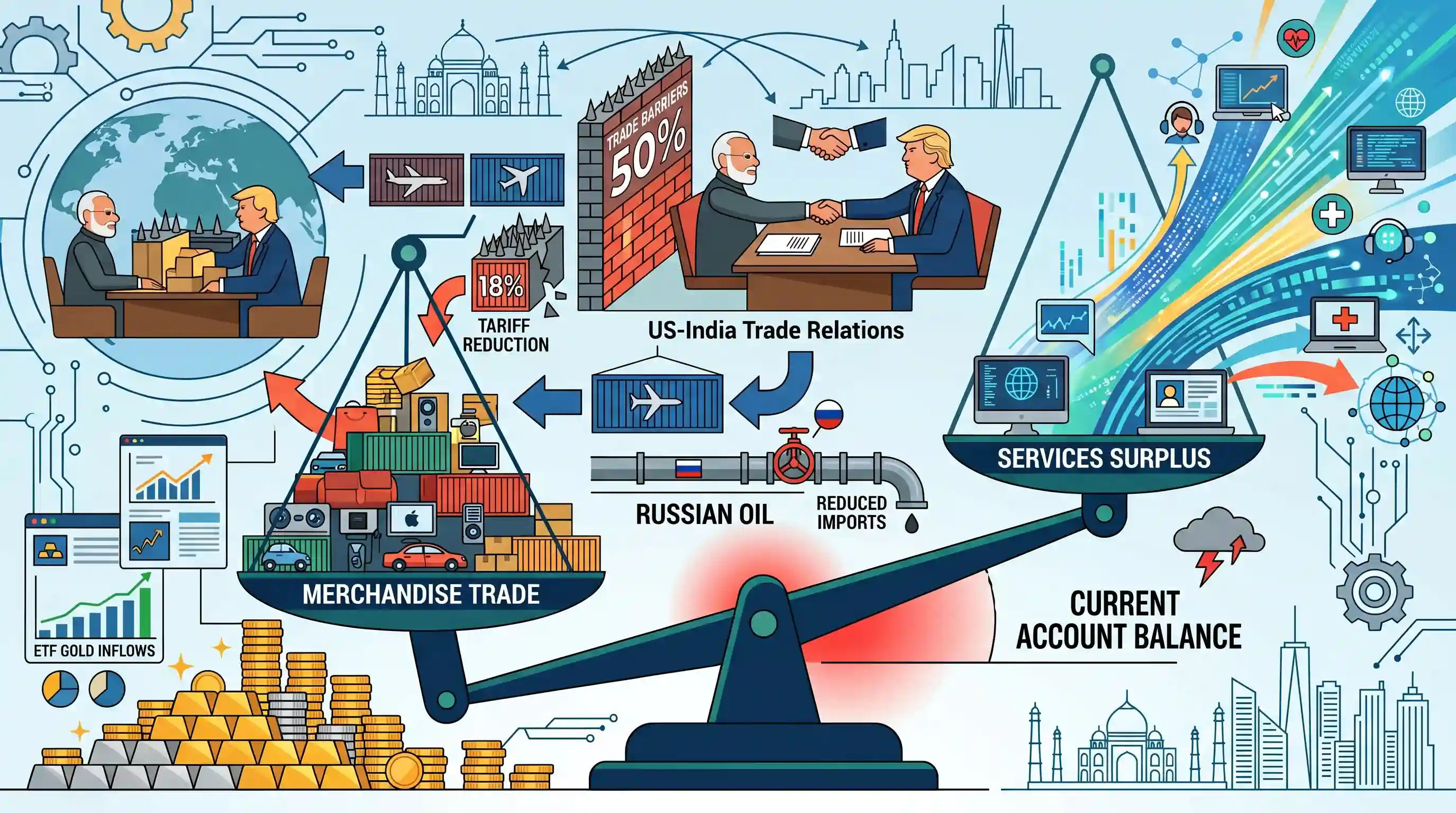
India's merchandise trade deficit surged to a three-month high of $34.68 billion in January, driven by a drop in exports due to massive US tariffs and a sharp rise in gold and silver imports. A notable factor was the doubling of inflows into gold ETFs, which necessitated corresponding physical gold imports, worsening the trade imbalance. To secure relief and reduce US tariffs from 50% to 18%, India negotiated a trade pact with US President Donald Trump, agreeing to cut Russian oil purchases and double US imports. While the merchandise deficit raises concerns for the Current Account Deficit (CAD), a robust services surplus continues to provide a buffer.
Key Points
- India's merchandise trade deficit widened to a three-month high of $34.68 billion in January, straining the Current Account Deficit (CAD).
- The widening deficit was driven by a 5% fall in merchandise exports caused by a 50% US tariff on Indian goods.
- Gold imports surged to $12.07 billion, partly fueled by inflows into gold ETFs which required backing by physical gold purchases.
- A new trade pact with the US aims to pare tariffs down to 18% in exchange for India reducing its Russian oil imports by two-thirds and doubling its intake of US goods.
- Despite the merchandise trade deficit, India's robust services trade surplus (estimated at $24.30 billion) provided some macroeconomic buffer.
Important Terms
Balance of Payments (BoP)

A systematic record of all economic transactions between residents of a country and the rest of the world. It comprises the current account, capital account, and changes in foreign exchange reserves.
UPSC context
GS-3 Economy; fundamental for understanding external sector stability, currency valuation, and macro-economic health.
Current Account Deficit (CAD)
The difference between the value of a country's total imports and its total exports of goods, services, and transfers. A deficit indicates a net outflow of foreign exchange.
UPSC context
GS-3 Economy; critical indicator of trade competitiveness and a primary factor in fiscal and monetary policy decisions.
Gold Exchange Traded Funds (ETFs)
Passive investment instruments that track physical gold prices. Each unit represents high-purity gold bullion held in dematerialized form, combining stock-market flexibility with gold's safety.
UPSC context
GS-3 Economy; tested under investment models and strategies to manage physical gold demand and trade imbalances.
Financialization of Gold
The process of moving gold from a physical asset (jewelry or bullion) into formal financial products like ETFs, bonds, or monetization schemes to integrate it into the economy.
UPSC context
GS-3 Economy; relates to government efforts to reduce physical imports and mobilize domestic assets for economic growth.
Protectionism
Government policies that restrict international trade through tariffs, quotas, or regulations to protect domestic industries from foreign competition. The US-India 50% tariff scenario exemplifies this.
UPSC context
GS-2 International Relations; tests knowledge of global trade wars and their impact on India’s foreign trade policy.
US-India Trade Pact (2026)
A 2026 agreement where the US reduced tariffs on Indian goods from 50% to 18% in exchange for India ending Russian oil purchases and increasing US energy imports.
UPSC context
GS-2 IR; crucial for analyzing bilateral diplomacy and India's strategic balancing between the US and Russia.
Prelims Trap
Surging investments in Gold ETFs reduce India's reliance on physical gold imports.
Gold ETFs must be backed by physical gold. Surging ETF inflows actually force Asset Management Companies to import physical gold, widening the trade deficit.
Static Concepts Connected
What are the primary components of India's Current Account?
- Trade in Goods: The balance of tangible exports and imports. India structurally runs a deficit in this segment.
- Trade in Services: Net income from intangibles like IT, software, and travel. This surplus typically cushions the merchandise deficit.
- Current Transfers: Remittances from Indians abroad, grants, and gifts that do not involve reciprocal economic value or liabilities.
- Net Income: Net earnings on foreign investments, including interest payments and dividends.
How do Gold ETFs and Sovereign Gold Bonds (SGBs) affect gold imports differently?
- Gold ETFs: Issued by mutual funds and strictly backed by physical gold. High retail inflows force AMCs to import gold, hitting the CAD.
- Sovereign Gold Bonds: Issued by RBI on behalf of the Government. They are purely digital/paper representations of gold value and do not require physical gold imports.
Cross-Topic Patterns
Energy security meets trade coercion
The US linking tariff relief to Russian oil cuts demonstrates how major powers weaponize market access to dictate India's strategic autonomy and energy imports.
Financialization paradox of gold
Promoting Gold ETFs for financialization paradoxically stresses the external sector, as the underlying assets still demand physical gold imports, unlike purely paper Sovereign Gold Bonds.

Expect a 2026 prelims question contrasting the balance-of-payments impact of Gold ETFs vs Sovereign Gold Bonds amid surging trade deficits.
Linked PYQs · 3
Linked PYQs · 3
- 2012MainsGS2
Discuss the likely negative impact of the protectionist measures proposed by the US on India's software industry.
- 2013PrelimsGS1
The balance of payments of a country is a systematic record of
- 2016PrelimsGS1
What is/are the purpose/purposes of Government's 'Sovereign Gold Bond Scheme' and 'Gold Monetization Scheme'? 1. To bring the idle gold lying with Indian households into the economy 2. To promote FDI in the gold and jewellery sector 3. To reduce India's dependence on gold imports Select the correct answer using the code given below.
