External Affairs Minister Emphasizes Strategic Autonomy for India
Source:The Hindu ↗
Why It Matters
This article provides a direct articulation of India's contemporary foreign policy doctrine by the External Affairs Minister. It offers valuable insights into the shift from non-alignment to multi-alignment, the strategic calculus behind the 'Neighbourhood First' approach, and India's maneuvering amidst great power competition—key themes for GS Paper 2 International Relations.
Summary
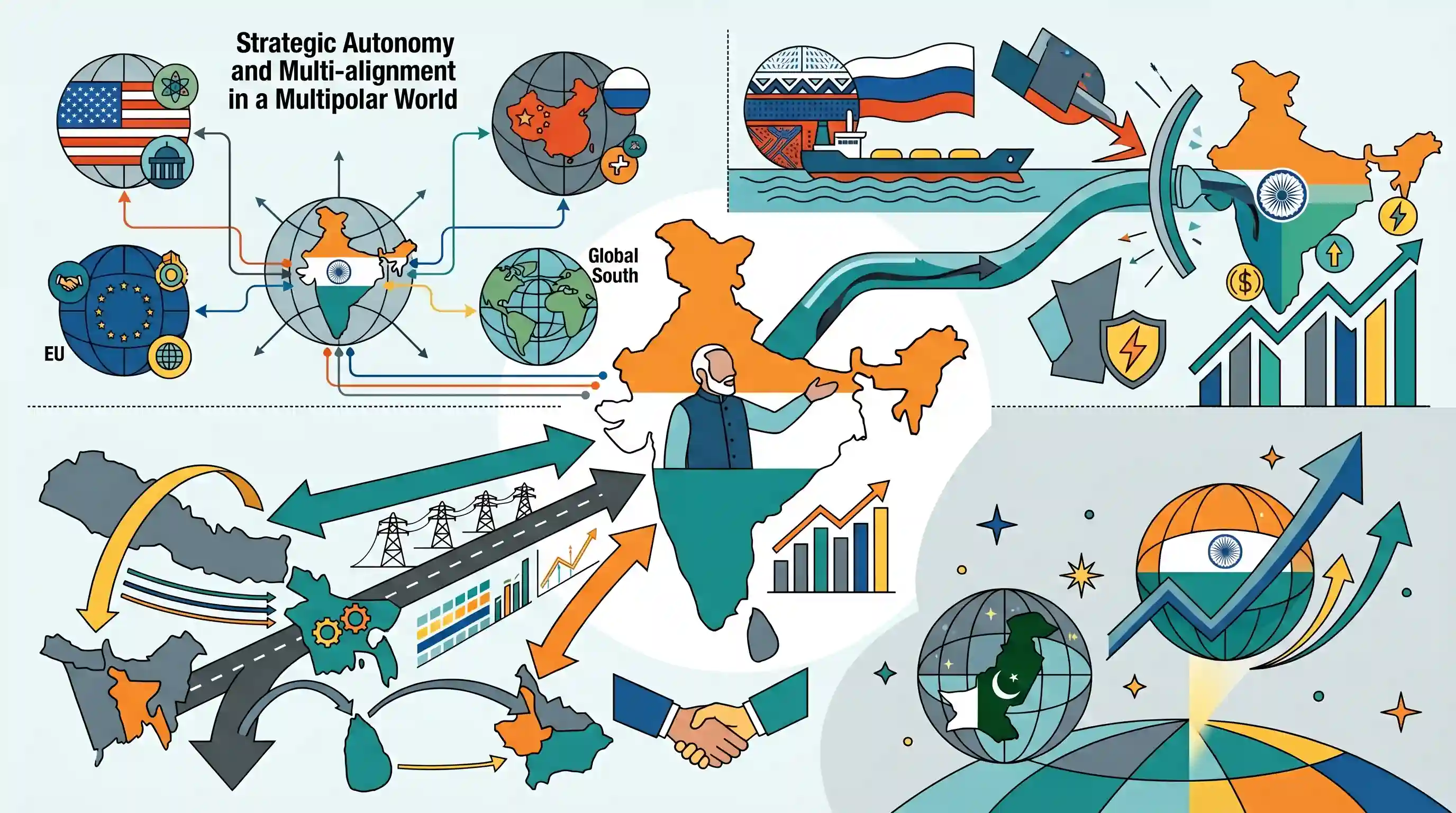
External Affairs Minister S. Jaishankar, speaking at JNU, articulated India's foreign policy framework, emphasizing 'strategic autonomy' and multi-alignment in a multipolar world. He outlined how India navigates complex global dynamics, specifically defending the pragmatic purchase of Russian oil to secure domestic economic stability despite Western pressure. Jaishankar underscored the 'Neighbourhood First' policy, suggesting India must unilaterally invest in regional infrastructure to remain the 'go-to' partner for South Asian nations, resilient against their domestic political changes. Furthermore, he noted the successful global de-hyphenation of India and Pakistan, reinforcing India's independent standing on the world stage.
Key Points
- External Affairs Minister S. Jaishankar stated that India's national interests are best protected through 'strategic autonomy' and multi-alignment, moving past historical non-alignment.
- Defended India's purchase of Russian oil amidst Western sanctions as a pragmatic necessity for economic stability and managing domestic inflation.
- Emphasized the 'Neighbourhood First' policy, asserting India should unilaterally invest in regional infrastructure to become the 'go-to option' for neighbors like Sri Lanka, Nepal, and the Maldives regardless of their domestic political shifts.
- Highlighted the de-hyphenation of India and Pakistan globally, noting that international actors no longer draw an equivalence between the two nations.
- Reflected on past geopolitical strategies, comparing the current multi-alignment approach to Indira Gandhi's 1971 pact with the Soviet Union, framed as a pragmatic response to the US-China-Pakistan axis of the time.
Important Terms
Strategic Autonomy

India’s ability to take independent foreign policy and defense decisions based on national interest, without external pressure or binding alliance obligations. It represents a shift from passive non-alignment to proactive engagement.
UPSC context
GS Paper II (International Relations). Tests understanding of India’s sovereignty and its transition from non-alignment to pragmatic interest-based diplomacy.
Neighbourhood First Policy
A diplomatic framework prioritizing immediate neighbors in South Asia and the Indian Ocean. It emphasizes regional stability, connectivity, and non-reciprocal economic investment to ensure India remains the primary regional partner.
UPSC context
GS Paper II (India and its neighborhood). Essential for questions on regional integration, security, and countering external influences like China.
Multi-alignment
A proactive diplomatic strategy of maintaining parallel, issue-based relationships with various global powers (e.g., US, Russia, China) simultaneously. It allows India to maximize national interests without joining rigid blocs.
UPSC context
GS Paper II. Tests the ability to analyze India’s modern foreign policy shifts within a complex, shifting global landscape.
De-hyphenation
A foreign policy approach where India manages bilateral relations with rival states (like Israel-Palestine or India-Pakistan) independently. It establishes India as a standalone global power, delinked from regional conflicts.
UPSC context
GS Paper II. Relevant for understanding India’s diplomatic maturity and efforts to project power beyond regional constraints.
Multipolar World
An international system characterized by three or more significant power centers (poles). India advocates for this order to prevent unipolar dominance and ensure a balanced global governance framework.
UPSC context
GS Paper II. Foundational concept for analyzing global power shifts and India’s role as an emerging pole in the international system.
Prelims Trap
"India's Neighbourhood First policy is strictly based on reciprocal investments and equal burden-sharing with South Asian nations."
Aspirants often assume diplomacy requires reciprocity. However, India's regional approach relies on unilateral, non-reciprocal concessions (rooted in the Gujral Doctrine) to build trust and structural leverage.
Static Concepts Connected
How does Multi-Alignment conceptually differ from traditional Non-Alignment (NAM)?
- Core Philosophy: NAM originated as a defensive strategy to maintain distance from Cold War blocs and avoid getting dragged into proxy wars.
- Proactive Engagement: Multi-alignment is proactive, focusing on simultaneous, issue-based engagement with competing global powers (e.g., Quad and SCO) to maximize national interests.
- Pragmatism over Ideology: While NAM had a strong ideological and anti-colonial undertone, multi-alignment is rooted in pure strategic pragmatism and economic realism.
What is the Gujral Doctrine and how does it relate to Neighbourhood First?
- Origin: A set of five principles guiding India's foreign relations with its immediate neighbours, articulated by I.K. Gujral in 1996.
- Principle of Non-reciprocity: India does not ask for reciprocity from neighbors like Nepal, Bangladesh, Bhutan, Maldives, and Sri Lanka, but gives unilaterally in good faith.
- Modern Application: Current infrastructure investments under 'Neighbourhood First' reflect this doctrine, aiming to make India the indispensable 'go-to' partner regardless of the neighbours' domestic politics.
Cross-Topic Patterns
Energy Security via Strategic Autonomy
India's purchase of discounted Russian oil amidst sanctions demonstrates how an independent foreign policy (GS2) is directly utilized to achieve GS3 goals like inflation targeting and energy security.
De-hyphenation as a broader diplomatic tool
The successful global de-hyphenation of India and Pakistan mirrors India's own successful diplomatic de-hyphenation of Israel and Palestine, marking a mature, interest-driven phase of Indian diplomacy.

Expect a GS-2 Mains question evaluating 'multi-alignment' using Russian oil and unilateral neighborhood investments as case studies.
Linked PYQs · 2
Linked PYQs · 2
- 2022MainsGS2
India is an age-old friend of Sri Lanka.’ Discuss India's role in the recent crisis in Sri Lanka in the light of the preceding statement.
- 2020MainsGS2
What is the significance of Indo-US defence deals over Indo-Russian defence deals? Discuss with reference to stability in the Indo-Pacific region.
