Integrated Management and Conservation Frameworks for Indian Wetlands
Source:Indian Express ↗
Why It Matters
Wetlands are heavily tested in UPSC (both Prelims and Mains) due to their role as carbon sinks, biodiversity hotspots, and sources of livelihood. Understanding India's statutory frameworks (Wetland Rules 2017) and recent schemes (Amrit Dharohar) is crucial for addressing direct questions on ecological conservation and the Ramsar Convention.
Summary
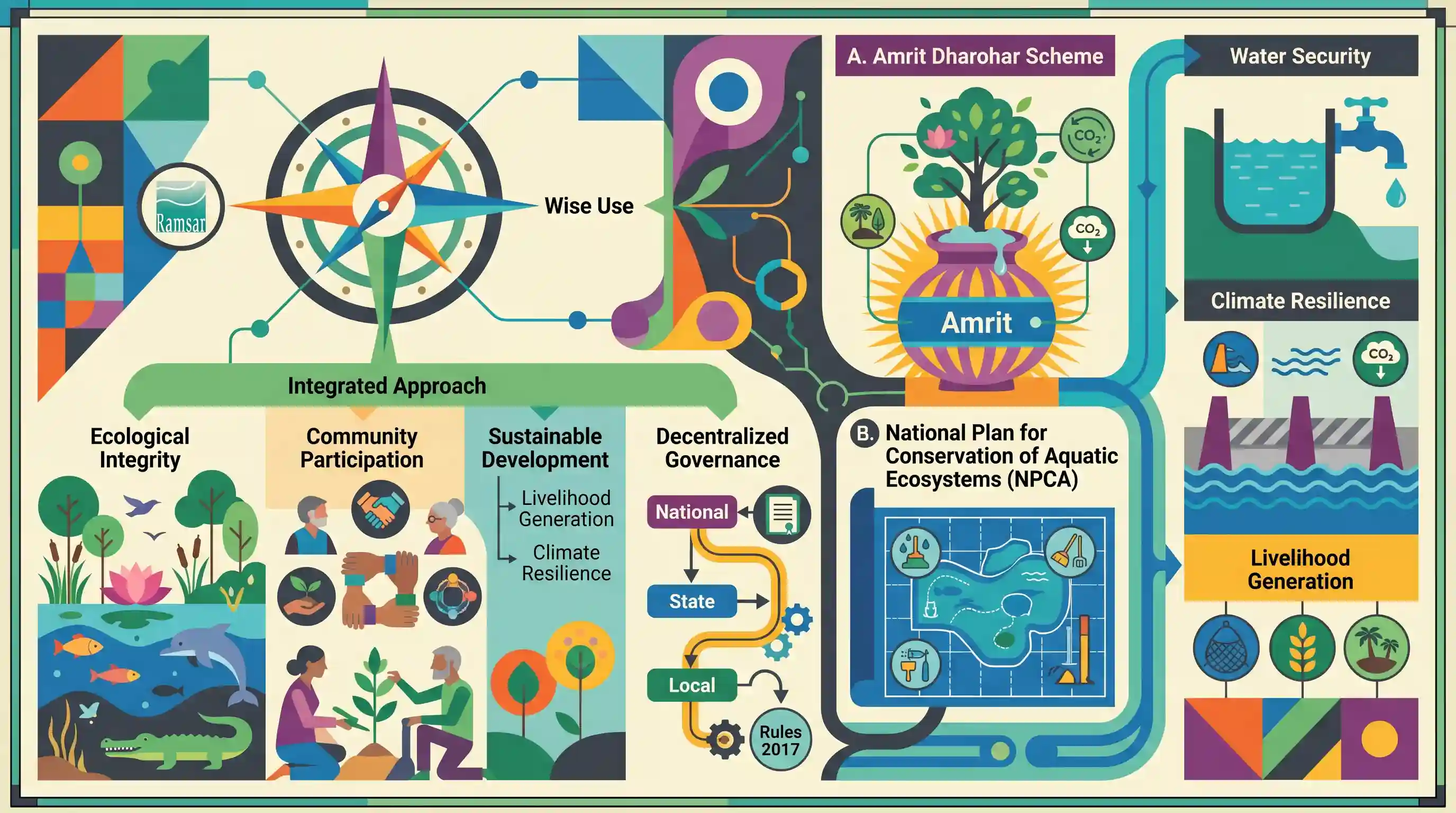
The article highlights India's multi-pronged and integrated approach to wetland sustainability, moving beyond mere conservation to include ecological integrity, community participation, and sustainable development. It underscores the Ramsar Convention's 'wise use' principle, operationalized through initiatives like the Amrit Dharohar scheme, the National Plan for Conservation of Aquatic Ecosystems (NPCA), and decentralized governance under the Wetlands (Conservation and Management) Rules, 2017. These measures collectively aim to protect wetland ecosystems while ensuring water security, climate resilience, and livelihood generation for local communities.
Key Points
- India has adopted an integrated management approach for wetlands, balancing ecological conservation with sustainable development through the Ramsar concept of 'wise use'.
- The Amrit Dharohar scheme promotes unique conservation values of Ramsar Sites, aiming to enhance eco-tourism, carbon sequestration, and local livelihoods.
- The Wetlands (Conservation and Management) Rules, 2017 decentralized wetland management by empowering State Wetland Authorities and emphasizing community participation.
- Programs like the National Plan for Conservation of Aquatic Ecosystems (NPCA) support comprehensive and holistic management action plans across various states.
Important Terms
Amrit Dharohar Scheme

A 2023-24 Budget initiative to promote the 'wise use' of Ramsar sites. It focuses on enhancing biodiversity, carbon stock, and livelihood opportunities for local communities via sustainable nature tourism.
UPSC context
GS Paper III (Environment); relevant for community-led conservation strategies and sustainable development initiatives.
National Plan for Conservation of Aquatic Ecosystems (NPCA)
A centrally sponsored scheme formed by merging lake and wetland conservation programs. It aims for the holistic restoration of aquatic ecosystems through integrated management and pollution control.
UPSC context
GS Paper III (Environment); tests knowledge of domestic policy frameworks for freshwater and wetland habitat management.
Wetlands (Conservation and Management) Rules, 2017
The primary legal framework for wetland protection in India, notified under the Environment (Protection) Act, 1986. It decentralizes management to states and prohibits activities like encroachment and waste dumping.
UPSC context
GS Paper III (Environment/Governance); critical for understanding decentralized environmental regulation and legal protections for vital ecotones.
Ramsar Convention
An international treaty (1971) dedicated to the conservation and sustainable utilization of wetlands. It emphasizes the 'wise use' principle to maintain ecological character within sustainable development frameworks.
UPSC context
GS Paper III (Biodiversity); essential for understanding global conservation standards and India's international environmental obligations.
State Wetland Authorities
Nodal bodies established in each State and UT under the 2017 Rules. Headed by the State Environment Minister, they identify, notify, and monitor wetlands.
UPSC context
GS Paper III (Governance/Environment); tests understanding of the institutional hierarchy and local enforcement mechanisms in Indian conservation.
Wetlands International
A global non-profit organization that provides science-based knowledge and advocacy for the restoration and conservation of wetlands and their resources worldwide.
UPSC context
GS Paper III (Environment); relates to the role of international NGOs and scientific partnerships in ecological preservation.
Prelims Trap
"All wetlands, including those in National Parks and Coastal Regulation Zones, are governed by the Wetlands Rules, 2017."
Wetlands falling within Protected Areas (Wildlife Protection Act, 1972), Indian Forest Act, and Coastal Regulation Zones (CRZ) are explicitly excluded from the 2017 Rules to avoid regulatory overlap.
Static Concepts Connected
How did the Wetlands (Conservation and Management) Rules, 2017 alter wetland governance?
- Decentralization: Replaced the Central Wetlands Regulatory Authority with State/UT Wetland Authorities (SWAs) to delegate regulatory powers.
- Wise Use Principle: Mandated that management action plans be based on the Ramsar Convention's 'wise use' principle.
- Exclusions: Specifically excludes river channels, paddy fields, and areas already covered by WLPA, IFA, and CRZ notifications.
What is the National Plan for Conservation of Aquatic Ecosystems (NPCA)?
- Merger: A Centrally Sponsored Scheme created by merging the National Wetland Conservation Programme and National Lake Conservation Plan.
- Holistic Approach: Aims for holistic conservation and restoration of both lakes and wetlands through a uniform policy framework.
- Funding Mechanism: Provides financial assistance to State Governments for implementing comprehensive management action plans.
Cross-Topic Patterns
Green Growth Budget Schemes 2023-24
Amrit Dharohar for wetlands is clustered with MISHTI (mangroves) and PM PRANAM (fertilizers) under the budget's 'Green Growth' pillar, linking ecological conservation directly to community livelihoods and eco-tourism.
Blue Carbon and Climate Mitigation
Wetlands are primary sinks for blue carbon. The scheme's explicit emphasis on carbon stock enhancement ties Ramsar conservation directly to India's UNFCCC NDC climate mitigation targets.

Expect a multi-statement question combining Wetlands Rules 2017 exclusions (CRZ/WLPA areas) with the Amrit Dharohar scheme's objectives.
Linked PYQs · 4
Linked PYQs · 4
- 2019PrelimsGS1
Consider the following statements: 1. Under Ramsar Convention, it is mandatory on the part of the Government of India to protect and conserve all the wetlands in the territory of India. 2. The Wetlands (Conservation and Management) Rules, 2010 were framed by the Government of India based on the recommendations of Ramsar Convention. 3. The Wetlands (Conservation and Management) Rules, 2010 also encompass the drainage area or catchment regions of the wetlands as determined by the authority. Which of the statements given above is/are correct?
- 2014PrelimsGS1
With reference to a conservation organization called 'Wetlands International', which of the following statements is/are correct? 1. It is an intergovernmental organization formed by the countries which are signatories to Ramsar Convention. 2. It works at the field level to develop and mobilize knowledge, and use the practical experience to advocate for better policies. Select the correct answer using the code given below.
- 2018MainsGS3
What is wetland? Explain the Ramsar concept of 'wise use' in the context of wetland conservation. Cite two examples of Ramsar sites from India.
- 2023MainsGS3
Comment on the National Wetland Conservation Programme initiated by the Government of India and name a few India's wetlands of international importance included in the Ramsar Sites.
