India Promotes Lifestyle Driven Wetland Conservation Model
Source:Indian Express ↗
Why It Matters
Wetlands are critical natural infrastructure facing extreme pressure from urbanisation and pollution. Understanding India's diplomatic leadership at Ramsar COP15 and its domestic integration of legal rules, waste governance, and citizen-led behavioral change (Mission LiFE) is highly relevant for GS-3 Environment and Essay papers.
Summary
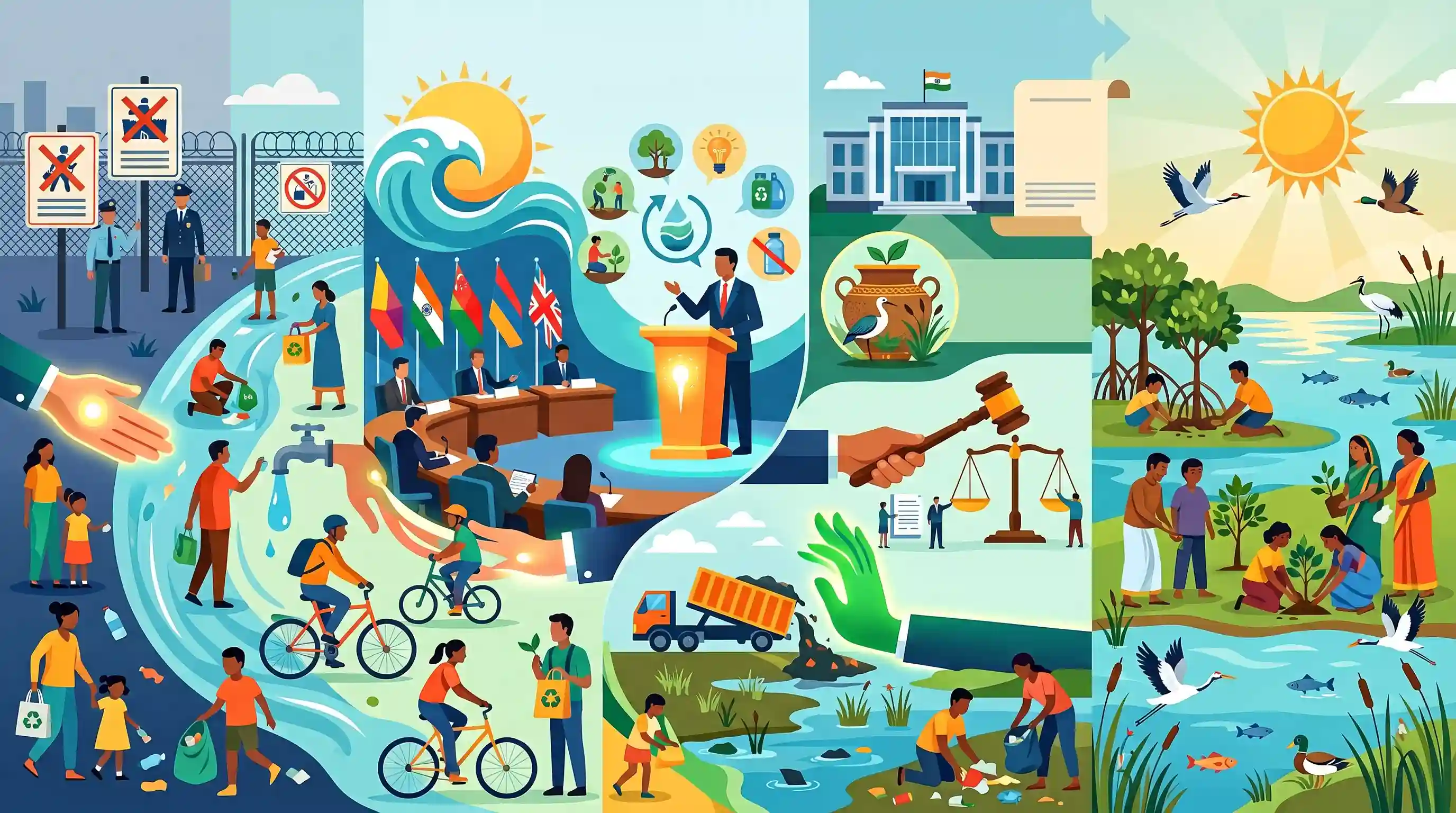
India's approach to wetland sustainability is evolving from purely regulatory measures to an integrated model that emphasises behavioural change. At the 15th Conference of the Contracting Parties (COP15) to the Ramsar Convention, India successfully introduced a resolution on 'Promoting Sustainable Lifestyles for the Wise Use of Wetlands'. The initiative, deeply rooted in the Mission LiFE vision, underscores the role of individual and societal choices in conservation. Domestically, while the Wetlands (Conservation and Management) Rules, 2017 and schemes like Amrit Dharohar provide the institutional framework, effective protection relies on strict enforcement against waste dumping, judicial oversight by the NGT, and fostering grassroots ecological stewardship.
Key Points
- Wetlands, often referred to as the 'kidneys of the landscape', are transitional ecosystems that are vital for ecological balance, climate resilience, and mitigating natural disasters.
- At the Ramsar COP15 in Zimbabwe, all 172 contracting parties adopted India's landmark resolution on 'Promoting Sustainable Lifestyles for the Wise Use of Wetlands'.
- The resolution introduces a behavioural lens to wetland management by linking community and individual lifestyle choices to conservation, aligning closely with India's Mission LiFE (Lifestyle for Environment).
- The Wetlands (Conservation and Management) Rules, 2017 provide the legal framework in India to restrict activities like waste dumping and industrial encroachment in wetlands, supplemented by judicial interventions from the NGT.
- Achieving wetland sustainability requires an integrated 'whole-of-society' approach that combines strict legal enforcement, robust waste governance, and widespread behavioural change.
Important Terms
Ramsar Convention

An international treaty (1971) providing the framework for national action and international cooperation for the conservation and 'wise use' of wetlands and their resources.
UPSC context
GS-3 Environment; essential for biodiversity conservation and international environmental treaties.
Mission LiFE
An India-led global mass movement to promote 'mindful and deliberate utilization' instead of 'mindless and wasteful consumption' to protect the environment (Lifestyle for Environment).
UPSC context
GS-3 Environment; tests understanding of climate action and behavioral change.
Amrit Dharohar Scheme
A 2023 initiative to promote the 'wise use' of Ramsar sites through nature tourism, biodiversity enhancement, carbon stock improvement, and livelihood opportunities for local communities.
UPSC context
GS-3 Environment; relevant for government schemes targeting wetland management and sustainable livelihoods.
Wetlands (Conservation and Management) Rules, 2017
Regulatory framework under the Environment (Protection) Act, 1986, that decentralizes wetland management to State Authorities and prohibits activities like encroachment and waste dumping.
UPSC context
GS-3 Governance/Environment; focuses on domestic environmental laws and decentralization.
National Green Tribunal (NGT)
A specialized judicial body established in 2010 for the expeditious disposal of cases related to environmental protection and conservation of forests.
UPSC context
GS-2 Statutory Bodies; GS-3 Environmental Justice and judicial oversight.
National Plan for Conservation of Aquatic Ecosystems (NPCA)
A centrally sponsored scheme merging older lake and wetland conservation programs to provide a holistic framework for restoring and managing India's aquatic ecosystems.
UPSC context
GS-3 Environment; relates to integrated water resource management and ecosystem restoration.
Prelims Trap
"The Wetlands Rules 2017 established a powerful Central Wetland Authority to directly govern all Ramsar sites."
The 2017 Rules actually decentralized governance, replacing the Central Authority with State Wetland Authorities. The Centre now only retains an advisory National Wetland Committee.
Static Concepts Connected
How did the Wetlands Rules 2017 change India's regulatory framework?
- Decentralization: Shifted primary regulatory power from the Centre to State/UT Wetland Authorities for wetland notification and management.
- Prohibited activities: Explicitly bans solid waste dumping, untreated effluent discharge, and permanent constructions within the wetland boundaries.
- Key exclusions: Excluded river channels, paddy fields, and certain human-made water bodies (like salt pans) from the definition of wetlands.
What is the "Wise Use" principle under the Ramsar Convention?
- Ecological character: Maintaining the ecosystem's structural and functional properties (its 'ecological character') while allowing human utility.
- Sustainable development: Utilizing wetland resources in a manner that benefits humanity but remains strictly compatible with sustainable development goals.
Cross-Topic Patterns
Mission LiFE infiltrating global treaties
India is systematically embedding its domestic behavioral ethos (LiFE) into global environmental frameworks, as seen previously at UNFCCC COP27 and now successfully at Ramsar COP15.
Ecotones bridging biodiversity and disaster management
Treating wetlands as 'kidneys of the landscape' shifts their syllabus weight from purely static biodiversity (GS3) to dynamic urban flood mitigation and climate resilience (GS1/GS3 Disaster Management).

A 2026 Prelims question will likely fuse India's Ramsar COP15 LiFE resolution with the decentralized powers of the 2017 Wetlands Rules.
Linked PYQs · 3
Linked PYQs · 3
- 2018MainsGS3
What is wetland? Explain the Ramsar concept of 'wise use' in the context of wetland conservation. Cite two examples of Ramsar sites from India.
- 2023MainsGS3
Comment on the National Wetland Conservation Programme initiated by the Government of India and name a few India's wetlands of international importance included in the Ramsar Sites.
- 2019MainsGS3
Define the concept of carrying capacity of an ecosystem as relevant to an environment. Explain how understanding this concept is vital while planning for sustainable development of a region.
