India Clarifies Inclusive Indo Pacific Policy at Regional Forum
Source:Indian Express ↗
Why It Matters
India's strategic messaging in multilateral forums like ADMM-Plus is critical for UPSC aspirants to understand India's balancing act—promoting a rules-based Indo-Pacific and maritime security while avoiding explicit containment rhetoric that could escalate regional tensions.
Summary
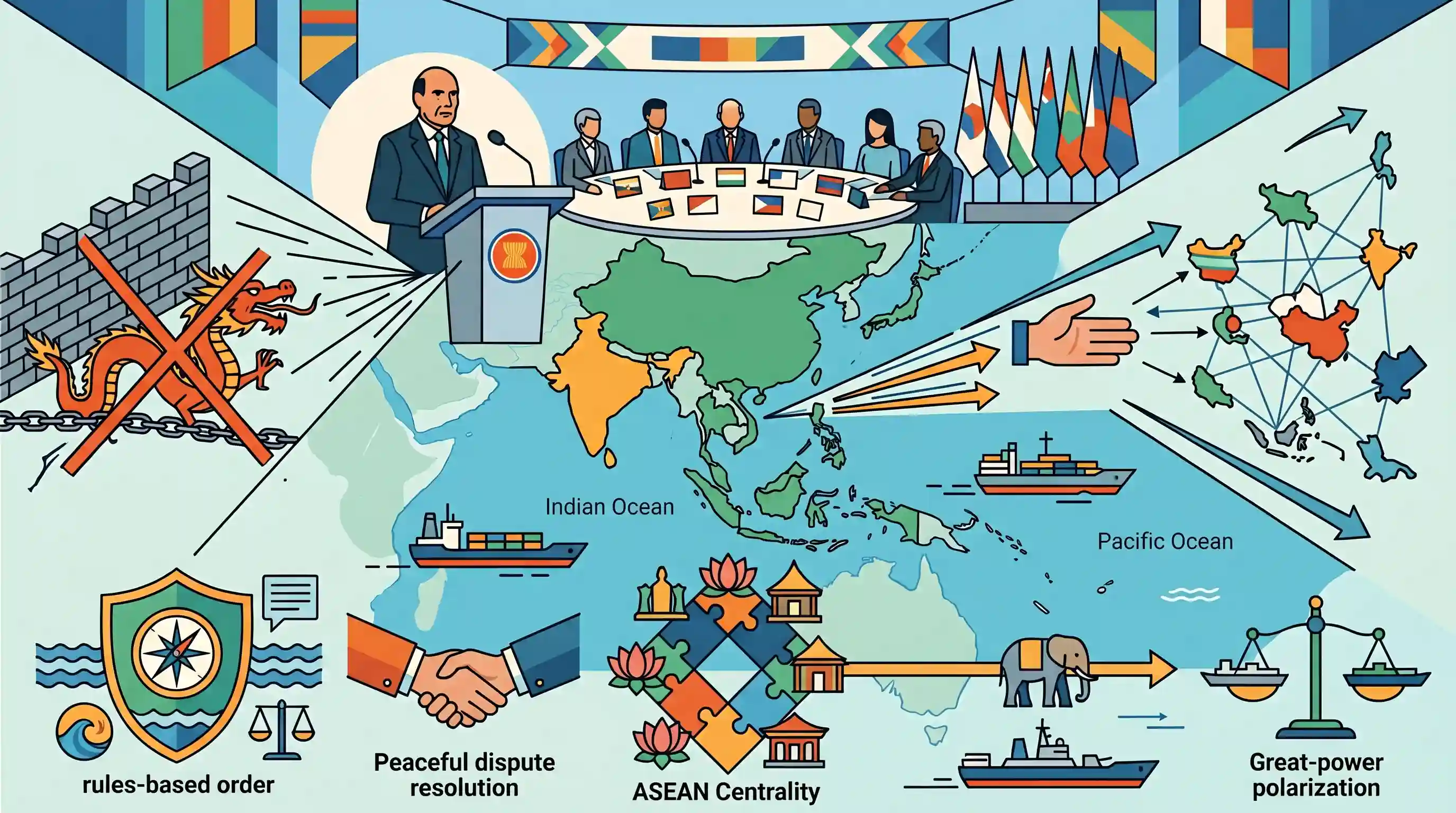
At the ASEAN Defence Ministers’ Meeting (ADMM-Plus), Defence Minister Rajnath Singh clarified that India's Indo-Pacific policy is inclusive and not directed against any nation, countering narratives that frame it solely as an anti-China containment strategy. He emphasized the necessity of a free, open, and rules-based Indo-Pacific, advocating for freedom of navigation, peaceful dispute resolution, and adherence to UNCLOS. By reaffirming ASEAN centrality, India continues to align its Act East Policy with its broader maritime security objectives, seeking regional stability without contributing to great-power polarization.
Key Points
- Defence Minister Rajnath Singh reiterated at the ADMM-Plus that India's Indo-Pacific policy is inclusive, open, and not targeted against any specific nation.
- He emphasized a rules-based regional architecture free from coercion, indirectly addressing ongoing assertiveness in the South China Sea.
- The statement reaffirmed 'ASEAN centrality' as the core of India's Act East Policy and its broader Indo-Pacific vision.
- Singh highlighted the importance of freedom of navigation and overflight, urging adherence to international maritime law, particularly UNCLOS.
Important Terms
Act East Policy

A proactive diplomatic strategy launched in 2014 to strengthen economic, strategic, and cultural ties with the Indo-Pacific region, upgrading the earlier 'Look East Policy'.
UPSC context
GS Paper-2/International Relations; essential for understanding India’s regional outreach and maritime security strategy in Southeast Asia.
UNCLOS (United Nations Convention on the Law of the Sea)
An international treaty (1982) establishing a legal framework for all marine and maritime activities, defining rights in zones like Territorial Seas and Exclusive Economic Zones.
UPSC context
GS Paper-2/3; critical for maritime security, international law compliance, and resolving South China Sea disputes.
ASEAN (Association of Southeast Asian Nations)
A 10-member regional organization (plus Timor-Leste as observer) established in 1967 to promote economic growth, social progress, and peace in Southeast Asia.
UPSC context
GS Paper-2/International Relations; central to India’s Act East Policy and regional stability in the Indo-Pacific.
ADMM-Plus (ASEAN Defence Ministers' Meeting Plus)
A platform comprising 10 ASEAN members and 8 dialogue partners (including India) to foster defense cooperation and address regional security challenges.
UPSC context
GS Paper-2/Groupings; relevant for studying Asia-Pacific security architecture and India’s defense diplomacy.
ASEAN Centrality
The principle that ASEAN must remain the primary driving force in shaping the regional architecture and managing external power relations in the Indo-Pacific.
UPSC context
GS Paper-2/International Relations; tests India’s stance on inclusive regionalism vs. great-power polarization.
Prelims Trap
"ADMM-Plus is a security grouping restricted to the democratic dialogue partners of ASEAN."
ADMM-Plus explicitly includes both China and Russia. It is designed to be an inclusive regional dialogue platform, not a democratic alliance or containment bloc.
Static Concepts Connected
What is ADMM-Plus and who are its Dialogue Partners?
- ASEAN+8 Mechanism: It includes the 10 ASEAN states and 8 dialogue partners: Australia, China, India, Japan, New Zealand, Russia, South Korea, and the US.
- Mandate: Established in 2010 to strengthen security and defence cooperation for peace, stability, and development in the Indo-Pacific region.
- Expert Working Groups: Practical cooperation occurs through seven Expert Working Groups (EWGs), including Maritime Security, Cyber Security, and Counter-Terrorism.
What does 'ASEAN Centrality' mean in India's foreign policy?
- Core Architecture: It asserts that ASEAN-led mechanisms (EAS, ADMM-Plus) must remain the primary architecture guiding strategic, maritime, and economic cooperation in the Indo-Pacific.
- Inclusive Multipolarity: It reflects an inclusive, rules-based approach that rejects zero-sum great power competition and avoids viewing the Indo-Pacific purely through a military lens.
Cross-Topic Patterns
Maritime Security + Act East
India’s defense diplomacy blends its Act East Policy with its SAGAR vision, using UNCLOS to protect the $200B of Indian trade passing through the contested South China Sea.
Minilaterals vs ASEAN Multilateralism
India balances targeted minilateral groupings (like Quad) with broad ASEAN-led platforms (like ADMM-Plus and EAS) to maintain strategic autonomy and engage rivals like China and Russia.

Expect a 2026 Prelims question contrasting ADMM-Plus, EAS, and Quad memberships, specifically testing the inclusion of China and Russia.
Linked PYQs · 4
Linked PYQs · 4
- 2014MainsGS2
With respect to the South China sea, maritime territorial disputes and rising tension affirm the need for safeguarding maritime security to ensure freedom of navigation and over flight throughout the region. In this context, discuss the bilateral issues between India and China.
- 2016MainsGS2
Evaluate the economic and strategic dimensions of India's Look East Policy in the context of the post Cold War international scenario.
- 2020MainsGS2
Quadrilateral Security Dialogue (Quad)' is transforming itself into a trade bloc from a military alliance, in present times - Discuss.
- 2020MainsGS2
What is the significance of Indo-US defence deals over Indo-Russian defence deals? Discuss with reference to stability in the Indo-Pacific region.
