Critical Mineral Security and High Technology Manufacturing Deficits
Source:Indian Express ↗
Why It Matters
Transition to clean energy and self-reliance in high technology are cornerstones of India's current economic and strategic policies. Understanding the historical gaps and current policy shifts in mineral security and tech manufacturing is crucial for understanding India's industrial and strategic future.
Summary
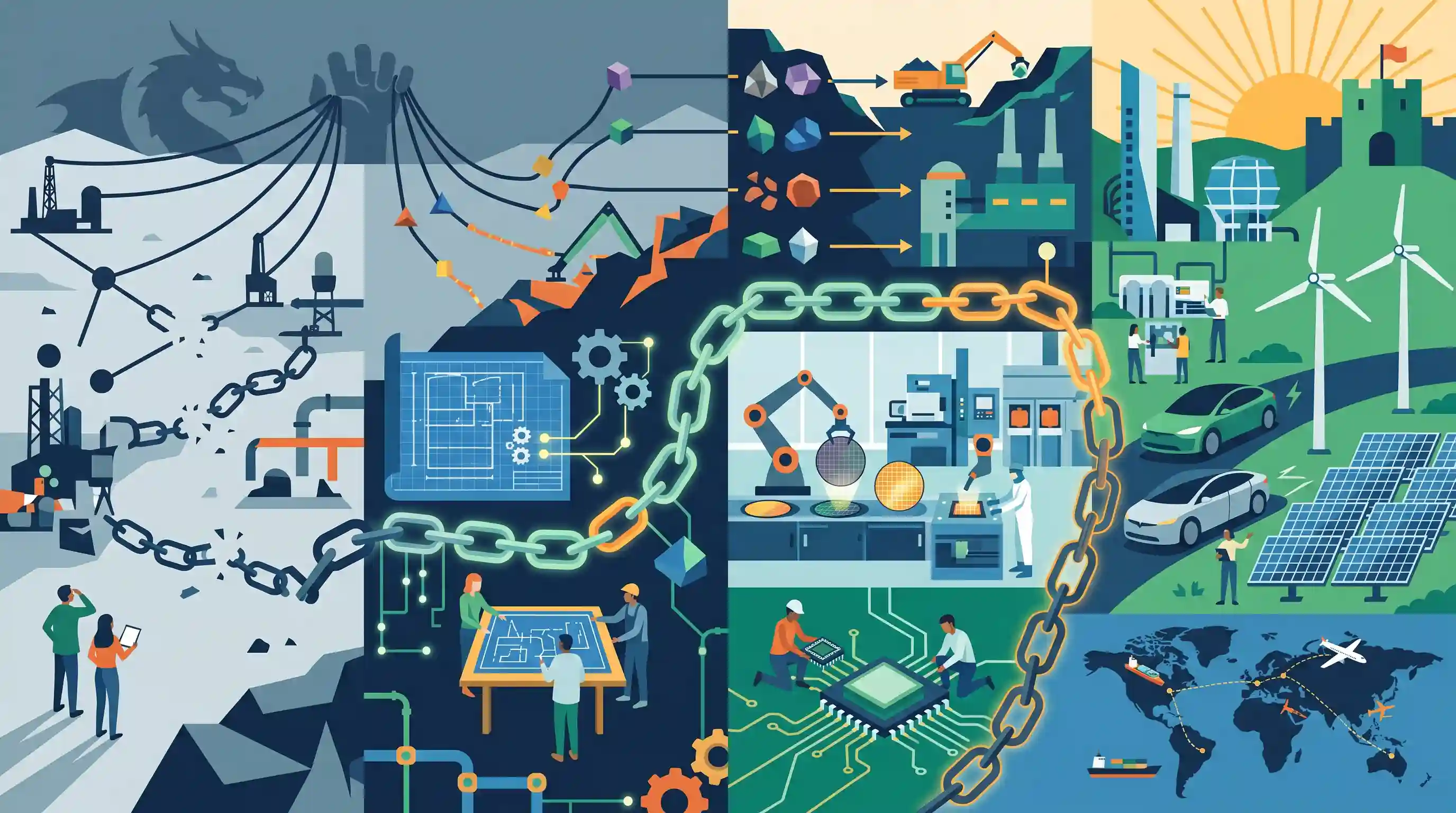
The article underscores India's historical neglect in developing robust supply chains for high technology and critical minerals. It emphasizes the urgent need for India to secure critical minerals—such as lithium, cobalt, and rare earths—and build domestic capabilities in high-tech manufacturing, particularly semiconductors. This is necessary to reduce import dependency on dominant players like China, support the clean energy transition, and enhance the country's strategic autonomy.
Key Points
- India has historically underinvested in securing supply chains for critical minerals and developing high-tech manufacturing ecosystems.
- The global transition to green energy and digital economies requires a secure and massive supply of critical minerals (like lithium, cobalt, and rare earths) and advanced technologies (like semiconductors).
- China's near-monopoly in critical mineral processing and electronics manufacturing poses significant strategic and economic risks for India.
- While recent initiatives like the India Semiconductor Mission reflect a policy shift towards self-reliance, execution must scale rapidly to overcome decades of inattention.
- Strengthening international alliances and participation in frameworks like the Mineral Security Partnership are essential to secure raw materials and technology transfers.
Important Terms
Critical Minerals

Non-fuel minerals essential for economic development and national security, characterized by high supply chain vulnerability. India identified 30 such minerals (e.g., lithium, cobalt) vital for clean energy, defense, and high-tech sectors.
UPSC context
GS Paper 3 (Economy/Resources). Tests knowledge of India’s resource security, import dependency (especially on China), and the 2023 MMDR Act amendments.
India Semiconductor Mission (ISM)
A specialized agency under the Digital India Corporation established to catalyze India's semiconductor and display ecosystem. It manages fiscal support schemes for fabrication, design, and assembly to ensure technological self-reliance.
UPSC context
GS Paper 3 (Industrial Policy/IT). Significant for "Make in India" and "Atmanirbhar Bharat" goals in high-tech manufacturing and strategic autonomy.
Mineral Security Partnership (MSP)
A U.S.-led multilateral alliance of 14 countries aimed at securing stable, sustainable critical mineral supply chains. India is the only developing nation in this "critical minerals club" targeting reduced global dependency on China.
UPSC context
GS Paper 2 (International Relations). Tests understanding of India’s strategic groupings and bilateral/multilateral efforts to ensure energy and technological security.
Khanij Bidesh India Ltd (KABIL)
A joint venture of three Indian PSUs (NALCO, HCL, MECL) under the Ministry of Mines. Its primary mandate is to identify, acquire, and develop strategic mineral assets—mainly lithium and cobalt—in overseas territories.
UPSC context
GS Paper 3 (Energy/Economy). Crucial for questions on India’s strategy to secure raw materials for the EV transition and renewable energy storage.
Rare Earth Elements (REE)
A group of 17 chemically similar metallic elements (15 lanthanides plus scandium and yttrium). They are indispensable for manufacturing permanent magnets used in electric vehicle motors, wind turbines, and advanced defense systems.
UPSC context
GS Paper 3 (Science & Tech/Economy). Relevant for understanding global supply chain monopolies and India’s efforts to reduce reliance on refined REE imports.
National Critical Mineral Mission (NCMM)
Launched in Budget 2024-25, this mission focuses on domestic production, recycling, and overseas acquisition of 30 critical minerals. It includes a framework for technology development and skilled workforce creation.
UPSC context
GS Paper 3 (Economy). A recent policy development testing knowledge of India’s mission-mode approaches to achieving net-zero targets and resource independence.
Supply Chain Resilience Initiative (SCRI)
A trilateral partnership between India, Japan, and Australia launched to diversify Indo-Pacific supply chains. It aims to reduce over-reliance on a single geographic source (China) and ensure stable trade during global disruptions.
UPSC context
GS Paper 2 (International Relations). Important for analyzing the "China Plus One" strategy and Indo-Pacific geopolitics affecting India’s economic stability.
Prelims Trap
The Mineral Security Partnership (MSP) is a UN-led initiative for equitable global distribution of critical minerals.
The MSP is a US-led alliance of 14 nations (including India) and the EU aimed at securing critical mineral supply chains, not a UN mechanism.
Static Concepts Connected
Where are Rare Earth Elements (REEs) found in India?
- Monazite sands: Beach placers in Kerala, Tamil Nadu, and Odisha contain Monazite sands, a principal source of REEs and Thorium.
- Reserves vs Output: India holds roughly 6% of global REE reserves but produces less than 1% globally, causing heavy import reliance for high-tech manufacturing.
- State control: Historically classified as "Atomic Minerals," their extraction and processing were heavily restricted and controlled by state-owned entities like IREL.
How did the MMDR Amendment Act 2023 alter critical mineral mining in India?
- Delisting atomic minerals: Removed 6 minerals, including Lithium, Titanium, and Niobium, from the restricted 'atomic minerals' list.
- Private sector entry: Allowed private sector entities to explore and mine these newly delisted critical minerals to rapidly boost domestic supply chains.
- Exploration licenses: Introduced a new exploration license (EL) specifically designed to encourage reconnaissance for deep-seated and critical minerals.
Cross-Topic Patterns
EV transition vs. new import dependence
India's push for electric vehicles risks merely shifting import reliance from Middle Eastern crude oil to Chinese lithium and cobalt cells, creating new macroeconomic vulnerabilities.
Quad, IPEF and Mineral Diplomacy
Supply chain resilience for high technology has moved beyond commerce into core diplomacy, featuring prominently in Quad working groups, IPEF pillars, and the US-led MSP.

Expect a multi-statement 2026 Prelims question mapping domestic Lithium/REE reserves against the US-led Mineral Security Partnership.
Linked PYQs · 3
Linked PYQs · 3
- 2025MainsGS3
India aims to become a semiconductor manufacturing hub. What are the challenges faced by the semiconductor industry in India? Mention the salient features of the India Semiconductor Mission.
- 2025PrelimsGS1
In the context of electric vehicle batteries, consider the following elements : I. Cobalt II. Graphite III. Lithium IV. Nickel How many of the above usually make up battery cathodes?
- 2025PrelimsGS1
Consider the following statements : Statement I: Some rare earth elements are used in the manufacture of flat television screens and computer monitors. Statement II : Some rare earth elements have phosphorescent properties. Which one of the following is correct in respect of the above statements?
