Mann ki Baat Highlights 2025: Security, Heritage and Public Health
Source:The Hindu ↗
Why It Matters
'Mann ki Baat' addresses frequently serve as a source for UPSC Prelims fact-based questions (e.g., location of Jehanpora Buddhist stupas, Narasapuram lace GI tag, unsung heroes like Parvati Giri) and provide context for Mains topics in GS1 (Culture/History) and GS3 (Health/AMR/Renewable Energy).
Summary
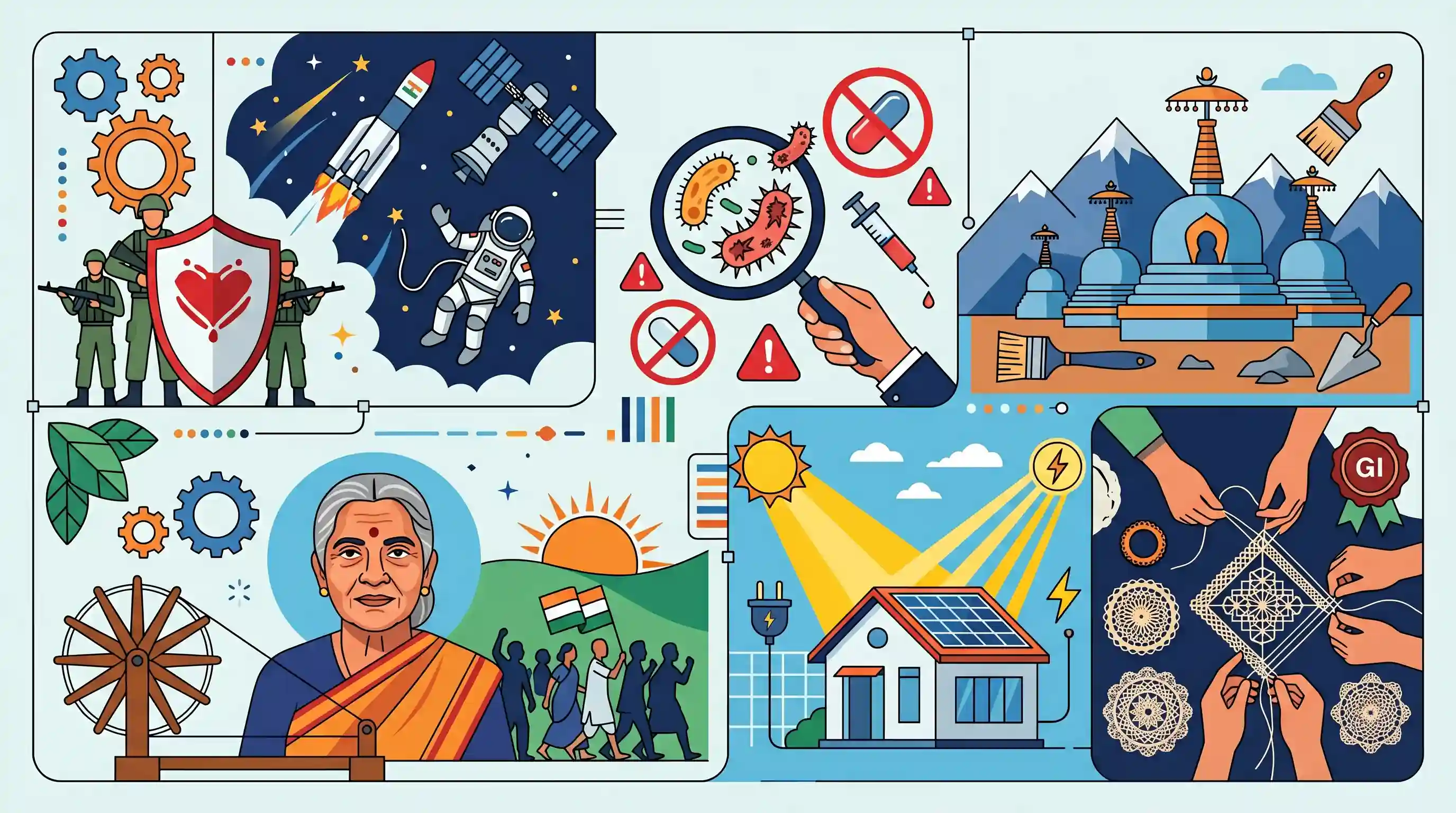
In the final 'Mann ki Baat' episode of 2025, Prime Minister Narendra Modi reflected on India's achievements across defense, science, culture, and sports. He referenced 'Operation Sindoor' as a testament to national security, and highlighted the Gaganyaan-related milestone of astronaut Shubhanshu Shukla reaching the ISS. Crucial UPSC-relevant topics included an ICMR warning on rising Antimicrobial Resistance (AMR), the discovery of 2,000-year-old Buddhist stupas at Jehanpora in Baramulla (J&K), and a tribute to Odisha's freedom fighter Parvati Giri (Quit India Movement) ahead of her birth centenary. He also promoted the PM Surya Ghar Muft Bijli Yojana for solar adoption and the GI-tagged Narasapuram lace craft for women's empowerment.
Key Points
- In the year-ending 'Mann ki Baat' for 2025, PM Modi highlighted India's strides across sectors, citing 'Operation Sindoor' as a symbol of uncompromising national security.
- The PM raised public health concerns regarding a recent ICMR report highlighting Antimicrobial Resistance (AMR), where antibiotics are increasingly failing against diseases like pneumonia and UTIs.
- Historical and cultural discoveries were emphasized, notably the identification of 2,000-year-old Buddhist stupa ruins at Jehanpora in Baramulla (J&K) using an archival photograph from a French museum.
- Odisha's unsung freedom fighter Parvati Giri was remembered ahead of her birth centenary in January 2026 for her role in the Quit India Movement and tribal welfare.
- Government welfare and empowerment schemes were highlighted, including the 'PM Surya Ghar Muft Bijli Yojana' for rooftop solar energy and NABARD's support for the GI-tagged Narasapuram lace craft, which provides livelihood to 1 lakh women in Andhra Pradesh.
Important Terms
Operation Sindoor

A 2025 Indian military operation involving pre-dawn strikes on terror camps in Pakistan/PoK following an attack in Pahalgam. It symbolised India's proactive 'no-compromise' stance on national security.
UPSC context
GS Paper III: Internal Security. Tests awareness of recent defense doctrine changes and cross-border security responses.
Parvati Giri
Renowned as the 'Mother Teresa of Western Odisha,' she was a Gandhian freedom fighter who participated in the 1942 Quit India Movement at age 16.
UPSC context
GS Paper I: Modern History. Tests knowledge of 'unsung' freedom fighters and women's roles in the national movement.
Jehanpora Stupas
A 2,000-year-old Buddhist monastic site discovered in J&K's Baramulla district in 2025. Sparked by archival photographs, it links the Kashmir Valley to the ancient Gandhara cultural network.
UPSC context
GS Paper I: Art and Culture. Relevant for Kushan-era architecture and the spread of Buddhism in India.
PM Surya Ghar Muft Bijli Yojana
A central scheme launched in 2024 to provide 1 crore households with 300 units of free electricity monthly through subsidized rooftop solar installations and net metering.
UPSC context
GS Paper II & III: Governance and Energy. Focuses on renewable energy targets and sustainable development schemes.
Antimicrobial Resistance (AMR)
A global health threat where bacteria and pathogens evolve to resist drugs. PM Modi highlighted an ICMR report warning against its rise due to antibiotic misuse.
UPSC context
GS Paper III: Science and Technology/Health. Key for public health policy and disease management topics.
Indian Council of Medical Research (ICMR)
India's apex body for biomedical research. Its 2025 reports on rising drug resistance and infectious disease trends are critical for national health policy.
UPSC context
GS Paper II & III: Statutory Bodies and Science. Tests knowledge of institutional roles in Indian healthcare.
Prelims Trap
"Operation Sindoor is a flagship welfare scheme aimed at empowering rural women and supporting their marriages."
Operation Sindoor was actually India's strategic cross-border counter-terror military response executed in May 2025 following the Pahalgam attack, not a social welfare program.
Static Concepts Connected
What was the role of the Kushan Empire in patronizing Buddhism in Kashmir?
- Fourth Buddhist Council: Held at Kundalvana in Kashmir under Kanishka's patronage, this council formally finalized the division between the Mahayana and Hinayana sects.
- Sanskrit Adoption: The Kushan era marked a pivotal linguistic shift where Sanskrit replaced Pali as the primary language for Buddhist scriptural texts.
- Architectural Synthesis: Kushans built numerous stupas and viharas across Gandhara and Kashmir, heavily blending Hellenistic artistic elements with Indian Buddhist themes.
What are the primary biological mechanisms behind Antimicrobial Resistance (AMR)?
- Genetic Mutation: Spontaneous changes in bacterial DNA that can alter the receptor target site, preventing the antibiotic from effectively binding to the bacteria.
- Horizontal Gene Transfer: Bacteria can acquire resistance genes directly from other resistant bacteria via plasmids through processes like conjugation, transformation, or transduction.
- Efflux Pumps: Bacteria develop biological pumps in their cell walls that actively expel the antibiotic out of the cell before it can take effect.
Cross-Topic Patterns
GI Handlooms + Rural Livelihoods
Linking DPIIT's Geographical Indications with NABARD's SHG-bank linkage programs is a recurring theme to foster women's empowerment, perfectly exemplified by the Narasapuram lace craft artisans.
AMR + The One Health Framework
ICMR's AMR warnings increasingly intersect with environmental policy. Antibiotic runoff in agriculture and pharma effluents drives multi-drug resistance, making the 'One Health' approach critical for Mains.

Expect a pairs-matching question in 2026 Prelims linking unsung female freedom fighters (e.g., Parvati Giri, Matangini Hazra) to regions.
Linked PYQs · 5
Linked PYQs · 5
- 2014MainsGS3
Can overuse and free availability of antibiotics without Doctor's prescription, be contributors to the emergence of drug-resistant diseases in India? What are the available mechanisms for monitoring and control? Critically discuss the various issues involved.
- 2023PrelimsGS1
With reference to ancient India, consider the following statements: 1. The concept of Stupa is Buddhist in origin. 2. Stupa was generally a repository of relics. 3. Stupa was a votive and commemorative structure in Buddhist tradition. How many of the statements given above are correct?
- 2024MainsGS1
What were the events that led to the Quit India Movement? Point out its results.
- 2016MainsGS1
Discuss the role of women in the freedom struggle especially during the Gandhian phase.
- 2020MainsGS3
Describe the benefits of deriving electric energy from sunlight in contrast to the conventional energy generation. What are the initiatives offered by our Government for this purpose?
